Casino RNG Regulation: Licensing, Testing & Enforcement

Introduction: Why RNG Regulation Matters for Online Casino Fairness
Online casino “fair” is simple: outcomes must be unpredictable, the advertised RTP must be mathematically correct over time, and nobody—operator, staff, or software vendor—can tilt results behind the scenes. That promise lives or dies on one component: the random number generator (RNG). If the RNG is weak, biased, or editable, every slot spin and card draw becomes a marketing trick, not a game.
RNG regulation is the system that keeps that from happening. Licensing rules set the baseline: approved platforms, documented controls, change management, and clear responsibility. Independent test labs verify the RNG’s statistical behavior and the game’s payout logic, then certification binds that result to a specific build. Ongoing audits check that what was tested is what’s running—after updates, new content, and configuration changes.
This chapter covers RNG basics, the licensing frameworks that govern them, how requirements differ by jurisdiction, and what enforcement looks like when standards are breached. For the deeper mechanics of verification, see Casino RNG Testing & Certification: How Fairness Is Verified. For the wider compliance picture beyond RNG, read Casino Security, Fairness & Regulation Explained.
- Fair = unpredictable outcomes, accurate RTP, no manipulation
- Integrity = licensing + lab testing + audits working as one
- Reality = rules vary by jurisdiction, but enforcement is the deterrent
Casino RNG Explained: How Random Number Generators Work
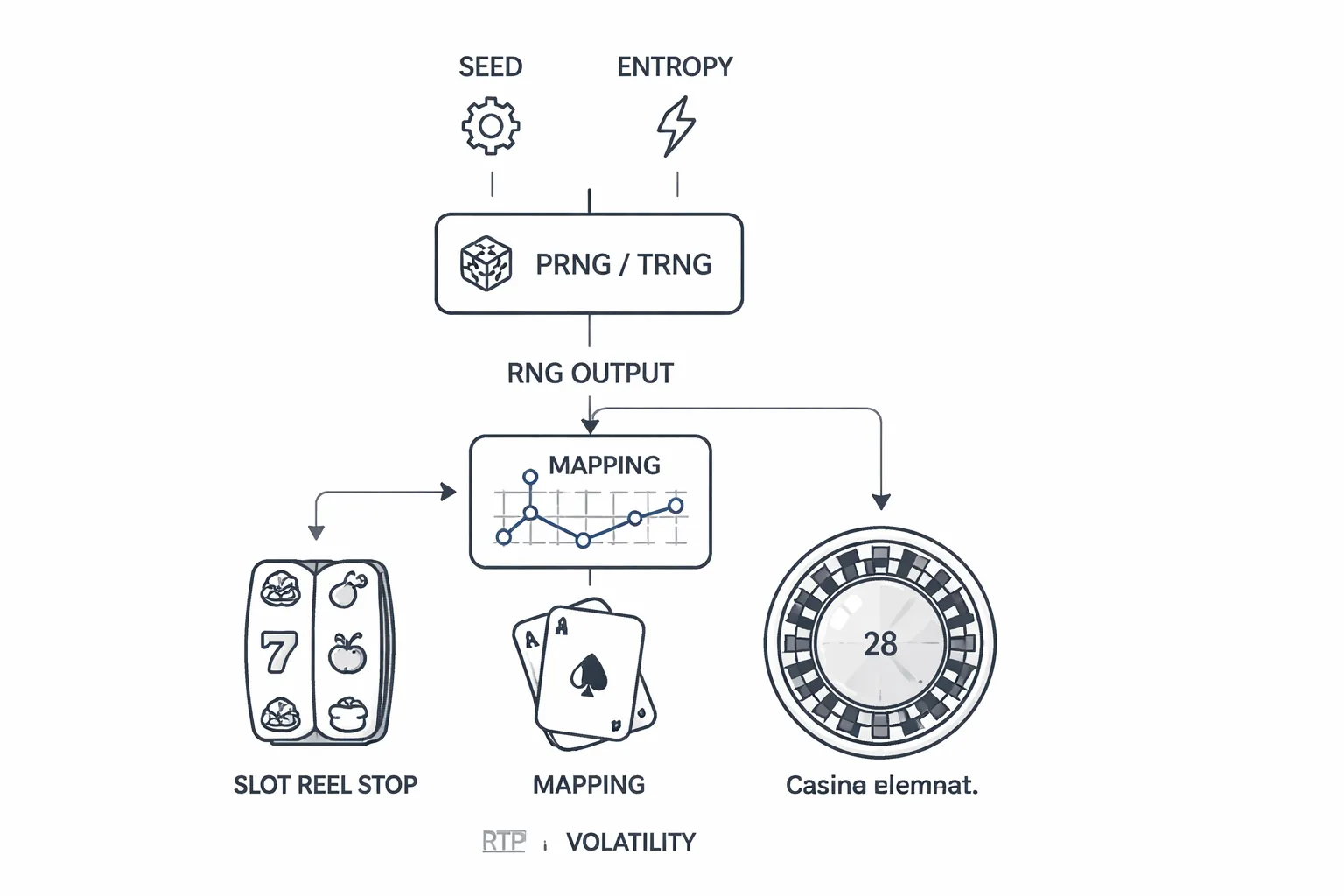
What an RNG Is (and Where It’s Used)
A casino RNG (Random Number Generator) is the engine that produces unpredictable numbers, then converts them into game results. In slots, it picks outcomes for each spin. In RNG table games (digital blackjack, roulette, baccarat), it replaces physical shuffles/spins with number draws. In instant-win games (scratch, keno-style, crash variants), it determines the revealed prize or multiplier.
PRNG vs TRNG: Two Ways to Generate “Random”
PRNG (pseudo-random) is software that creates statistically random sequences from a starting value. It’s fast, repeatable under audit, and widely used in online casino games. TRNG (true random) uses physical entropy (e.g., electronic noise) to generate numbers and is often used to seed PRNGs or in high-integrity systems where hardware entropy is preferred.
Seeding, Entropy, and Statistical Randomness
A PRNG needs a seed. Good seeds come from entropy sources so the sequence can’t be predicted. “Random” doesn’t mean patternless in the short run; it means outcomes match expected distributions over large samples (streaks and clusters happen).
How Numbers Become Reels, Cards, and Dice
- Slots: numbers select virtual reel stops, then the game renders the symbols.
- Cards: numbers map to a shuffle order (or deal draws) from a virtual deck.
- Dice/roulette: numbers map to faces or wheel pockets.
RNG vs RTP vs Volatility
RNG controls outcome selection, not payout intent. RTP is the long-run return set by the game’s math (how slot RTP is set). Volatility controls payout shape (frequency vs size), not fairness.
Myths That Don’t Hold Up
- Timing clicks doesn’t “catch” a win.
- “Hot/cold” machines and “due” numbers are betting-system myths (read more).
- Near-misses are design/animation, not evidence the RNG is “almost” paying.
RNG Testing & Certification: How Fairness Is Verified
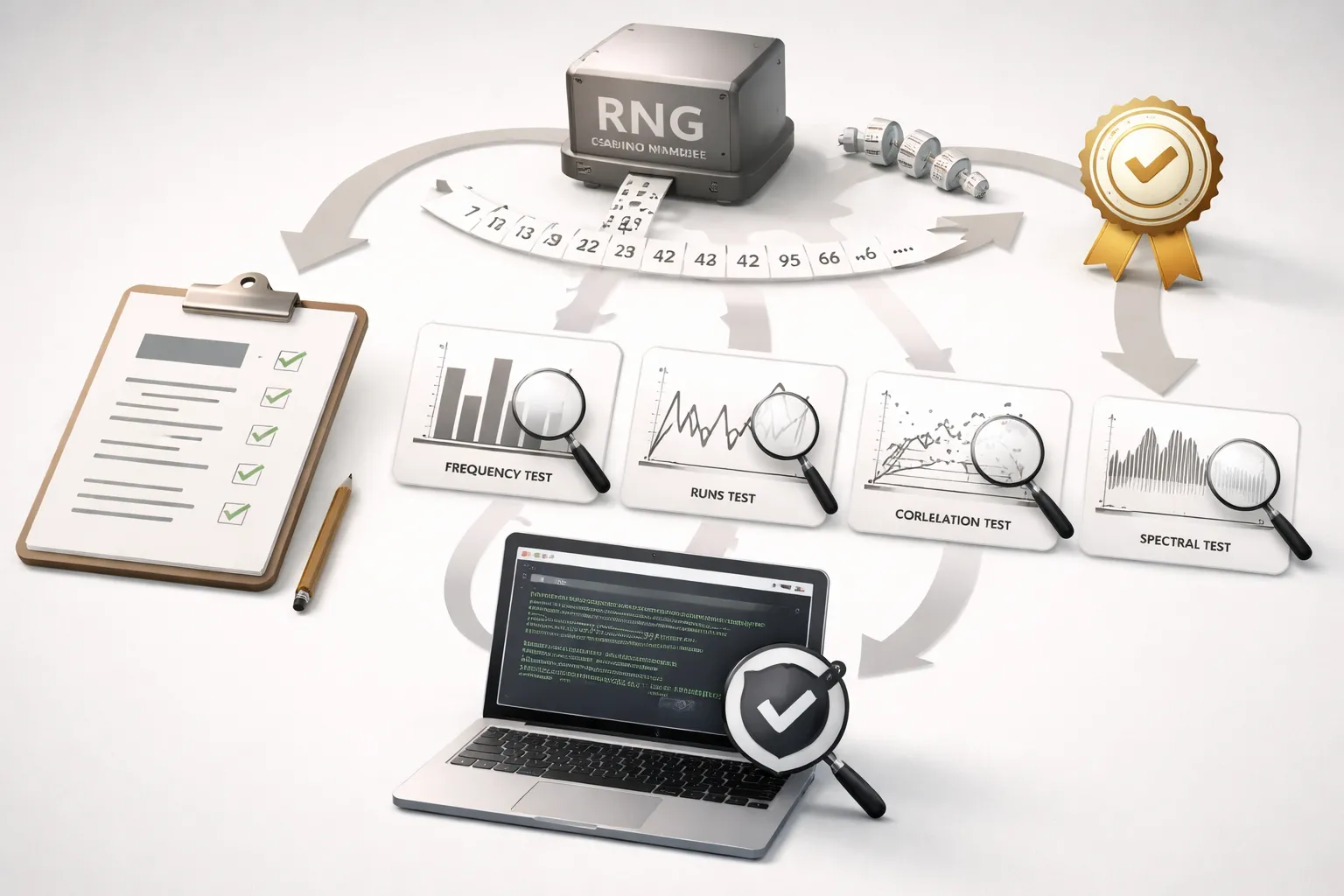
What labs test
Independent test labs verify that the RNG produces outcomes that are statistically random, unpredictable (no practical way to forecast the next result), and protected against repeatability via improper seeding, state resets, or exploitable cycles. They also confirm that game settings can’t be quietly altered to change behavior outside approved parameters.
Key statistical test families
- Frequency (distribution) tests: check whether symbols/numbers appear at expected rates over large samples.
- Serial correlation tests: detect dependence between successive outputs (patterns across time).
- Runs tests: measure streak behavior (too many/too few clusters of results).
- Spectral/periodicity tests: look for hidden cycles, lattice structures, or repeating spacing that implies a weak generator.
Technical evaluation: code, builds, and configuration
Testing isn’t only “spin it a million times.” Labs review source code and the RNG implementation, then perform build verification (hashes/signatures) to ensure the deployed binary matches what was reviewed. They validate configuration controls: who can change RTP/denominations/limits, how changes are logged, and whether settings are locked to approved values. For RTP, they validate the math model, including paytable-to-RNG mapping and any feature logic. For a deeper explanation of RTP setup, see how slot RTP is set and why it varies by casino.
Security testing: tamper resistance and change management
- Tamper resistance: integrity checks, secure storage, and protection of RNG state/seeds.
- Access controls: role-based permissions, MFA, least-privilege administration.
- Change management: versioning, audit trails, and approval workflows for updates.
What a certification report includes (and validity)
Reports typically include the game/RNG version, tested configurations, methodology and results, pass/fail statements, and cryptographic identifiers for the approved build. Validity usually lasts until a material change (code/config/RNG) occurs, plus periodic re-tests required by the regulator. If you’re still thinking “systems can be beaten,” link it to reality: Casino Myth #4: Can You Beat the System?
Licensing Rules for RNGs: What Regulators Typically Require
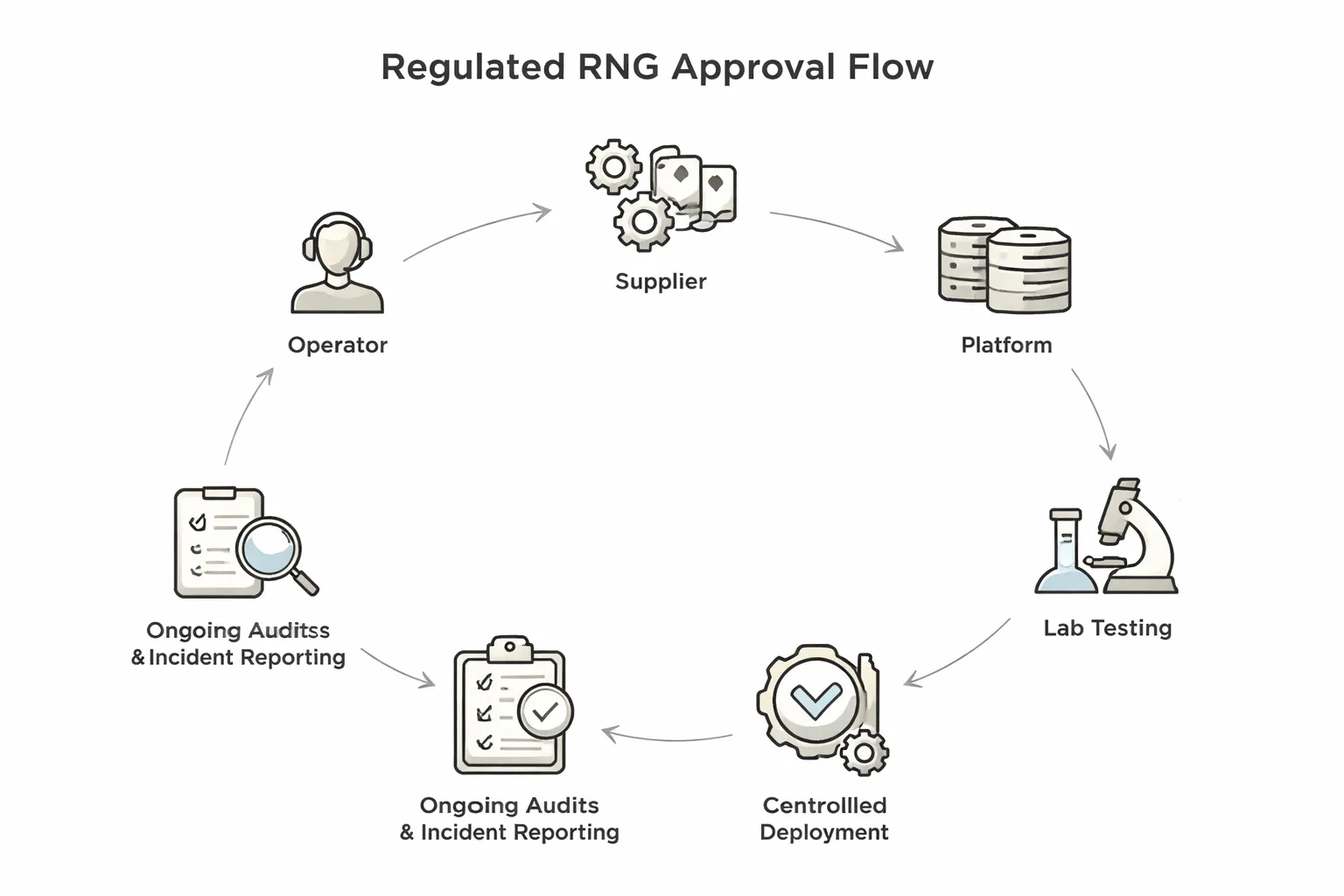
Who Must Be Licensed
Regulators rarely license “a game” in isolation. They license the chain: the operator (who offers play), the supplier (RNG and game content), the platform/aggregator (wallet, remote game server), and the game studio (math, code, art build). Many also vet key persons (directors, compliance, security, MLRO/AML leads) for suitability, control, and accountability.
Pre-Launch Approvals
Before go-live, expect: game submission (math/RTP, rules, RNG design), independent lab certification (RNG and game outcome testing), and controlled deployment (staging, sealed builds, restricted access). Approvals commonly tie to an exact version and configuration, with a lab report that states tested methodology, pass/fail, and identifiers (hashes/signatures) for the approved build.
Ongoing Obligations
- Periodic audits and regulator-triggered re-tests.
- Reporting of key events (RTP changes, incidents, supplier swaps).
- Version control: every code/config change tracked, reviewed, and, when “material,” re-certified.
- Incident response: monitoring, anomaly detection, breach handling, evidence preservation, and player remediation.
Player Protection Tied to RNG Integrity
Rules often require clear game rules, accessible RTP disclosures where mandated, and a defined dispute process using logs to reconstruct outcomes. Transparency isn’t optional when complaints hit.
Technical Standards Frameworks
Testing is typically performed by ISO/IEC 17025-accredited labs, guided by GLI/IEC-style technical requirements for RNGs, game logic, and secure deployment.
Document Trail (Compliance Packs)
Expect a compliance pack: lab certificates, configuration snapshots, build hashes, signing keys policy, change logs, and release notes. If you assume “systems can be beaten,” ground it in due diligence: choose platforms and vet matches.
-
Online vs Land-Based Casino Odds: Rules & House Edge
1 month ago -
Casino Betting Systems: Myths, Hot Streaks & “Due” Numbers
1 month ago -
Online vs In-Person Casino Odds: RNGs & Fair Play
1 month ago -
Casino Security, Fairness & Regulation Explained
1 month ago -
Signs of Gambling Addiction: Warning Signs & Help Options
1 month ago
-
Signs of Gambling Addiction: Warning Signs & Help Options
1 month ago -
Casino Betting Systems: Myths, Hot Streaks & “Due” Numbers
1 month ago -
Casino Systems Myth: Can You Really Gain an Edge?
1 month ago -
Online vs In-Person Casino Odds: RNGs & Fair Play
1 month ago -
Online vs Land-Based Casino Odds: Rules & House Edge
1 month ago
-
Online vs Land-Based Casino Odds: Rules & House Edge
1 month ago -
Casino Betting Systems: Myths, Hot Streaks & “Due” Numbers
1 month ago -
Online vs In-Person Casino Odds: RNGs & Fair Play
1 month ago -
RTP Explained: How to Use Return to Player to Choose Slots
1 month ago -
Casino Security, Fairness & Regulation Explained
1 month ago