Online vs In-Person Casino Odds: RNGs & Fair Play

Online slots feel like a black box. A live roulette wheel feels “real.” Yet both can be fair—or not. Players question fairness because outcomes online are hidden behind code, while in-person games are visible but still vulnerable to human error, biased equipment, or dealer procedure. The core question is simple: are the odds actually different, or just the experience?
This guide breaks down what changes between online and land-based play: how randomness is generated, how odds are set, and where regulation and game settings can shift your results. For the full comparison, see Online vs Land-Based Casino Odds: What Changes?.
- RNG (Random Number Generator): Software that produces unpredictable outcomes for digital games (slots, online roulette, video poker).
- House edge: The casino’s built-in advantage over time, expressed as a percentage.
- RTP (Return to Player): The long-run payout rate of a game (e.g., 96% RTP implies ~4% house edge).
- Variance (volatility): How swingy results are—small steady wins vs rare big hits.
One note: don’t confuse “different vibes” with different math. A glossy app and a felt table can run on the same edge, but settings, rules, and pace can change what you feel—and what you lose per hour. If you’re looking for strategy frameworks in other areas, these guides show how small percentage edges add up: Effectieve strategieën om vroegboekkorting te benutten and Natuurreizen boeken met vroegboekkorting: De beste tips.
Randomness Online vs In Person: RNGs, Shuffling, and What “Fair” Means

What “random” means in gambling
In casino math, “random” has three jobs: independence (each result doesn’t “remember” the last), unpredictability (you can’t reliably forecast the next outcome), and uniformity (over time, results match the stated probabilities). Random doesn’t mean “no streaks.” It means streaks don’t signal a beatable pattern.
How land-based randomness is produced
In person, randomness is physical: cards (riffles, washes, cut cards, continuous shufflers), dice (bounce, grip, pyramids on the back wall), and wheels (ball speed, rotor variance, deflectors). Real-world friction adds noise, but procedures aim to prevent control—proper shuffles, stick calls, and wheel maintenance.
How online randomness is produced
Online games use pseudo-RNGs: algorithms that generate number streams from an internal seed (often mixed with timing and system entropy). The output is then mapped to game events: a number range becomes a roulette pocket, a virtual deck order, or a slot reel stop. Good RNGs are deterministic under the hood but statistically indistinguishable from true randomness in practice.
RNG certification & audits
Legit operators submit RNGs and game builds to independent labs (e.g., GLI, iTech Labs, BMM). Audits run statistical test suites, verify seeding and mapping, and check compliance: correct paytables, published RTP, change control, and tamper-resistant deployment.
Common misconceptions
- “Hot” machines: past wins don’t increase future odds.
- Patterns in roulette: clusters happen in random data.
- Streaks: normal variance, not a signal.
- Gambler’s fallacy: “due” outcomes aren’t due.
What “fair” means in practice
Fair is transparent rules + verified odds, not guaranteed outcomes. Check RTP/house edge, game rules, and speed of play—because pace changes losses per hour. For a sharp lens on boundaries and clear expectations, see Safer Sex Agreements: Boundaries, Consent & Swinging Talk and How to Debrief After Swinging: Fix Resentment Early. For a behind-the-scenes look at another high-variance industry, read Camgirl Lifestyle: Hinter den Kulissen. Planning-focused readers can also start here: Urbane vakanties boeken met vroegboekkorting: Waar te beginnen?.
Online vs Land-Based Odds: RNGs, Game Rules, and What Actually Changes
Odds vs payouts vs RTP: what you’re really comparing
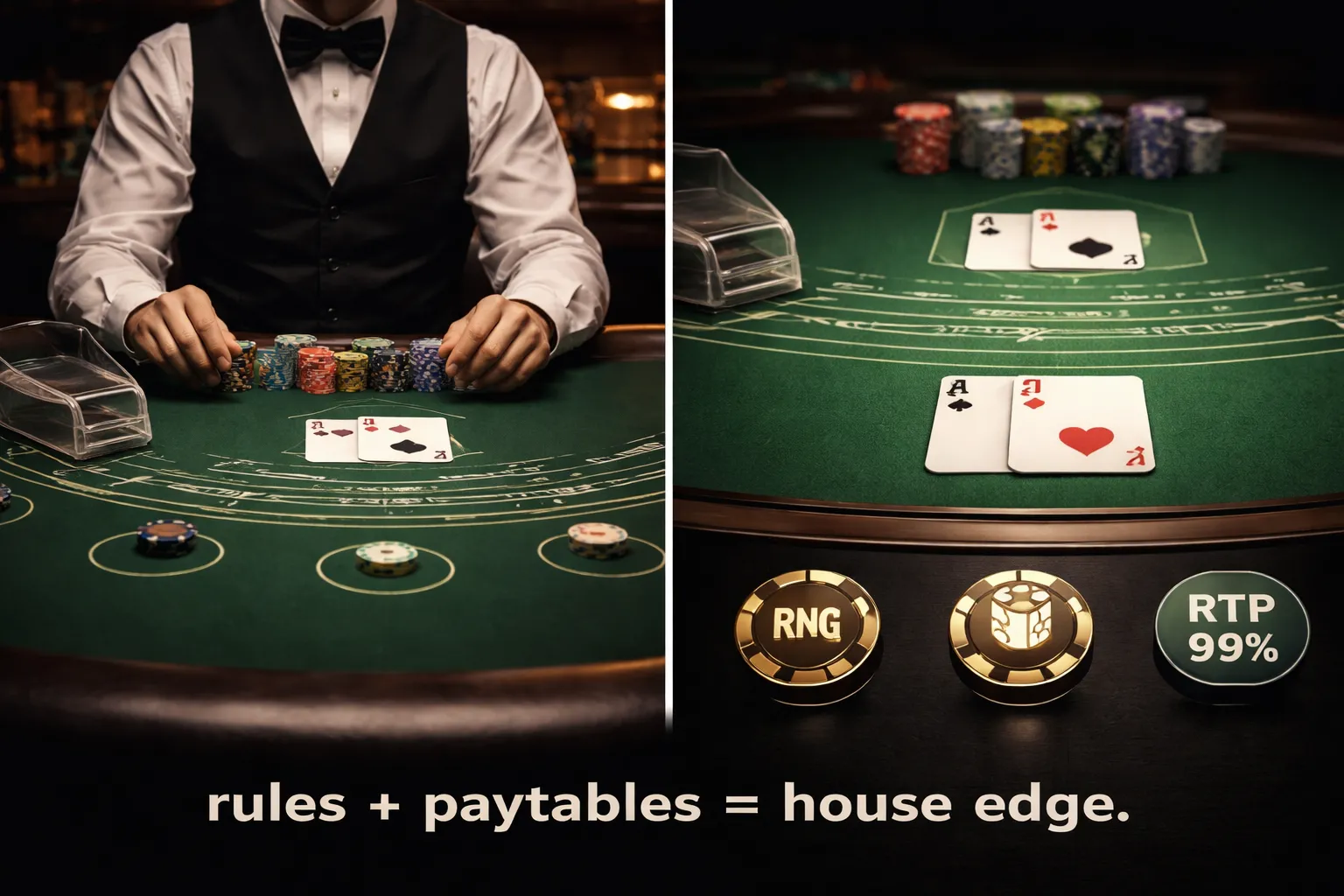
Odds describe how likely an outcome is. Payouts describe what you get when it hits. RTP (return to player) combines both over the long run: change the payout or a rule, and RTP moves—even if the “feel” of the game doesn’t.
What usually stays the same
If the rules and paytables match, the underlying math is the same online or on a casino floor. A fair RNG produces outcomes consistent with stated probabilities; a physical shoe and dice do the same when procedures are solid. The house edge isn’t “online” or “in-person.” It’s in the rules.
What can actually change (and move your edge)
- Blackjack table rules: number of decks, dealer hits/stands soft 17, double-after-split, re-split limits, surrender, blackjack payout (3:2 vs 6:5).
- Video poker paytables: “full pay” vs tightened schedules can swing RTP meaningfully.
- Side bets: often higher house edge, heavily marketed online and live.
- Max payout caps: more common online via game/provider or bonus terms; it doesn’t change base RTP, but it can cap upside in rare high hits.
Speed changes variance, not the math
Online play is faster: more hands/spins per hour means your bankroll sees the long-run edge sooner. Swings feel bigger because volume is bigger—not because the game is “rigged.”
Human factors in land-based play
- Dealer errors can help or hurt; casinos correct when spotted.
- Hand shuffles reduce hands/hour; procedures and cut cards affect penetration.
- Game protection (heat, mistakes, mispays) is a live-only variable.
Game selection: versions, limits, and jurisdiction
Online often offers more variants and limits, but availability depends on where you play. Like pricing rules in travel planning, the fine print matters—see Invloed van Vroegboekkorting op Prijs: Wat u Moet Weten. For another “behind the curtain” market dynamic, read Camgirls Angebot: Alles was du wissen musst.
How Casino Game Odds Work: House Edge, Probability, and Payouts
House Edge: The Built-In Cost
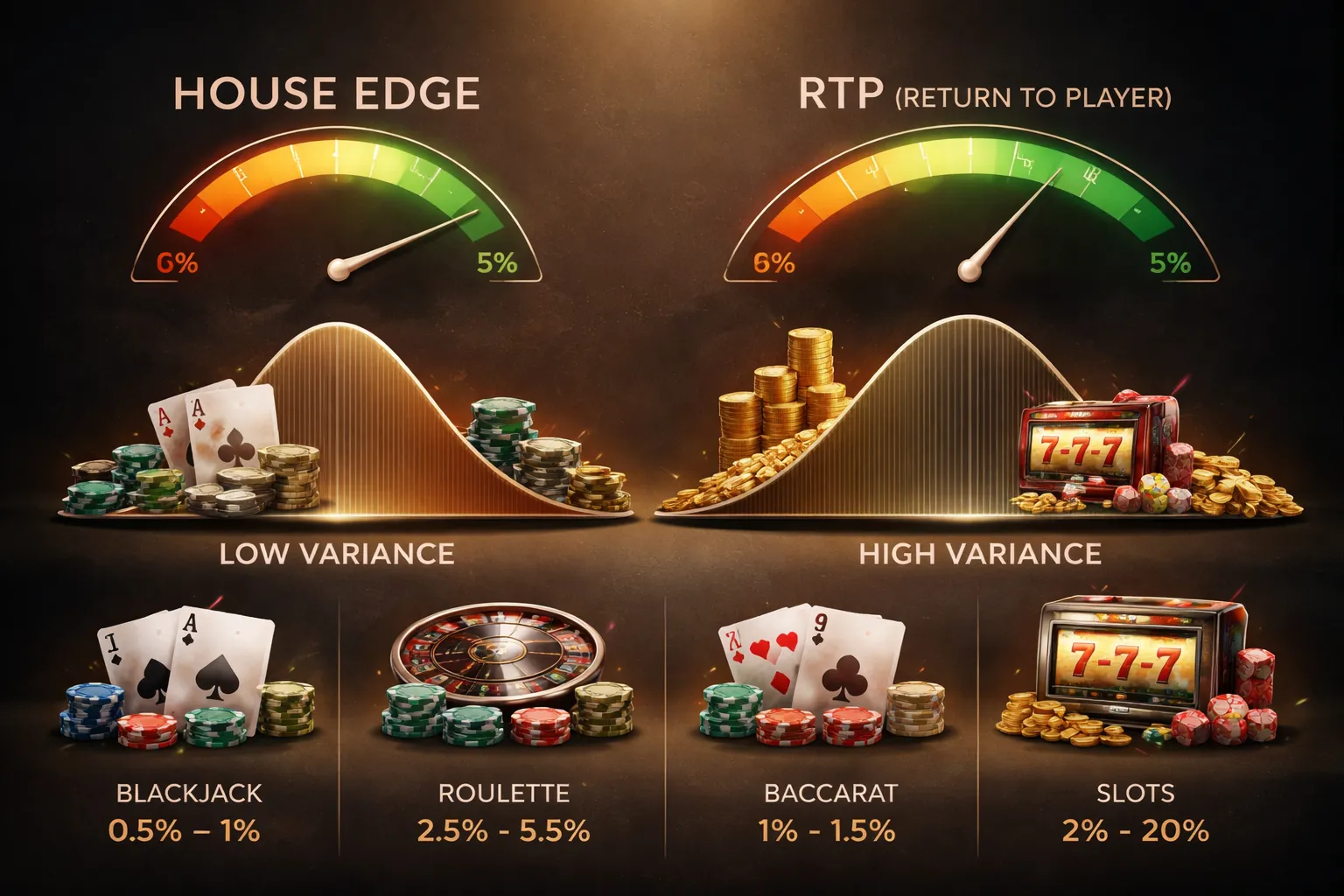
House edge is your expected loss per unit wagered over the long run. If a game has a 2% house edge, the math says you’ll lose about $2 for every $100 bet—on average, across many bets. It’s not a prediction for tonight; it’s the pricing model behind the game.
Probability Basics: Independent Trials, EV, and Variance
Most casino bets are independent trials: the next spin or hand doesn’t “owe” you a win. The core metric is expected value (EV): average outcome per bet when you repeat it enough times. Casinos win because EV is negative for players.
Variance (volatility) explains why real results swing. Two games can share similar EV, yet feel wildly different because one pays small wins often while the other pays rarely but huge.
RTP vs House Edge: Same Coin, Different Side
RTP (return to player) is the long-run payback percentage; house edge is the remainder. Example: 96% RTP equals 4% house edge. RTP describes millions of trials; your session is a tiny sample, so outcomes vary.
Payout Structures: Hit Frequency and Big-Win Shape
Odds aren’t just “win/lose.” The payout table shapes the distribution: hit frequency, average win size, and the tail of rare jackpots. High-volatility games create more long losing stretches—and occasional spikes.
Why Winning Sessions Happen Anyway
Negative EV doesn’t ban short-term profit. Variance plus limited time equals “winning nights,” even when the long-run expectation stays against you—like agreements that feel clear until tested in practice (see ENM Consent, Communication & Agreements Glossary (A–Z)).
Comparing Games by House Edge (Typical Ranges)
- Blackjack: ~0.5%–2% (rules + strategy drive it)
- Roulette: ~2.7% (European) to ~5.26% (American)
- Baccarat: ~1%–1.5% on main bets
- Slots: often ~3%–10%+ (RTP settings, volatility, jackpots)
Rules, side bets, and paytables move the edge—so read the fine print like you would with travel bonuses (see Bonus bij vroegboekkorting: Welke extra voordelen krijg je?).
Game-by-Game: What the Math Looks Like Online vs In Person (Quick Comparisons)

Slots: RTP, Volatility, and Bonuses (Online vs Floor)
Online slots use an RNG that picks outcomes, then maps them to “virtual reels” (symbol strips). Physical reels are mostly cosmetic now; math still comes from programmed strips.
- RTP ranges: Online often offers multiple RTP settings (commonly ~90%–97%+ depending on jurisdiction/operator). Land-based tends to be more fixed by venue policy and regulation, but can still vary by game and denomination.
- Volatility: Online libraries skew toward higher volatility (bonus buys, big max wins). Floor slots often feel “steadier,” but that’s design choice, not inherent fairness.
- Bonus mechanics: Wagering requirements and capped wins can change effective value. Treat them like travel deals: compare offers like goedkope vluchten met vroegboekkorting and sanity-check with a calculator.
Blackjack: Rules Beat “Online vs In Person”
- Rule swings: Dealer H17 vs S17, surrender availability, double after split, resplit limits, and 6:5 vs 3:2 payouts move the house edge more than location.
- Shoe depth: Online RNG blackjack is effectively infinite-deck; card counting dies. In-person shoe depth and penetration matter, but rules usually dominate.
Roulette: Zeros Decide
- Single-zero: ~2.7% edge. Double-zero: ~5.26%. Triple-zero: higher again—avoid if you care about math.
- Wheel bias: Rare today due to maintenance and monitoring; don’t lean on “patterns” (see gambler’s fallacy).
Baccarat: Banker/Player and Commission Traps
- Banker vs Player: Banker is usually lowest edge; Player slightly worse; Tie is a high-edge side bet.
- No-commission variants: Often “pay 1:2 on Banker 6” or similar rules that claw back value.
Video Poker: Paytables Matter Most
Full-pay vs short-pay changes edge dramatically; online vs in-person is secondary. Always read the paytable before you play.
Live Dealer vs RNG Tables: What’s Truly Different
RNG tables resolve instantly with certified randomness; live dealer adds dealing pace, cut-card/shoe effects, and human procedures. The math still comes from rules, payouts, and speed—not “vibes.”
Practical tip: Track session cost and pace with budget tools.
How to Evaluate Fairness and Odds as a Player (Practical Checklist)
Read the Paytable First (RTP + Rules)
Start with what the game publishes: RTP/return range, paytable, and rule set. For blackjack, confirm dealer stands/hits soft 17, number of decks, surrender, double-after-split, and split limits. For roulette, confirm single vs double zero. For slots, check RTP, max bet, and feature triggers.
- Action: Screenshot the paytable and rules before you deposit or sit down.
- Why: Odds come from payouts + rules. “Online vs in-person” is secondary.
Verify Licensing and Independent Testing
Look for a real license (named regulator, license number) and third-party testing. Credible labs include eCOGRA, iTech Labs, and GLI. Match seals to the operator’s legal entity, not just a logo in the footer.
- Action: Cross-check the license on the regulator’s site when possible.
- Action: Prefer sites with posted audit/testing statements for RNGs.
Don’t Confuse Volatility With Unfairness
Short losing streaks happen in fair games. High-volatility slots and side bets can look “rigged” because payouts are rare by design. Use bankroll rules: fixed session budget, stop-loss, and a pace limit (hands/spins per hour).
- Action: Track time + spend; speed increases the house edge you pay per hour.
Red Flags
- Missing RTP/unclear rules or rule changes mid-game
- Unlicensed operator or unverifiable testing claims
- Bonuses that sound impossible: huge matches with tiny wagering disclosure
Best Practices (Lower Edge, Fewer Traps)
- Choose low-edge games; avoid high-edge variants
- Minimize side bets unless you accept their higher house edge
- Read promo terms: wagering, max cashout, game contribution, time limits
- Use self-exclusion tools when needed: Privacy, Compliance & Self-Exclusion: What to Know
- If play stops being controlled, get help: Signs of Gambling Addiction: Warning Signs & Help Options
Key Takeaways
Key Takeaways
- In het kort: Online randomness comes from RNGs; live casinos use physical processes—both can be fair under strong regulation.
- In het kort: Your long-term odds come from rules and paytables (RTP/house edge), not whether you play online or in person.
- In het kort: House edge is the core “cost of play”; faster online speed can make swings feel bigger, but it doesn’t change the math.
- In het kort: Verify fairness with licensing, third-party audits, and clearly published RTP/rules.
- In het kort: Choose low-edge games; avoid high-edge variants.
- In het kort: Treat side bets as a premium: higher edge unless proven otherwise.
- In het kort: Read promo terms closely: wagering, max cashout, eligible games, and time limits.
- In het kort: Use limits and self-exclusion if control slips; don’t chase patterns—see Psychology of the Gambler’s Fallacy (With Examples).
Online casinos typically rely on certified RNGs; land-based casinos rely on cards, wheels, and dealer procedures. The generation method differs, but fairness is about oversight: licensing, audits, and transparent rules.
Odds are usually set by the game’s rules and paytable. A blackjack table with unfavorable rules will cost more than a well-ruled table—anywhere. The same logic applies to slots via RTP and to roulette via variant choice.
House edge stays constant, but pace changes your experience. More hands/spins per hour means results cluster faster—good and bad—without changing expected value.
FAQ
Are online casino RNGs truly random?
Licensed sites use certified RNGs tested by independent labs. Outcomes are statistically random, not “patterned.” Fairness depends on regulation, audits, and game certification—not on whether the game is online or in a building.
Do online casinos have worse odds than land-based casinos?
Not inherently. Odds come from the rules and paytable. Some online slots offer higher RTP than many land-based machines, but poor variants exist everywhere. Always check the specific game’s RTP and rules, not the venue.
Why do online games feel ‘streakier’ than in-person play?
Speed. Online you see more spins/hands per hour, so variance shows up faster. Also, autoplay and quick sessions compress outcomes, making runs feel extreme—even though the math (house edge) hasn’t changed.
Is live dealer blackjack ‘fairer’ than RNG blackjack?
Both can be fair. Live dealer uses real cards and shuffles; RNG uses certified randomness. What matters is rules (dealer hits soft 17, surrender, payout) and procedures (shoe depth, shuffle frequency), not the dealing method.
What matters more: RTP or volatility?
RTP sets your long-run cost. Volatility sets your ride: smaller, frequent wins vs rare, big hits. Choose RTP for value; choose volatility for bankroll fit and session comfort. Ideally: high RTP, volatility you can afford.
How can I find the house edge for a specific game variant?
Check the paytable/rules screen, then look up the exact variant (e.g., European roulette, 3:2 blackjack) on a trusted calculator or rules chart. If the casino won’t show rules, skip it.
Unrelated but useful: If you like optimizing value, apply the same discipline to travel deals—see Vakantie Vroegboekkorting - Bespaar Meer Geld and Vroegboekkorting Met Kortingscode: Extra Besparingen.
Conclusion
Online vs in-person isn’t the real question. Fair play comes down to three basics: transparent rules, audited randomness (RNG or physical procedures), and a house edge you can verify before you bet.
So don’t compare “casino types.” Compare specific game variants and the exact paytable in front of you. European roulette beats double-zero. Blackjack with 3:2 beats 6:5. A slot with higher RTP (and sane volatility) can beat a flashy clone with worse returns. If you want the slot side in detail, see How Slot RTP Is Calculated (and Why It Varies by Casino).
- Confirm the rules screen or table placard.
- Match it to the right variant on a trusted odds chart/calculator.
- Choose the lowest edge you can actually play well.
- If rules are hidden, walk.
Next steps: use game-specific guides and calculators, and keep notes on which casinos offer the best versions of the games you like. The same “verify before you commit” habit also helps outside gambling—if you’re value-driven, check zeer voordelige vroegboekkorting: waar vind je de beste deals?.
Final tip: pick one game, learn one ruleset, and only play that variant—consistency beats guesswork.
-
Online vs Land-Based Casino Odds: Rules & House Edge
7 months ago -
Casino Betting Systems: Myths, Hot Streaks & “Due” Numbers
7 months ago -
Casino Security, Fairness & Regulation Explained
7 months ago -
How Slot RTP Is Set: Design, Paytables & RNG
7 months ago -
Signs of Gambling Addiction: Warning Signs & Help Options
7 months ago
-
Signs of Gambling Addiction: Warning Signs & Help Options
7 months ago -
Casino Betting Systems: Myths, Hot Streaks & “Due” Numbers
7 months ago -
Casino Systems Myth: Can You Really Gain an Edge?
7 months ago -
Online vs Land-Based Casino Odds: Rules & House Edge
7 months ago -
How Slot RTP Is Set: Design, Paytables & RNG
7 months ago
-
Crypto Casinos Explained: Pros, Cons, and Volatility Risks
7 months ago -
Online Casino Security Tips: 2FA, Passwords, and Phishing Protection
7 months ago -
Casino Game Providers Explained: Who Makes the Games (and Why It Matters)
7 months ago -
Bitcoin Casino Deposits and Withdrawals Explained (How It Works)
7 months ago -
Fairness Testing in Online Casinos: Provably Fair and Audits Explained
7 months ago