Casino RNG Testing & Certification: How Fairness Is Verified

Introduction: Why RNG Fairness Needs Independent Verification
“Fair” in online casino games usually means three things: outcomes aren’t rigged, each spin/hand is unpredictable, and the long-run odds match the published RTP. Players don’t expect to win; they expect the game to follow math, not moods. That expectation only holds if the random number generator (RNG) behaves like real randomness, not a controllable script. For the technical basics, start with Casino RNG Explained: How Random Number Generators Work.
Casinos must prove randomness because trust alone doesn’t satisfy regulators, payment partners, or license terms. Licensing frameworks typically require documented testing, repeatable verification, and controls that prevent tampering. Without independent proof, “provably fair” becomes marketing—and one scandal can sink a brand.
Verification is handled by a chain of oversight: accredited testing labs evaluate the RNG and game mapping, regulators review reports and enforce standards, and audits continue after launch to confirm nothing changed. In practice, that means pre-release certification, periodic checks, and ongoing monitoring—so fairness isn’t a one-time claim, but a maintained condition.
Casino RNG Explained: How Random Number Generators Work (and Where Testing Fits In)
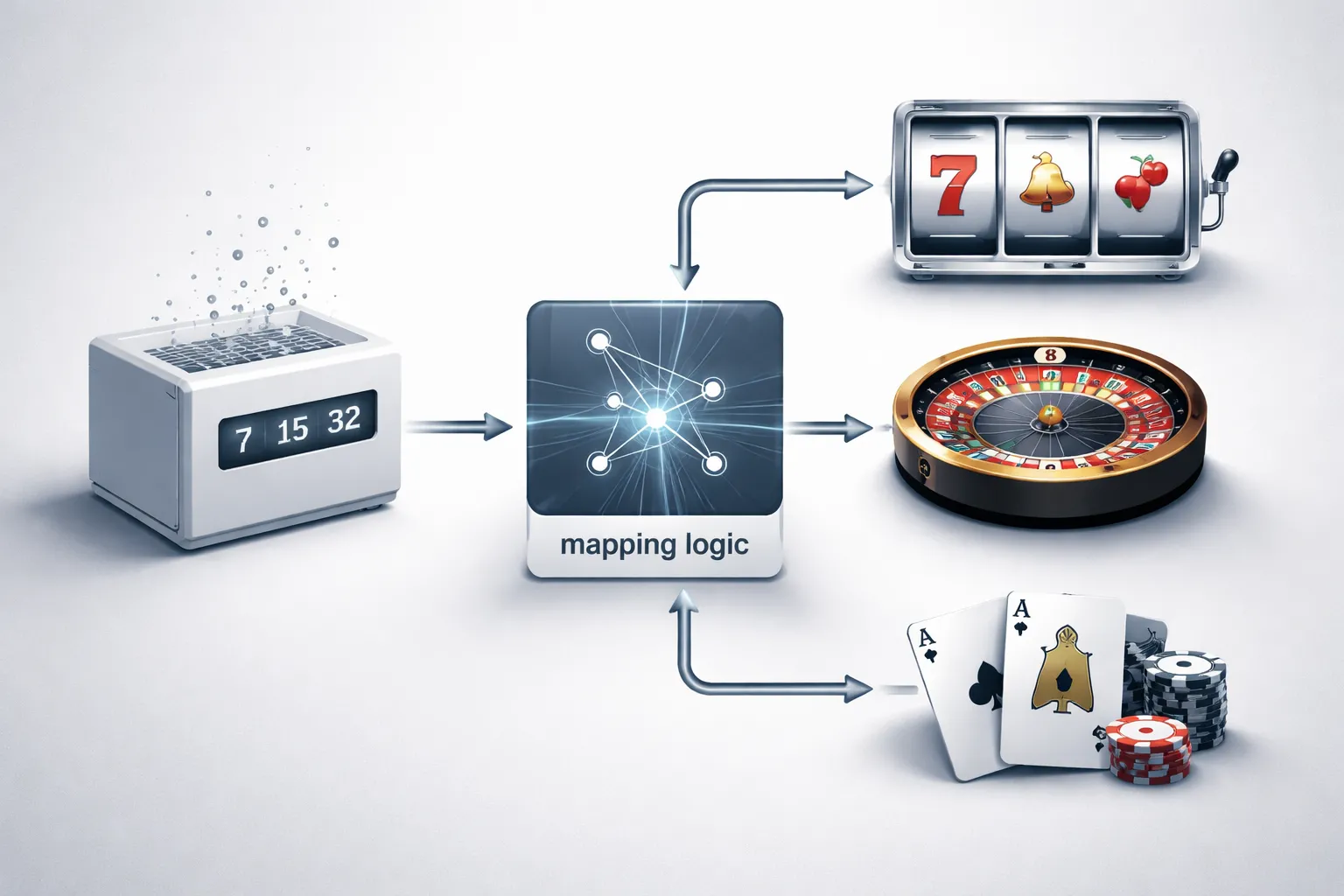
RNG Basics: PRNG vs TRNG in Casino Games
A casino RNG is the engine that produces random-looking results. Most online games use a PRNG (pseudo-random number generator): a fast algorithm that turns an internal “seed” into a long stream of numbers that should be statistically random and impossible to predict without the seed.
Some systems also use a TRNG (true random number generator), which collects physical noise (hardware entropy). In practice, TRNG output often feeds the seed for a PRNG, combining real-world unpredictability with the speed and consistency casinos need. Testing focuses on whether the generator and its implementation behave as required—not what marketing label is used.
How RNG Outputs Become Game Outcomes
- Slots: the RNG selects a number; the game’s math model maps it to a reel-stop combination, then the paytable determines the win.
- Roulette (digital): the RNG selects a number that maps to 0–36 (and 00 where used), then the wheel animation reflects that outcome.
- Blackjack side bets: the RNG drives a shuffle/deal process; outcomes are mapped to card sequences, then evaluated against side-bet rules. (Live dealer is different: cards are physical; RNG may be used only for features like multipliers.)
Labs test both the RNG and the mapping layer to ensure results follow the published rules and probabilities—separate from player behavior and timing.
What “Fair” Means in RNG Terms
- Unpredictability: players (and attackers) can’t forecast future results.
- Uniformity: each outcome occurs at the correct frequency over time.
- Independence: each result doesn’t depend on the prior one.
Common Misconceptions (and Why Testing Matters)
- “Hot/cold streaks” happen naturally in random sequences.
- Timing clicks doesn’t “catch” a better result; the RNG runs continuously (or is sampled at play).
- Pattern spotting mistakes noise for signal; certified systems are built to resist prediction.
For conduct at table games (where randomness may be physical), see Casino Table Game Etiquette: Blackjack to Poker Rules. For control, use Step 3: Set Per-Bet Rules for a Gambling Budget.
RNG Testing: How Fairness Is Verified (Methods, Metrics, and Standards)
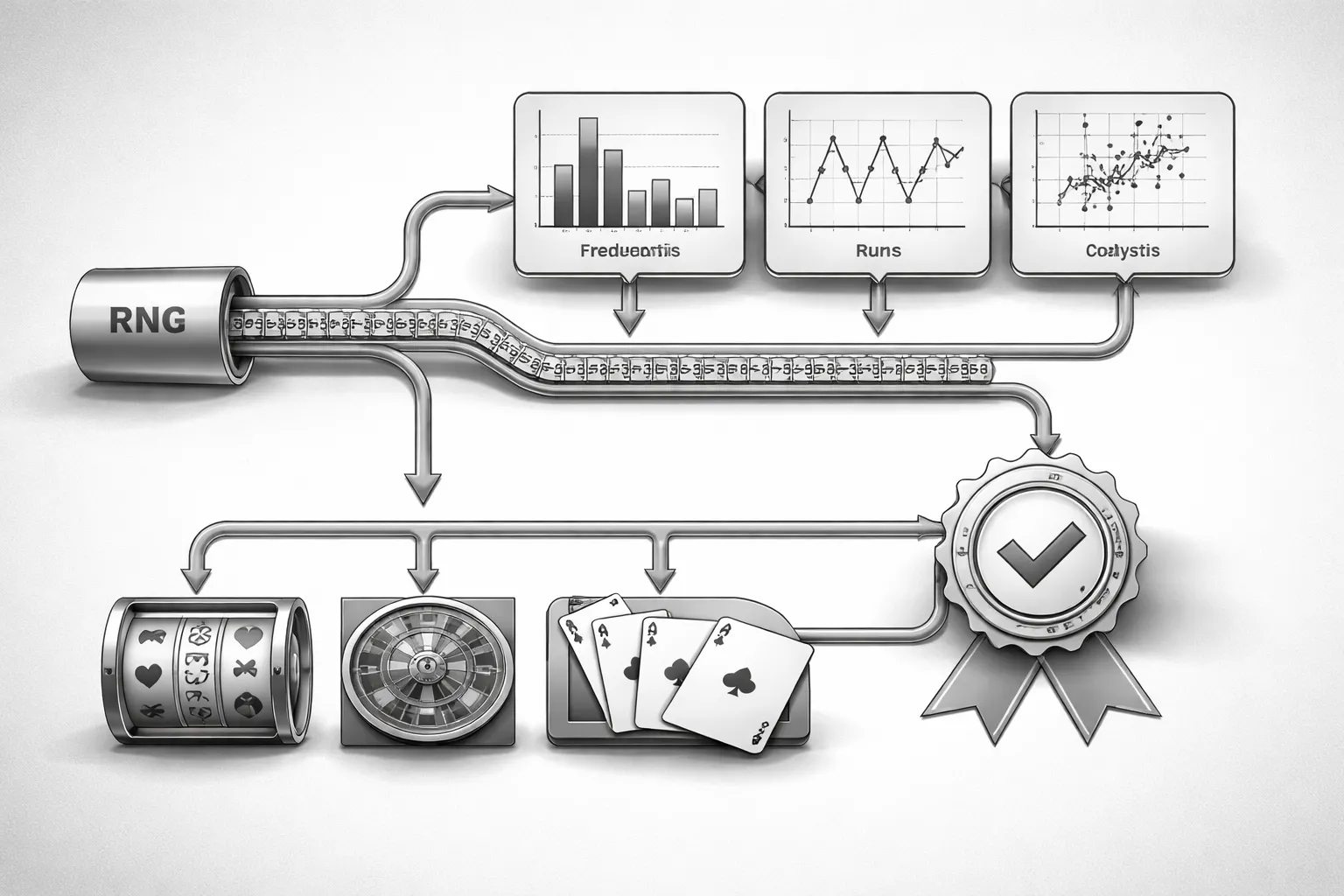
Two Test Tracks: Randomness vs. Correct Game Mapping
Labs verify fairness in two ways. Statistical randomness tests ask: do outputs look unpredictable across huge samples? Functional/game mapping tests ask: does the RNG output get translated into game results exactly as the rules and math model claim (no hidden weighting, no “extra” rerolls, no off-by-one errors).
Typical Statistical Suites and What They Measure
- Frequency/monobit: are 0s/1s (or number buckets) balanced as expected?
- Runs tests: do streak lengths match probability, or show clumping beyond chance?
- Serial correlation: is one output influencing the next (predictable dependence)?
- Entropy estimates: is there enough uncertainty per output, or signs of compression/patterning?
- Distribution checks: do all outcomes hit at the correct long-run rate?
Sampling, Confidence, and the “Pass” Misconception
“Passing” means results fall within statistical tolerance at a chosen confidence level. It does not mean “perfectly random.” Any finite sample can look slightly skewed. Good testing defines sample size, significance thresholds, and repeatability to separate noise from bias.
Game-Specific Verification (Where Cheating Really Hides)
- Slots: confirm virtual stops map to reel strips correctly and paytable odds match the submitted math.
- Roulette: verify number selection is uniform and independent; no wheel-sector bias in the digital mapping.
- Card games: validate shuffle algorithms, deck integrity, no duplication/omission, and unbiased dealing order.
Edge Cases and Failure Modes Labs Try to Catch
- Bias from modulo errors or uneven ranges.
- Seeding flaws (reused seeds, low-entropy sources, predictable time seeding).
- State leakage (outputs revealing internal state or becoming forecastable after resets).
For physical randomness and conduct, see Casino Table Game Etiquette: Blackjack to Poker Rules. For controls beyond testing, use Self-Exclusion Programs: Rules, Privacy & Compliance.
RNG Certification: Who Certifies, What Gets Reviewed, and What a Certificate Actually Means
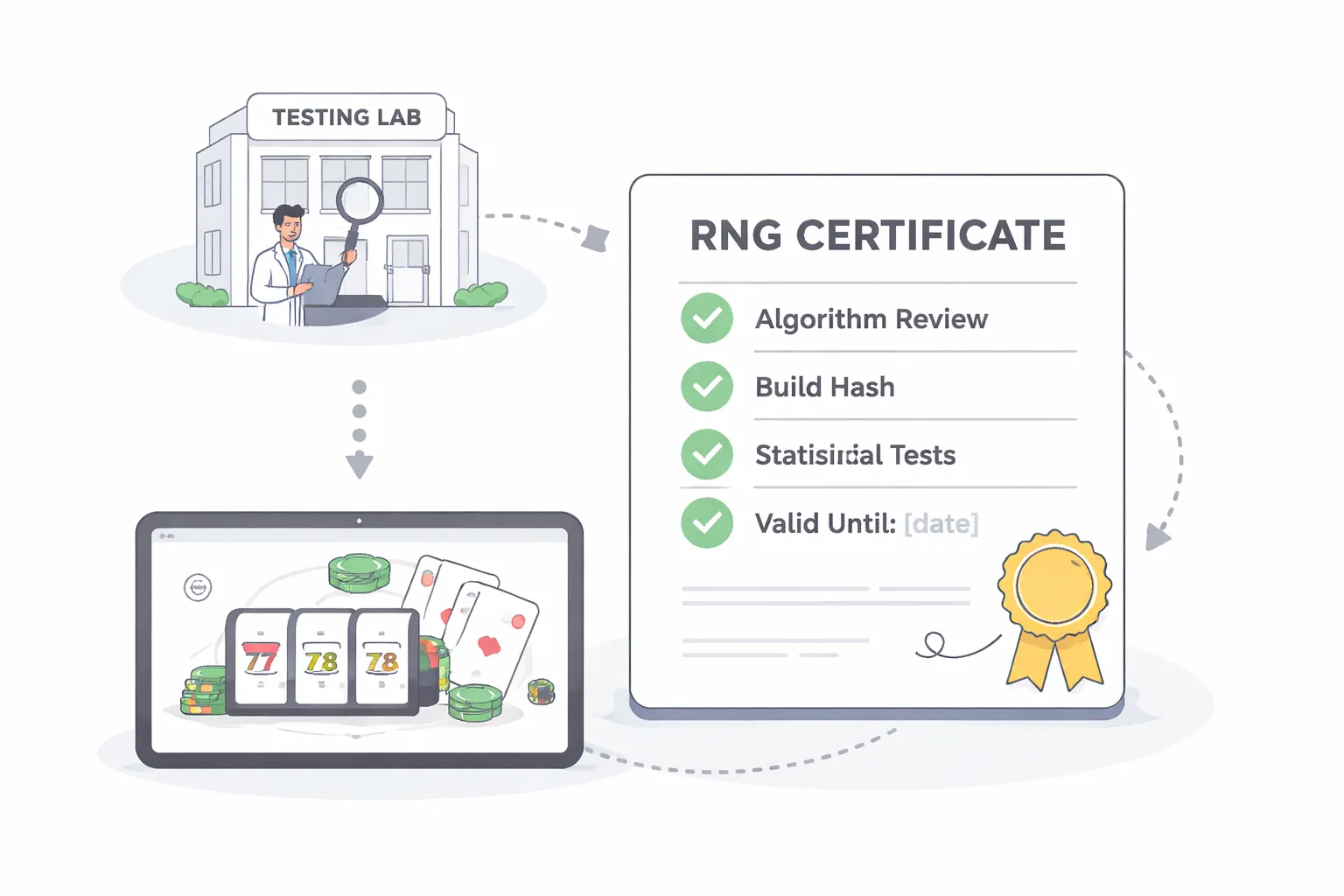
Independent test labs: who certifies and why it matters
RNG certification is typically issued by independent test laboratories, not by the casino or game studio. Well-known names include eCOGRA, iTech Labs, GLI (Gaming Laboratories International), and BMM Testlabs. Their job is to evaluate whether the random number generator behaves as claimed, meets relevant technical standards, and is deployed in a controlled, traceable way. Regulators may require a specific lab or accept multiple labs depending on the jurisdiction.
What gets reviewed: the paper trail behind “random”
- RNG algorithm description: PRNG design, seeding method, period expectations, and intended output range.
- Implementation notes: how the algorithm is coded, called, and protected (including reset behavior and entropy sources).
- Build/version evidence: hashes, compiler/build settings, release IDs, and change control so the tested code matches production.
Scope: RNG component vs game vs the full platform
- Component-only: validates the RNG module but not how each game consumes it.
- Game-level: checks mapping from RNG output to symbols/outcomes (where modulo bias can happen).
- System-level: may include platform integration, remote game servers, and sometimes wallet/accounting interfaces—often outside pure RNG scope unless explicitly listed.
What the certificate actually means (and what it doesn’t)
Reports usually state pass/fail against defined statistical and procedural criteria, plus limitations (tested build only, specified environment) and a validity period or re-test schedule. It does not guarantee you will “win,” only that outcomes aren’t engineered or predictably biased in the tested configuration.
How players can verify certification
- Look for audit seals in the site footer and click through to the lab’s verification page where available.
- Check the casino’s “About/Fairness” page for the report date, game/provider list, and jurisdiction.
- Match the certified brand/entity to the operator you’re using.
For boundaries and verification in other high-trust contexts, see Swinging Consent Agreements: Boundaries & Safer Sex.
RNG Regulation: Licensing Rules, Jurisdiction Differences, and Enforcement
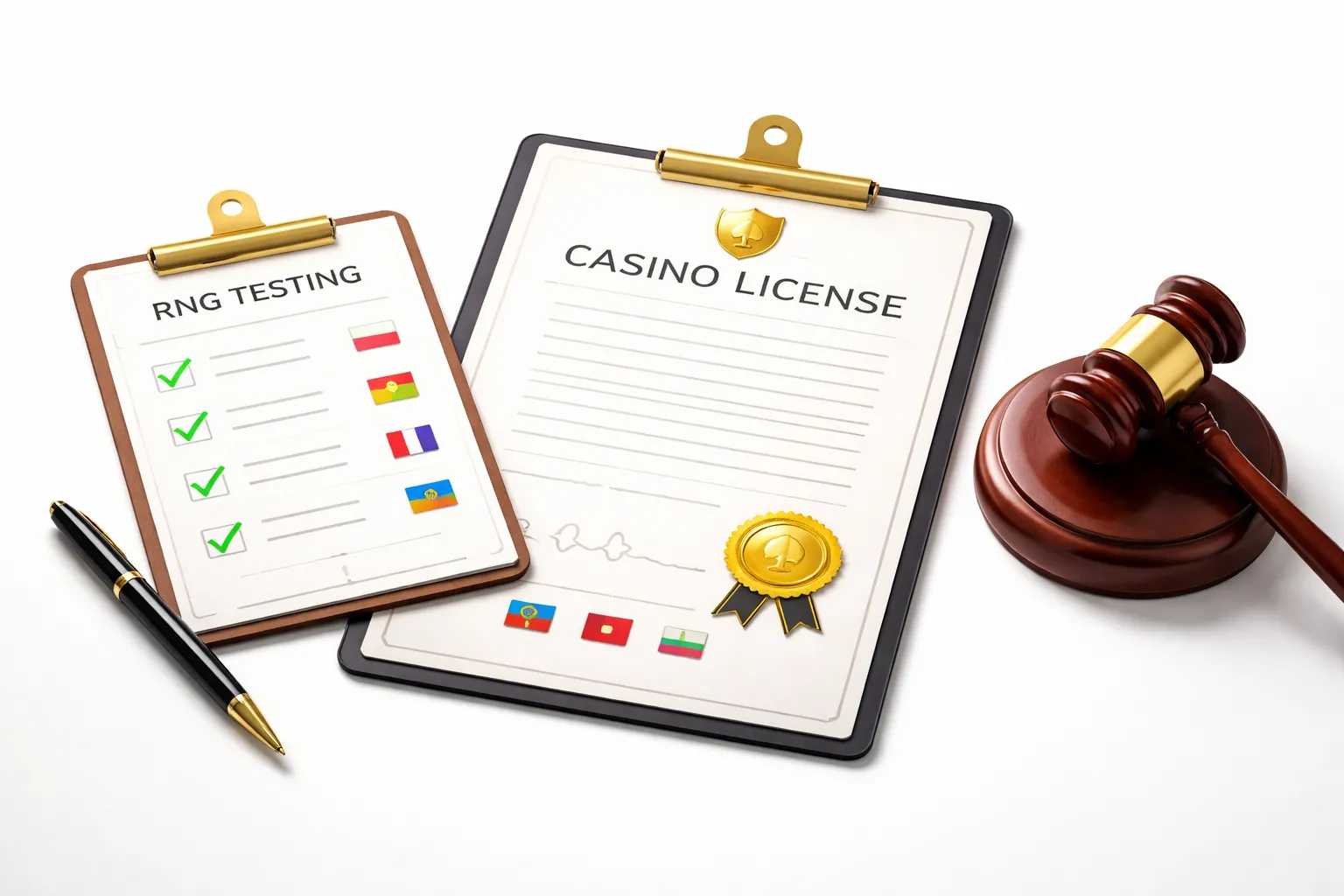
RNG Regulation: Licensing Rules, Jurisdiction Differences, and Enforcement
RNG fairness isn’t just a lab badge—it’s a licensing obligation. Regulators set the rulebook: which RNG standards apply, how often systems must be tested, what changes trigger re-certification, and how game providers and operators must document deployments. The details vary by jurisdiction. Some markets require approved labs, audited change-control, and ongoing reporting; others accept prior certifications or allow broader self-attestation, creating uneven protection for players.
Enforcement is the backstop. Strong regulators can suspend licenses, fine operators, order game removals, or mandate corrective testing when incidents occur. Weak enforcement turns “certified” into a marketing word. The practical takeaway: check who licenses the casino, which legal entity holds the license, and whether certification matches the exact brand, platform, and game list you’re playing.
For boundaries and verification in other high-trust contexts, see Swinger Lifestyle for Beginners: Communication & Consent.
Read our detailed guide: Casino RNG Regulation: Licensing, Testing & Enforcement
Ongoing Monitoring: Post-Certification Audits, Change Control, and Real-World Integrity Checks

Why Ongoing Monitoring Matters
Certification is a snapshot. Real casinos change weekly: software patches, RNG library updates, math model tweaks, jackpot seed values, game configuration, and new game builds. Any change can alter outcomes, even if the “same” game name remains. That’s why regulators and test labs require post-certification controls to keep the certified version aligned with what players actually receive.
Change Control: Versioning, Re-Test Triggers, Approvals
Strong operators run formal change management: signed builds, documented version numbers, and traceable release notes. Re-testing is typically triggered by RNG code changes, paytable edits, RTP setting changes, game engine upgrades, aggregation/platform migrations, or any modification that touches randomness, outcomes, or reporting. Deployment should require approvals (segregated duties) and rollback plans—so production never drifts from the audited baseline.
RTP Checks in Production: Theoretical vs Observed
Theoretical RTP is what the math model predicts over massive sample sizes. Observed RTP in live traffic will swing above/below due to variance, especially on high-volatility slots and low spin counts. Monitoring focuses on whether results remain within expected statistical ranges over time, per game, per stake band, and per jurisdictional configuration—flagging outliers for review, not punishing normal volatility.
Security Controls That Protect Fairness
- Access control: least-privilege, MFA, and separated roles for dev, ops, and compliance.
- Logging: immutable audit trails for config edits, deployments, and critical admin actions.
- Tamper evidence: checksums, signed binaries, integrity monitoring, and secure time sync.
- Key management: HSM/KMS, rotation, and strict handling of signing and encryption keys.
Incident Response: Anomalies and Complaints
When alarms or player complaints hit, the operator preserves logs, freezes affected versions, and escalates to compliance. Labs/regulators may request evidence packs (build hashes, configs, RNG logs, RTP reports) and mandate re-testing or suspension. For how high-trust rules are verified in other contexts, see Swingers Lifestyle Guide: Rules, Boundaries & Consent.
How Players Can Check RNG Fairness Signals Before Playing
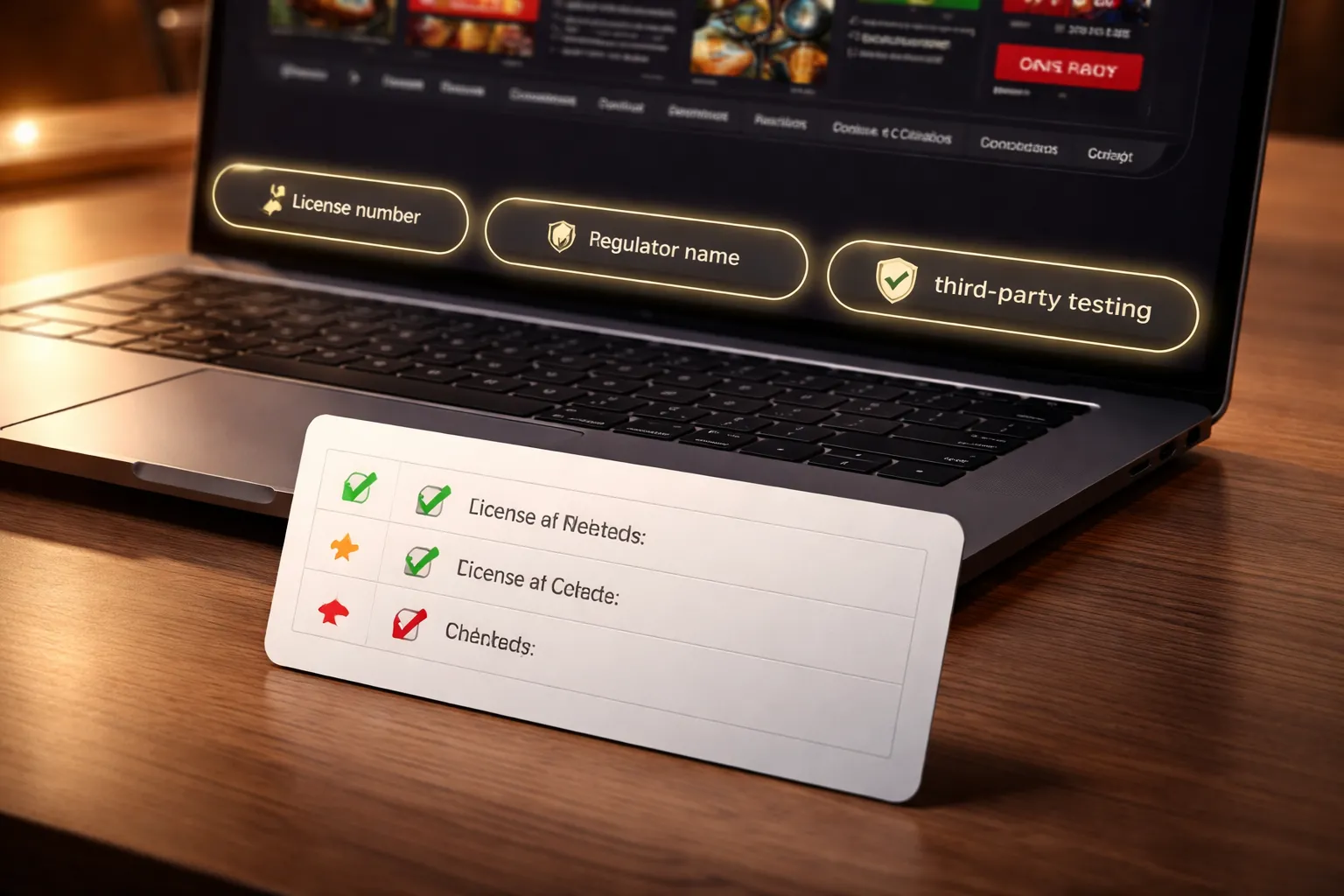
Where to find licensing info, testing seals, and audit reports
Start in the site footer. Legit casinos usually list the licensing authority, license number, and company name/address there, plus links to “Responsible Gaming” and “Terms.” Open those pages and confirm the same entity is named throughout.
Next, look for third-party test lab seals (eCOGRA, GLI, iTech Labs) near the footer or in a “Fairness,” “RNG,” or “About” page. Some operators also publish RTP/audit summaries in “Game Rules” or “Help.”
Red flags to treat as deal-breakers
- Missing license details: no license number, no regulator named, or a generic “licensed offshore” claim.
- Unverifiable seals: logos that don’t link to a certificate page, or links that go to the casino’s own PDF only.
- Vague wording: “certified RNG” with no lab, no date, no scope (which games/build/version), no audit cadence.
- Entity mismatch: footer company differs from the T&Cs or payment processor merchant name.
Practical due diligence checklist
- Regulator strength: check the regulator’s site for license status and any enforcement history.
- Game provider reputation: prioritize well-known studios that undergo independent lab testing across jurisdictions.
- Dispute channels: confirm a clear complaints path (support escalation, ADR/mediation, regulator contact).
- Document trail: screenshots/URLs of license info, seal pages, and any published audit/RTP notes.
What RNG verification can’t guarantee
Certification helps verify randomness and expected RTP over the long run. It does not promise you will win, prevent short-term losing streaks, or make “due” outcomes real. Variance can be brutal even in fair games.
Related reads: Camgirls Hintergrund: Stilvolle Kulissen and Zeer voordelige vroegboekkorting: Waar vind je de beste deals?.
Key Takeaways
In het kort:
- RNG testing checks statistical randomness and confirms the game’s mapping (RNG output → reels/cards/results) matches the published rules.
- Certification is third-party evidence tied to a specific game build, RNG library, and version scope; updates can change what’s covered.
- Regulators set the real muscle: who oversees licensing, how often audits happen, and what penalties apply when things fail.
- Ongoing monitoring matters as much as the first certificate: patches, new game content, and platform changes should trigger re-tests and fresh reports.
- What it can’t guarantee: no promise of short-term “fair” sessions, no protection from variance, and no such thing as outcomes being “due.”
- Quick player checklist: look for an accredited lab name and dated report, match the certified version to the game/provider, verify license details, and prefer operators with clear audit history and transparent RTP info.
- Fairness signals live outside casinos too—build a habit of checking disclosures and boundaries in other online spaces, from ENM Communication Terms: Consent, Check-Ins & Conflict to creator ecosystems like Camgirls Strip: Die Kunst des Entblätterns and Camgirls Kombinieren: Multiplattform-Strategien.
- For deal-hunting transparency parallels, see Populaire bestemmingen met vroegboekkorting: Waar moet je zijn?.
FAQ
Can an RNG be “rigged” and still pass tests?
Not easily. Labs test statistical randomness and verify the exact RNG build (hash/signature). A “fair-looking” but manipulated game can fail if the code differs from the certified version. Still, risks shift to hidden payout logic—verify disclosures like you would elsewhere (see Camgirls Updaten: Bleib aktuell).
How often are casino RNGs re-tested after updates?
Any meaningful change (RNG, game math, platform, libraries) typically triggers re-certification or regression testing. Many jurisdictions require periodic audits too. Practical rule: treat every major patch like a new product release—check the certificate date and version listed.
Is a game fair if it has a low RTP but a certified RNG?
Yes—randomness can be correct while the expected return is low. Certified RNG means outcomes aren’t predictably biased; RTP is the cost of play over time. “Fair” here means transparent odds, not generous payouts—similar to pricing clarity in why early-booking discounts matter.
Do all regulators require independent RNG testing labs?
No. Strong regulators often mandate accredited third-party labs; others allow self-testing, internal controls, or lighter oversight. If you can’t find an independent lab name (eCOGRA, iTech Labs, GLI, BMM), treat it as a transparency red flag—like unclear “deals” in maximale besparingen.
What’s the difference between game fairness, RNG randomness, and casino payout policies?
Randomness: unpredictable outcomes. Game fairness: correct probabilities and stated RTP/volatility. Payout policies: withdrawals, limits, bonuses, and terms. A casino can have a certified RNG yet still feel “unfair” via restrictive policies—compare how terms shape value in deal-finding.
Conclusion: What “Verified Fairness” Really Means for Casino RNGs
Conclusion: What “Verified Fairness” Really Means for Casino RNGs
“Verified fairness” doesn’t mean you’ll win. It means the game’s outcomes are generated by a tested random number generator, the math matches the published rules, and the stated RTP/volatility is delivered over the long run.
Think in three layers:
- Randomness: results are unpredictable and not steerable.
- Game fairness: probabilities and payout tables behave as advertised.
- Payout policies: how the casino treats your money—withdrawal limits, bonus wagering, verification steps, and rule wording.
A casino can pass RNG certification and still feel “unfair” if its policies are tight, slow, or stacked with conditions. That’s not an RNG problem. It’s a terms-and-value problem—similar to how the fine print can make or break any “deal” when you’re comparing offers.
Trust comes from a framework, not a logo: independent testing, certification, licensing oversight, and ongoing monitoring. When those pieces are in place, you’re reducing the risk of rigged outcomes—not eliminating variance.
Best next step: before you deposit, verify the casino’s license details and read the latest RNG/lab reports (or certification statements) for the games you actually plan to play.
Final tip: if you enjoy comparing value across niches, you may also like these guides: Studenten en vroegboekkorting: Hoe boek je voordelig?, Waarom kiezen voor vroegboekkorting: Voordelen en voordelen, and for adult live-stream context, Was sind Camgirls? Eine Einführung in die Welt der Cam-Modelle or Camgirls Nudelive: Unzensierte Streams.
-
Online vs Land-Based Casino Odds: Rules & House Edge
1 month ago -
Casino Betting Systems: Myths, Hot Streaks & “Due” Numbers
1 month ago -
Online vs In-Person Casino Odds: RNGs & Fair Play
1 month ago -
Casino Security, Fairness & Regulation Explained
1 month ago -
Signs of Gambling Addiction: Warning Signs & Help Options
1 month ago
-
Signs of Gambling Addiction: Warning Signs & Help Options
1 month ago -
Casino Betting Systems: Myths, Hot Streaks & “Due” Numbers
1 month ago -
Casino Systems Myth: Can You Really Gain an Edge?
1 month ago -
Online vs In-Person Casino Odds: RNGs & Fair Play
1 month ago -
Online vs Land-Based Casino Odds: Rules & House Edge
1 month ago
-
Online vs Land-Based Casino Odds: Rules & House Edge
1 month ago -
Casino Betting Systems: Myths, Hot Streaks & “Due” Numbers
1 month ago -
Online vs In-Person Casino Odds: RNGs & Fair Play
1 month ago -
RTP Explained: How to Use Return to Player to Choose Slots
1 month ago -
Casino Security, Fairness & Regulation Explained
1 month ago