Gambler’s Fallacy Explained: Common Mix-Ups and Examples

Introduction: Why the Gambler’s Fallacy Gets Confused With Other Biases
A roulette wheel doesn’t “remember.” But your brain does—and it hates randomness. After five reds in a row, “black is due” feels like logic, not a guess. That mental shortcut is the gambler’s fallacy: believing past independent outcomes change what should happen next. This section clarifies what it is, what it isn’t, and why people mix it up with nearby biases. For the full breakdown, see The Gambler’s Fallacy Explained (With Simple Examples).
- What you’ll learn: a clean definition, fast comparisons, and quick examples you can spot in seconds.
- Where it shows up: casino games, sports narratives, investing decisions, and everyday “streak” thinking.
The confusion comes from overlap: several biases use the same raw material—patterns, streaks, and selective memory—but reach different wrong conclusions.
- Gambler’s fallacy: “It’s due to switch.” (Independent events get treated as connected.)
- Hot-hand fallacy: “They’re on fire, it’ll keep happening.” (A streak is treated as a persistent skill boost.)
- Confirmation bias: You notice the times the “due” bet wins and ignore the rest.
- Regression to the mean: Extreme results often drift back toward average—without being “owed.”
You’ll see it at the roulette table, in sports talk (“a win is coming”), in investing (“this stock can’t fall again”), and in daily life (“I’ve had bad luck all week, so tomorrow will be good”). The fix is simple but not easy: treat independent events as independent, and treat streak stories as stories.
Even planning gets hijacked by “due” thinking—like assuming prices must rebound after you waited too long. If you want a rational alternative, compare fixed, measurable strategies such as early-booking savings in Waarom Kiezen voor Vroegboekkorting? De Voordelen and Vliegbedrijfsdeals met vroegboekkorting: Hoe bespaar je?.
The Gambler’s Fallacy Explained (With Simple Examples)

What the Gambler’s Fallacy Is
The gambler’s fallacy is the belief that an outcome is “due” after a streak—when the events are independent. You see five losses and assume a win must be next. You see a run of red and assume black is coming. The story feels balanced; the math isn’t.
The Key Condition: Independence
An event is independent when the past doesn’t change the odds of the next try. If each trial resets the same way, then yesterday’s results don’t “load” the future. That’s why streak logic fails in many casino games and random draws. (For practical guardrails that don’t rely on “due” thinking, use clear limits like per-bet rules and budgeting.)
Simple Examples (No Math Required)
- Coin flips: If a fair coin lands heads 6 times, the next flip is still 50/50. Heads didn’t “use up” anything.
- Roulette red/black: Ten reds in a row doesn’t make black more likely on the next spin. The wheel has no memory.
- Lottery numbers: “Hot” and “cold” numbers don’t become due. Each draw re-randomizes the field.
Quick Self-Check
Ask one question: “Is each trial independent?” If yes, then nothing is due. Treat streaks as stories, not signals—like setting boundaries in advance and sticking to them, the way you would with clear consent agreements.
Gambler’s Fallacy vs the Hot Hand Fallacy (Opposite Mistakes About Streaks)

Two Opposite Mistakes About Streaks
Gambler’s fallacy is the reversal expectation: after a streak, you think the outcome must “balance out.” Classic line: “Black is due after many reds.”
Hot hand fallacy is the continuation expectation: after a streak, you think the same outcome will keep happening. Classic line: “They’re on fire, they’ll keep hitting.”
When Each Applies (Independence vs Feedback)
Use the key test: Is each trial independent?
- Independent, random processes (roulette spins, lottery draws): streaks don’t change the next probability. Here, both “due to reverse” and “will keep going” are stories, not signals.
- Performance with feedback/skill (sports, tasks, games with learning): recent outcomes can sometimes correlate with what happens next (confidence, fatigue, adjustment, better reads). Even then, the “hot hand” can be exaggerated, and reversals aren’t automatic.
Side-by-Side Examples: Roulette vs Basketball
- Roulette: Red hits 7 times. Gambler’s fallacy says, “Black is due.” Hot-hand thinking says, “Red is hot.” Reality: each spin is independent; odds stay the same. Keep your behavior disciplined—like following casino etiquette and table rules, you don’t get to renegotiate probability mid-streak.
- Basketball: A shooter makes 5 in a row. Hot-hand belief says, “Feed them, they can’t miss.” Gambler’s fallacy says, “They’re due to brick.” Reality: skill and context matter (shot quality, defense, fatigue), so continuation can exist—but it’s not guaranteed.
Bottom line: in pure chance games, don’t chase “due” or “hot.” In skill settings, look for causes—not streak worship. Preparation still beats superstition, whether it’s practice reps or clean, consistent styling.
Gambler’s Fallacy vs the Law of Large Numbers (And the ‘Law of Averages’ Myth)
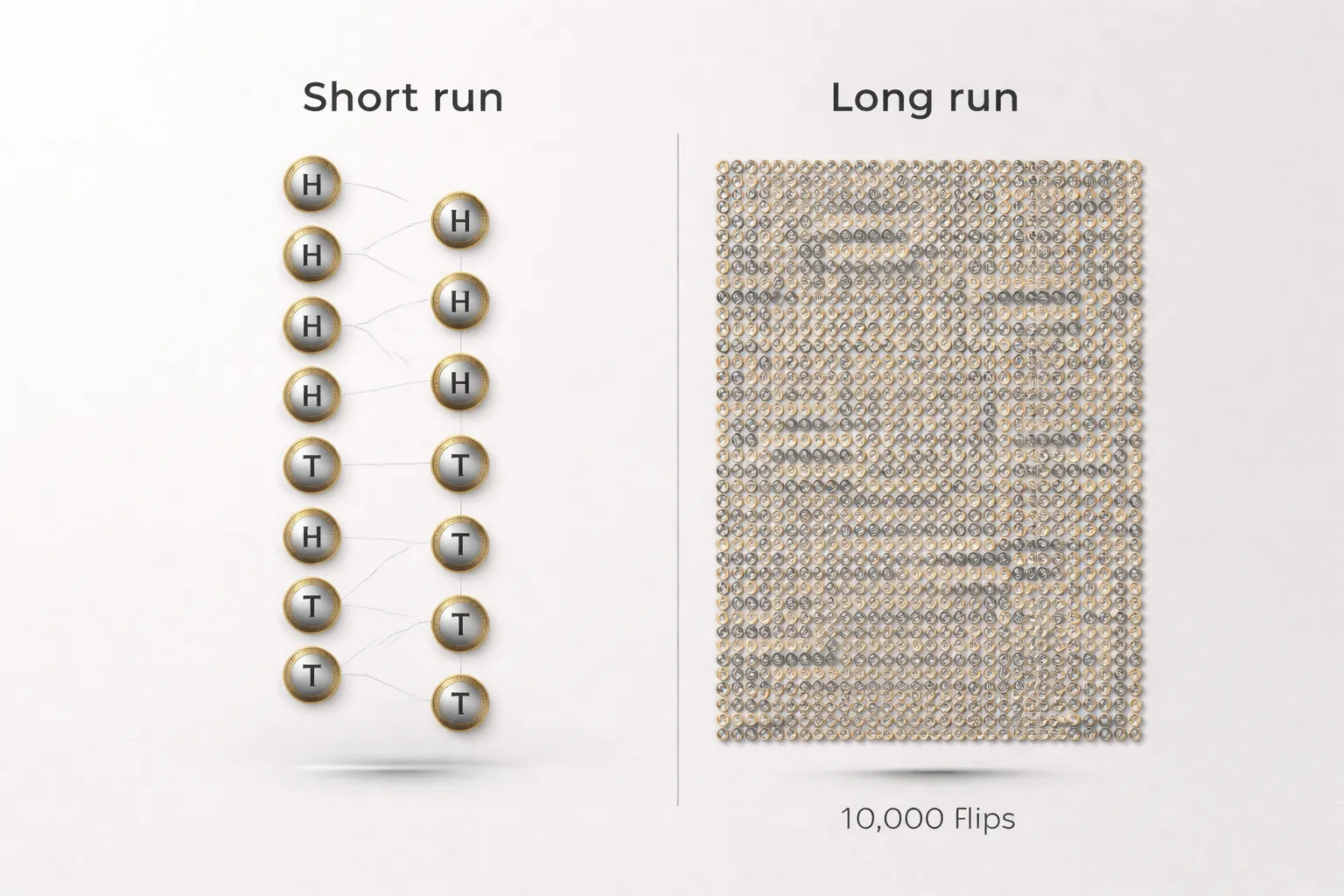
Law of Large Numbers: What It Actually Says
The Law of Large Numbers (LLN) is about the long run. As you repeat an independent chance event many times, the relative frequency tends to stabilize near the true probability. Flip a fair coin enough times and the share of heads drifts toward 50%.
The Common Mix-Up: “Balancing” Has to Happen Soon
LLN does not promise short-run symmetry. After five heads in a row, the next flip is still 50/50. People smuggle in a false deadline: “It’s due.” That’s the gambler’s fallacy.
The “Law of Averages” Myth
There’s no real “law” that forces outcomes to even out quickly. The myth says: if you’re below average now, you must get above average soon. Reality: randomness can stay lopsided for a while, and it doesn’t owe you a correction on your timetable.
Examples: 10 Flips vs 10,000 Flips (Why Streaks Are Normal)
- 10 flips: Getting 7 heads isn’t shocking. Neither is a streak like HHHH. Small samples swing hard.
- 10,000 flips: You’ll likely land closer to 50/50 overall, but you’ll still see plenty of streaks inside the run.
- Key point: Streaks don’t “break” probabilities; they’re often what random looks like.
Want an intuitive way to think about variance? Short windows mislead, long windows stabilize—same idea whether you’re tracking live patterns or travel pricing. See Camgirls Updaten: Bleib aktuell, Camgirls Live-Erlebnisse: Was Du erwarten kannst, Populaire bestemmingen met vroegboekkorting: Waar moet je zijn?, and Invloed van vroegboekkorting op de prijs van je vakantie.
Gambler’s Fallacy vs Regression to the Mean (What Actually ‘Returns to Normal’)
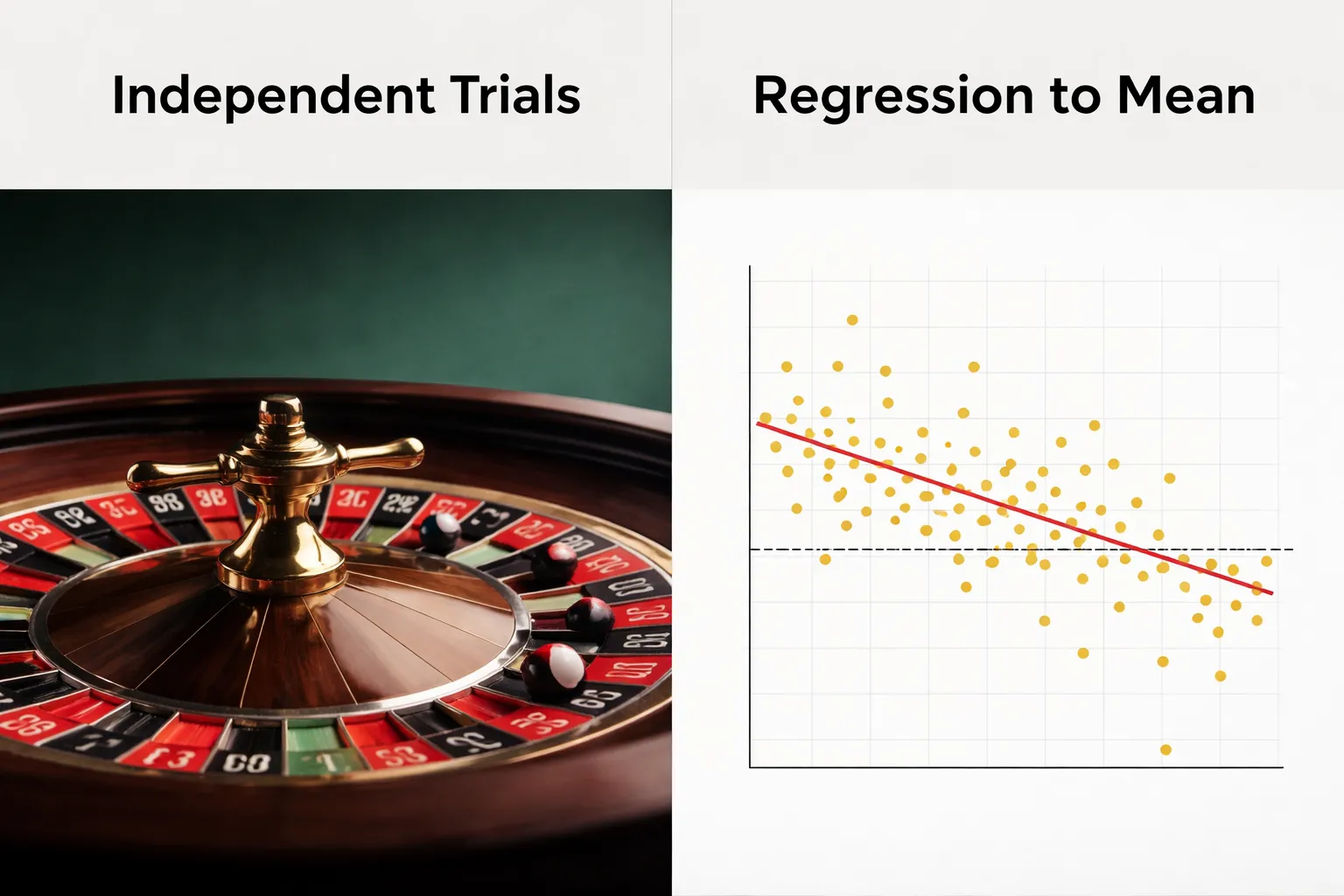
Regression to the Mean: What “Returns to Normal”
Regression to the mean is a statistical pattern: unusually high or low results are often followed by results that are closer to the average. Not because the universe “corrects” anything, but because extreme outcomes usually include a mix of real skill + luck + noise. When the luck/noise fades, the next result looks more typical.
Why It’s Not the Gambler’s Fallacy
The gambler’s fallacy says a run of outcomes makes the opposite outcome due (e.g., “red is due after five blacks”). Regression to the mean says extreme measurements tend to be followed by less extreme ones because of variability and imperfect measurement, not because future events owe you a reversal.
Examples People Confuse
- Athlete after a career-best game: A player drops 45 points, then scores 18 next game. Fans call it “balance.” More often, it’s that 45 included hot shooting and favorable matchups that didn’t repeat.
- Test score after an unusually high score: A student scores 98 after guessing well and getting topics they studied, then scores 86 next time. It’s not “payback.” It’s normal variance plus exam-to-exam differences.
How to Tell Which One You’re Seeing
- Regression to the mean: Outcomes blend skill + randomness; there’s noise, changing conditions, or measurement error.
- Gambler’s fallacy territory: Truly independent trials (roulette spins, coin flips) where past results don’t change the next probability.
If you want a clean intuition for variance: short windows mislead; long windows stabilize—same logic whether you’re tracking odds or comparing early-booking deals by destination.
Other Common Mix-Ups: Clustering Illusion, Randomness Misconceptions, and the Monte Carlo Fallacy
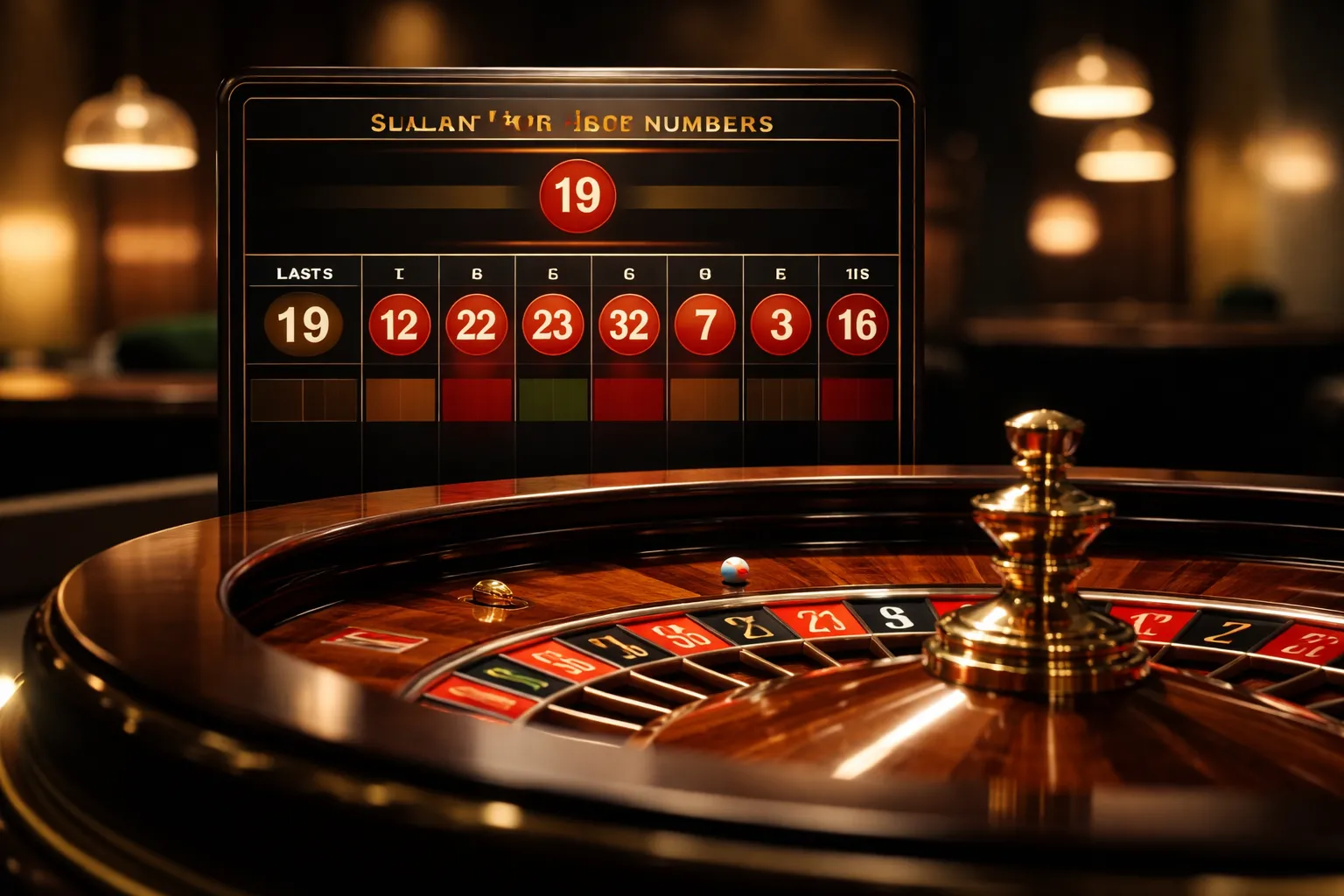
Clustering Illusion: When Randomness Forms “Meaningful” Runs
Random data naturally clumps. You’ll see streaks, repeats, and gaps even when outcomes are independent. The clustering illusion is mistaking those normal runs for a hidden pattern: “That can’t be random.”
- “Red hit five times—something’s up.”
- “These numbers keep showing together—must be a system.”
In reality, streaks are part of randomness. Our brains treat clusters as signals because they feel “too unlikely,” especially in short windows.
Randomness Misconceptions: The Representativeness Heuristic
Another common mix-up is expecting small samples to look like the long-run distribution. That’s the representativeness heuristic: “A fair process should look balanced right now.” But short sequences are noisy; they don’t owe you symmetry.
- “If the coin is fair, it should alternate more.”
- “After three heads, tails is more likely to ‘even it out.’”
Long runs stabilize; short runs mislead. The same logic applies when judging early-booking deals: a few observations can distort what’s “typical,” so compare across larger sets and destinations (see bonus bij vroegboekkorting and vroegboekkorting beschikbaarheid).
Monte Carlo Fallacy: A Name People Use for Gambler’s Fallacy
“Monte Carlo fallacy” is often used as “gambler’s fallacy in casino clothing”—the belief that a roulette number is “overdue,” or that a machine “must pay soon.” The terms get conflated because both describe the same mistake: past independent outcomes don’t change the next probability.
- “Numbers are overdue.” (roulette)
- “This slot is due to pay out.” (slots)
- “Streaks can’t be random.” (any game)
How to Avoid the Gambler’s Fallacy: Practical Decision Rules (Gambling, Sports, Investing)
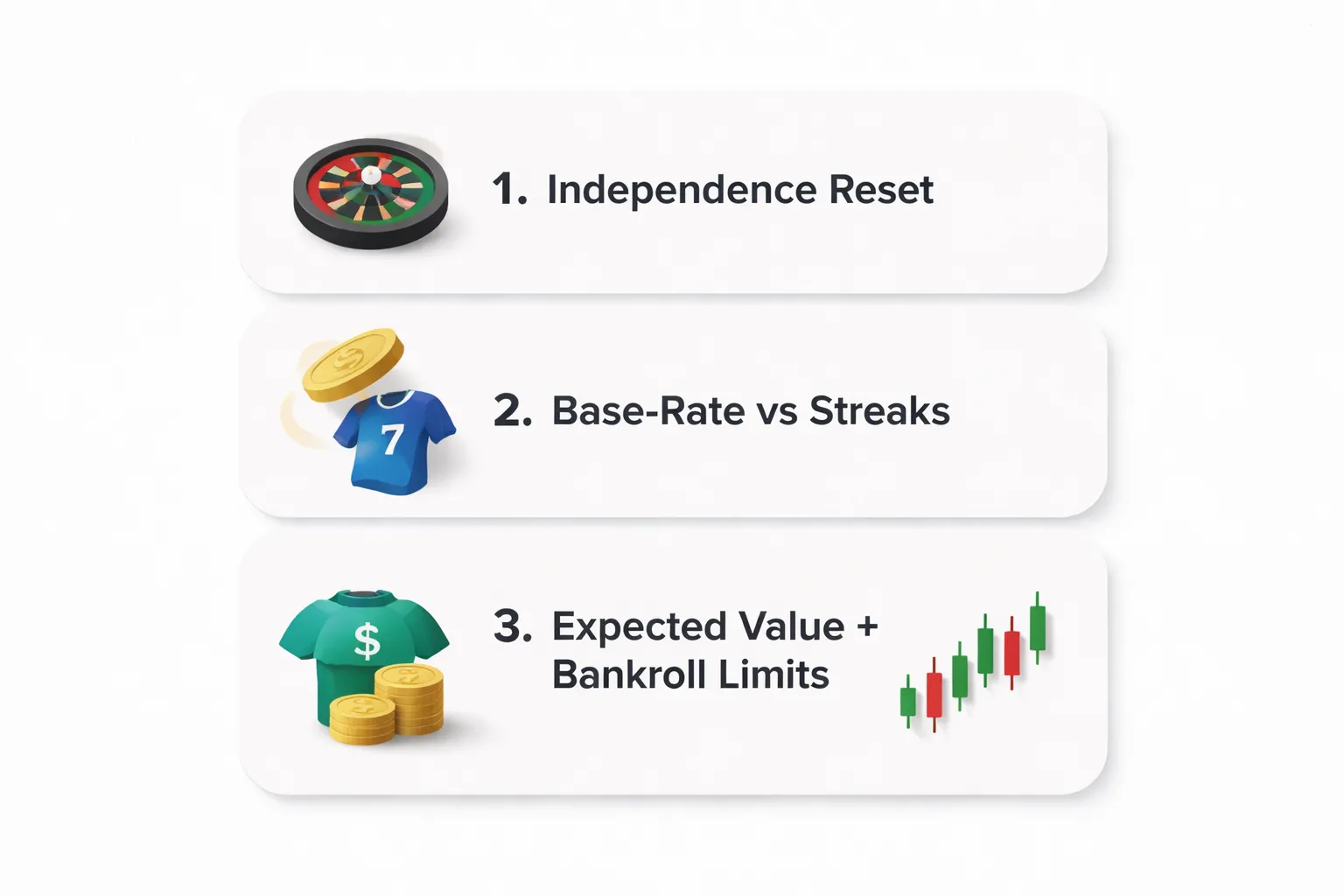
How to Avoid the Gambler’s Fallacy: Practical Decision Rules (Gambling, Sports, Investing)
Rule 1: Ask “Are events independent?”
If each trial doesn’t affect the next, reset the probability every time. A roulette wheel has no memory. A fair coin doesn’t “correct” itself. If the process is independent, “overdue” is a story, not a signal.
Rule 2: Separate odds from outcomes
Odds (base rates) are the math. Outcomes are the noise you just watched. A streak can happen in random sequences, so don’t treat it like new information. Update only when the underlying conditions change (injury, lineup, rule change, market regime), not because the last five results “look weird.”
Rule 3: Use expected value and bankroll limits
Before you bet or trade, ask: “Is the expected value positive after fees/house edge?” Then cap risk. Bankroll rules prevent the classic error: chasing losses because you feel “due.” If you can’t express the edge and the limit in numbers, you’re guessing.
Quick checklist + examples
- Independence: Does one outcome change the next? If no, ignore streaks.
- Base rate: What’s the true probability, not the narrative?
- EV: What do you win/lose on average per bet/trade?
- Limits: Set max loss per session/day; stop on trigger.
- Roulette: “Red is due” → wrong. Each spin is the same probability.
- Coin flips: 6 heads in a row → tails is not more likely next flip.
- Sports betting: “They must bounce back” → check price, injuries, matchup; don’t pay for a story.
- Trading: “Three green days, a drop is due” → trends and mean reversion depend on context, not superstition.
Camgirls Chat: Interaktiv und Persönlich | Camgirls Kostenlos: Gratis Erfahrungen | Camgirls Make-up-Tricks: Tipps für das perfekte Aussehen | Camgirls Ohne Anmeldung: Anonymes Vergnügen
Key Takeaways: Gambler’s Fallacy vs Related Concepts (At-a-Glance)
Key Takeaways: Gambler’s Fallacy vs Related Concepts (At-a-Glance)
- In het kort: Gambler’s fallacy = thinking independent outcomes “must” reverse soon (e.g., after 5 reds, black is due).
- Hot hand (the mirror mistake): expecting a streak to continue because it’s “hot.” Sometimes real in skill-based settings; not guaranteed in pure chance.
- Law of large numbers (LLN): long-run frequencies tend to settle near expected rates; it does not promise short-run “balancing” after a streak.
- “Law of averages” myth: the idea that results self-correct on schedule is superstition. Randomness has no memory.
- Regression to the mean: extreme performance often drifts back toward typical levels—without anything being “due.” Many “comebacks” are just statistical cooling-off.
- Fast check: If each trial is independent (roulette spins, many slot outcomes), prior results don’t change the next probability—RTP is about long-run return, not your next spin (see How Slot RTP Is Calculated (and Why It Varies by Casino)).
- Practical guardrail: Don’t pay for a story. Update beliefs with new info (injuries, price, matchup), not streak vibes—same logic when judging timing and pricing differences like vroegboekkorting vs last minute and the invloed van vroegboekkorting op prijs.
- Quick example labels: “A drop is due” = gambler’s fallacy. “It’ll keep running” = hot-hand thinking. “It’ll even out soon” = LLN misread.
FAQ
Is the gambler’s fallacy the same as the Monte Carlo fallacy?
Yes. “Monte Carlo fallacy” is a famous case of the gambler’s fallacy: thinking a random process must “correct” after a streak. Example: “A drop is due” after many reds in roulette—wrong if spins are independent.
Can streaks happen in random sequences, and how common are they?
Yes. Randomness naturally produces clusters. In long sequences, surprising runs are expected, not special. The mistake is treating a streak as proof of a coming reversal (“It’ll even out soon”) or as a guaranteed continuation (“It’ll keep running”).
Does the gambler’s fallacy apply to sports, or only to casino games?
It applies anywhere people misread randomness. In sports, don’t predict outcomes from “streak vibes.” Update with new info (injuries, price, matchup). Same logic for timing and pricing differences like vroegboekkorting vs last minute.
How is regression to the mean different from ‘being due’?
Regression to the mean is about extreme performance tending to look more average next time when skill + luck are mixed. Being due claims luck must flip because of past outcomes. Regression is statistical; “due” is a myth.
What’s the simplest way to test independence in real life?
Check whether the chance changes after the past changes. If it shouldn’t (coin, roulette), treat events as independent. If it can (sports with injuries, markets with new info), it’s not independence—don’t confuse it with vroegboekkorting logic or the invloed van vroegboekkorting op prijs.
Conclusion: The One Question That Prevents Most Mix-Ups
Conclusion: The One Question That Prevents Most Mix-Ups
If you remember one thing, make it this question: “Did anything real change that can change the odds?”
If the answer is no, stop building a story. A fair coin doesn’t “owe” heads. A roulette wheel doesn’t “heat up.” Past spins don’t push future spins. Treat each trial as independent and ignore streak narratives. If you want reassurance on casino randomness, learn how outcomes are audited in Casino RNG Testing & Certification: How Fairness Is Verified.
If the answer is yes, you’re not looking at the gambler’s fallacy—you’re looking at new information. Injuries, lineup changes, weather, rule tweaks, limits, and market-moving news can shift probabilities. That’s not “due.” That’s updated conditions.
The second guardrail is sample size. Small runs are noisy. Ten flips, ten spins, ten games: all can look “patterned” by accident. Before you trust a trend, ask: “How many trials would I need before this is more than variance?”
- Replace streak talk with numbers: use expected value, base rates, and the true payout/price.
- Track, don’t guess: write outcomes down; your memory edits losing streaks and “near misses.”
- In travel timing: compare fare rules, inventory, and cancellation terms—not “due” thinking or the invloed van vroegboekkorting op prijs. For coverage details, see Vroegboekkorting en Uw Reisverzekering: Wat U Moet Weten.
Final tip: when emotions spike (tilt, FOMO, jealousy), pause and re-run the same question. Tools that reduce story-driven decisions help in other high-stakes areas too, like How to Handle Jealousy in Swinging: Practical Tools and Safety First: Sexual Health & Security in Swinging Beginners.
-
Online vs Land-Based Casino Odds: Rules & House Edge
1 month ago -
Casino Betting Systems: Myths, Hot Streaks & “Due” Numbers
1 month ago -
Online vs In-Person Casino Odds: RNGs & Fair Play
1 month ago -
Casino Security, Fairness & Regulation Explained
1 month ago -
Signs of Gambling Addiction: Warning Signs & Help Options
1 month ago
-
- Is the gambler’s fallacy the same as the Monte Carlo fallacy?
- Can streaks happen in random sequences, and how common are they?
- Does the gambler’s fallacy apply to sports, or only to casino games?
- How is regression to the mean different from ‘being due’?
- What’s the simplest way to test independence in real life?
-
- Is the gambler’s fallacy the same as the Monte Carlo fallacy?
- Can streaks happen in random sequences, and how common are they?
- Does the gambler’s fallacy apply to sports, or only to casino games?
- How is regression to the mean different from ‘being due’?
- What’s the simplest way to test independence in real life?
-
Signs of Gambling Addiction: Warning Signs & Help Options
1 month ago -
Casino Betting Systems: Myths, Hot Streaks & “Due” Numbers
1 month ago -
Casino Systems Myth: Can You Really Gain an Edge?
1 month ago -
Online vs In-Person Casino Odds: RNGs & Fair Play
1 month ago -
Online vs Land-Based Casino Odds: Rules & House Edge
1 month ago
-
Online vs Land-Based Casino Odds: Rules & House Edge
1 month ago -
Casino Betting Systems: Myths, Hot Streaks & “Due” Numbers
1 month ago -
Online vs In-Person Casino Odds: RNGs & Fair Play
1 month ago -
RTP Explained: How to Use Return to Player to Choose Slots
1 month ago -
Casino Security, Fairness & Regulation Explained
1 month ago