How Game Rules and Player Choices Affect Casino Edge

Introduction: Why the “Edge” Changes From Game to Game (and Even Table to Table)
The “casino advantage” isn’t a vibe. It’s a number: the average cut the house keeps from every dollar wagered over the long run. That cut shifts because games aren’t built the same—and neither are the rules in the same game. A blackjack table that pays 6:5 instead of 3:2 can turn a beatable-feeling session into a grinder. A roulette wheel with one extra zero quietly raises the price of every spin. Slots bury it in paytables and bonus design.
Luck decides short streaks. Rules, payouts, and player decisions decide the math. If you’re tempted to “chase” because the next result “has to hit,” you’re drifting into the logic traps covered in Gambler’s Fallacy Explained: Common Mix-Ups and Examples.
This chapter fits inside How Casinos Make Money: House Edge, RTP, and the Math Behind It and shows where the edge actually moves.
- House edge: the built-in average loss rate per bet.
- RTP (return to player): the flip side—what returns over time.
- Volatility: how wild the ride is while that average plays out.
You’ll see how these differ across blackjack (decisions + rules), roulette (wheel layout + bets), slots (RTP + volatility), and video poker (paytables + correct play). For a quick detour into “choosing early for better odds” in another context, see Waarom Kiezen voor Vroegboekkorting? De Voordelen and Vind Goedkope Vliegtickets met Vroegboekkorting.
House Edge, RTP, and Expected Value: The Math Casinos Rely On
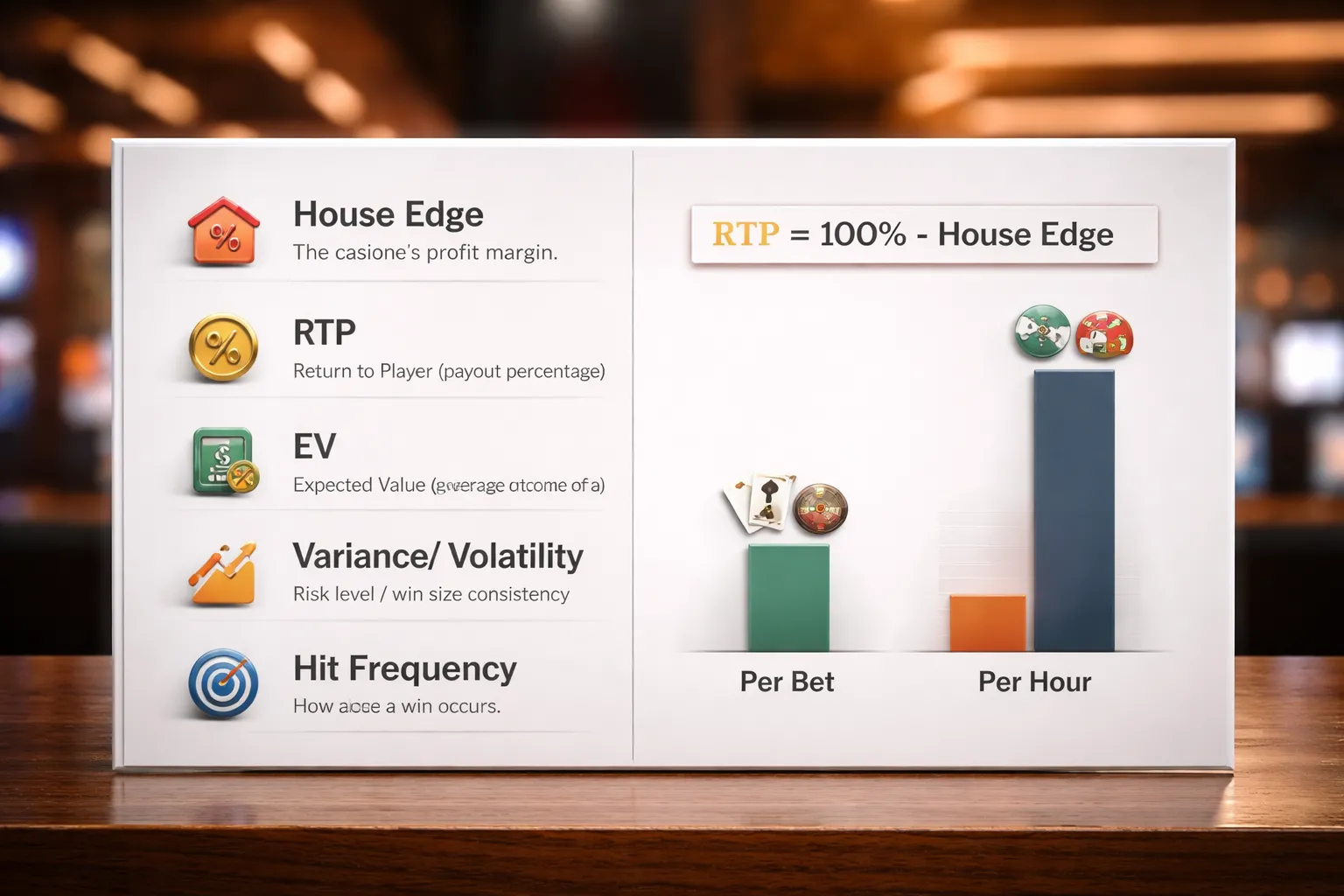
Key Definitions (House Edge, RTP, EV, Variance, Hit Frequency)
House edge is the casino’s average profit per unit bet, expressed as a percentage. A 2% edge means the casino expects to keep $2 per $100 wagered over time.
RTP (Return to Player) is the flip side: the average amount returned to players. RTP = 100% − house edge (for a fixed wager with no skill factor).
Expected value (EV) is your average profit/loss per bet in dollars. EV = (probability-weighted payouts) − (stake). Negative EV is the casino’s business model.
Variance/volatility describes how wild results swing around the average. High volatility can mean long losing stretches punctuated by big wins.
Hit frequency is how often a game pays something (not how much). A slot can “hit” often and still have a low RTP if payouts are small.
How House Edge and RTP Relate (and Differ in Practice)
In roulette, edge is baked into the wheel layout. In slots, RTP is set by the game’s math, while volatility changes the ride. In blackjack and video poker, rules and choices move EV: the posted “house edge” assumes correct play and specific rules.
Why Short-Term Results Can Clash with Long-Term Expectation
EV is an average, not a promise. Variance lets you run hot or cold for hours (or weeks) while the average “catches up.” Treat outcomes like trust after a boundary break: one good or bad moment doesn’t rewrite the underlying pattern—see How to Repair Trust After a Boundary Is Broken.
Comparing Games Fairly: Edge per Bet vs Edge per Hour
- Per bet: edge × average wager.
- Per hour: (edge × wager) × hands/spins per hour.
A slower game with a lower edge can cost less per hour than a fast game with a slightly higher edge. Pace, rules, and even table norms matter—see Casino Etiquette: Poker Room and Table Game Rules.
Blackjack: How Rules and Player Choices Can Shrink (or Increase) the House Edge
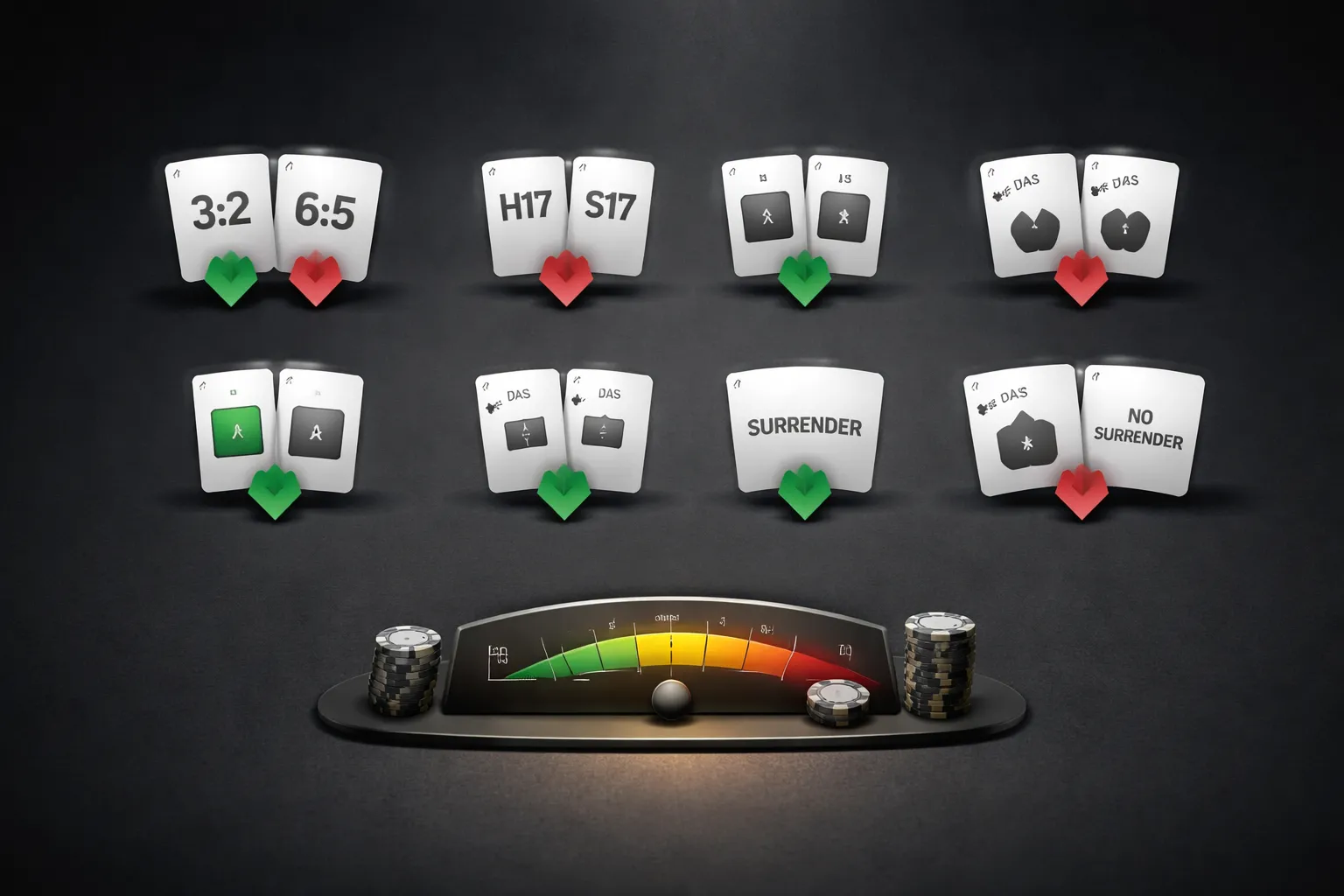
Blackjack Is Decision-Driven (Your Choices Move the EV)
Unlike slots or roulette, blackjack isn’t “set-and-forget.” Every hit, stand, double, or split changes expected value. With solid rules and correct play, the house edge can be small. With sloppy choices, it balloons.
Don’t let streak thinking steer decisions; see Gambler’s Fallacy Explained: Streaks, Randomness, Odds.
Rule Levers That Shrink (or Inflate) the House Edge
- Blackjack payout: 3:2 is standard; 6:5 is a major player disadvantage.
- Dealer on soft 17: S17 (stands) is better for players than H17 (hits).
- Number of decks: fewer decks generally lowers the edge (all else equal).
- Doubling rules: “double on any two,” and “double after split (DAS)” help players.
- Surrender: late surrender reduces losses in bad matchups.
- Resplits: resplitting pairs (especially aces) can improve EV; limits hurt.
- Peek/no-peek: no-peek rules can make some doubles/splits riskier vs dealer 10/A.
For how casinos keep games consistent, read Casino Security, Fairness & Regulation Explained.
Common Player Choices That Raise the House Edge
- Wrong hit/stand calls (especially 12–16 vs dealer 2–7).
- Misusing doubles and splits (or avoiding them out of fear).
- Insurance: usually a long-term loser for non-counters.
- Side bets: often carry a much higher edge than the base game.
Basic Strategy = “RTP Optimization”
Basic strategy is the mathematically best response to each dealer upcard. It doesn’t guarantee wins; it minimizes expected loss under the rules you’re playing.
If gambling stops being entertainment, use Gambling Addiction Treatment: Signs, Help & Recovery Options.
Table Speed: Edge per Hour Can Matter More Than Edge per Hand
Your expected loss scales with hands per hour. A slightly worse game played slowly can cost less per hour than a “better” table dealt fast. If you want fewer decisions per hour, choose slower tables, more conversation, or lower-limit rooms—like how planning early reduces pressure elsewhere: Waarom Kiezen voor Vroegboekkorting? De Voordelen.
Roulette: Fixed Edge by Wheel Type, With a Few Rule Exceptions
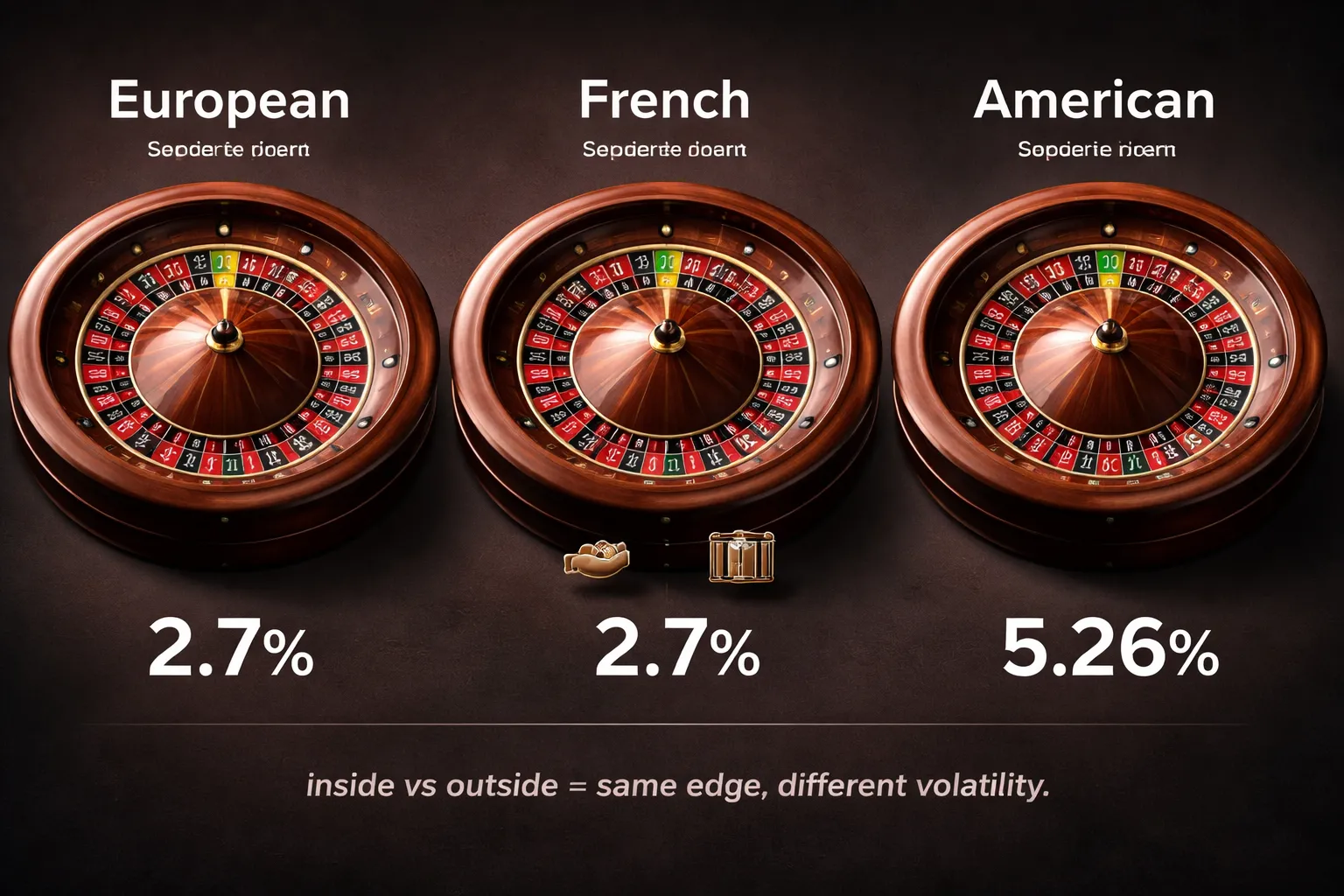
Wheel type sets the baseline edge
Roulette is “fixed” because the wheel bakes in the math. On a single-zero wheel (European/French: 0–36), the house edge is about 2.70% on all standard bets. On a double-zero wheel (American: 0, 00–36), it jumps to about 5.26%. Same layout, same payouts; the extra pocket dilutes your win probability.
French wheels usually share the single-zero math, but can add rules that shave the edge further on even-money bets.
Inside vs outside: same edge, different feel
In a given wheel type, inside bets (straight, split, street) and outside bets (red/black, odd/even, dozens) carry the same house edge. What changes is volatility. A straight-up bet pays 35:1 but hits rarely; swings feel brutal. Red/black pays 1:1 and hits often; the session feels “stable,” even though the long-run drain is identical.
If you’re trying to manage emotional tilt rather than math, think of it like planning early to avoid pressure later—similar to choosing the best time to book early instead of scrambling last minute.
Rule exceptions that can lower the edge
- La Partage (single-zero, even-money bets): if 0 hits, you lose only half. Edge drops to about 1.35% on those bets.
- En Prison (single-zero, even-money bets): if 0 hits, your bet is “imprisoned” for one spin; you may get it back. Also about 1.35% on those bets.
“Systems” don’t change EV
Progressions can change variance, not expectation. Example: Martingale on red doubles after losses. You win small often—until a streak or table limit forces a big loss. Expected value stays negative, like skipping a debrief: avoidable pain later. If you want cleaner decision-making, see how to debrief after swinging.
Slots: RTP, Volatility, and Why Player Choices Usually Don’t Change the Edge (But Settings Can)
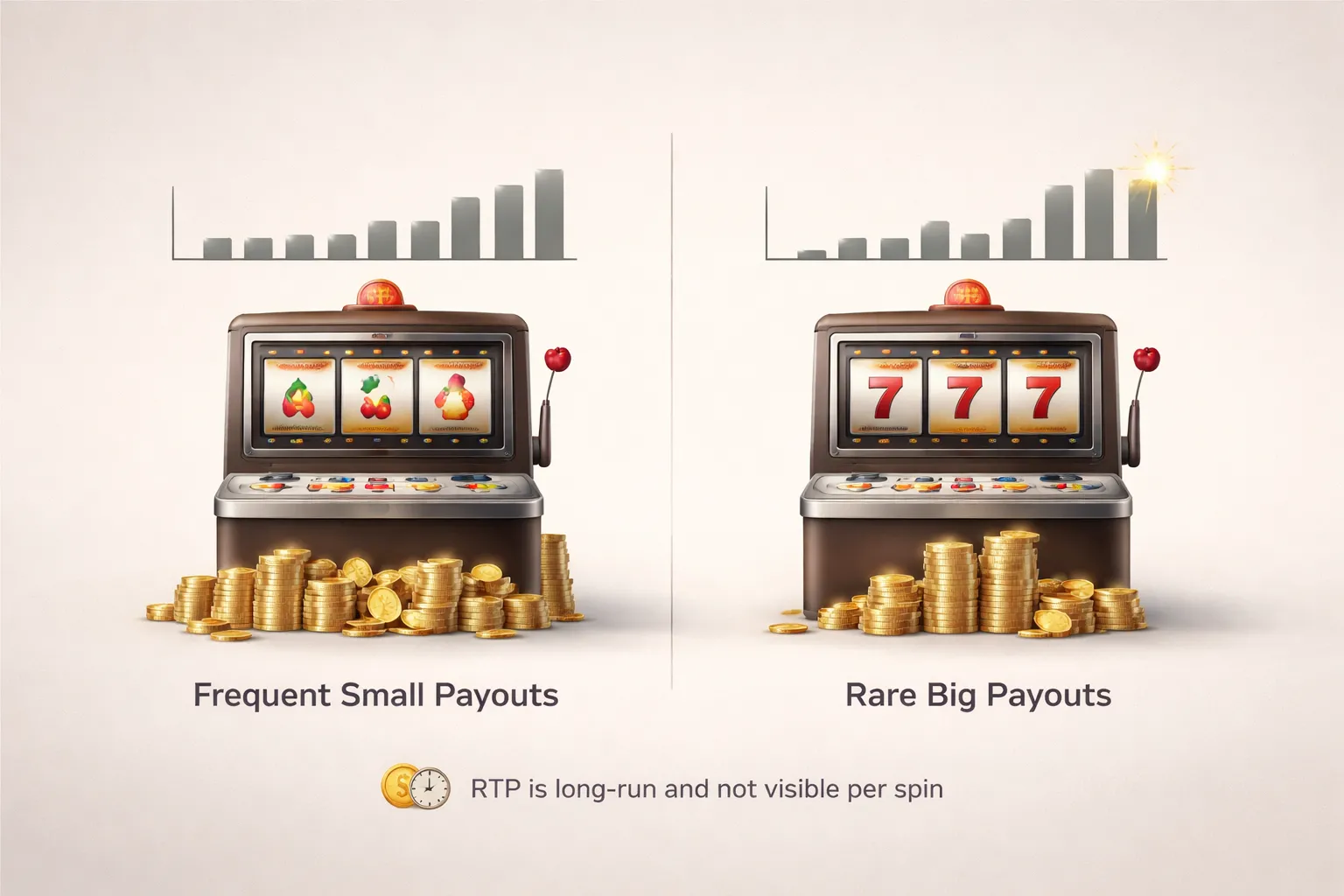
How slot RTP is set (and why you can’t “see” it spin by spin)
Slot RTP (return to player) is baked into the math model: reel/weighting, paytable, and feature rules determine the long-run average return. That “long run” can mean millions of spins. A short session is mostly noise, not proof. One player can run far above RTP; another can get crushed—both inside the same designed edge.
Volatility vs RTP: same edge, totally different feel
RTP is the average. Volatility is the ride. Two slots can both be 96% RTP, yet one pays small wins constantly while the other goes cold for ages then hits huge. Your bankroll experience is dominated by volatility, not the posted RTP.
Bet size, paylines, denomination: what changes variance (usually) vs what doesn’t
- Bet size: typically scales results up/down. The RTP % usually stays the same; your swings get bigger.
- Paylines/ways: on many games, fewer lines increases volatility (more dead spins). RTP often stays similar if the game is balanced, but some titles do change RTP by configuration.
- Denomination/settings: some casinos offer different RTP versions of the same slot. That’s not skill; it’s a different payback file.
Bonus features, progressives, and must-hit-by mechanics
Bonuses and progressives are part of RTP. A must-hit-by jackpot can raise your effective RTP if the meter is high relative to its remaining range—but only if you’re allowed to play long enough to realize that value.
Myths to avoid
- Hot/cold machines: RNG has no memory.
- Timing and “stop the reels”: cosmetics; outcomes are already determined.
- “Systems”: can reshape variance, not the edge.
Want a cleaner way to think about “deals” vs real value? See wat zijn de beste vroegboekkorting deals van het seizoen? and vroegboekkorting met kortingscode: extra besparingen.
Unrelated but similar psychology: pricing and “control” cues show up in other markets too—see camgirls exklusiv: einzigartige erlebnisse and camgirls bezahlen: faire preise und optionen.
Video Poker: The Game Where Strategy and Paytables Dramatically Change RTP

Why video poker is closest to “solvable” for RTP optimization
Video poker is one of the few casino games where your decisions directly shape the return. The rules are fixed, the odds are knowable, and “optimal play” exists: a best hold/draw choice for every hand. That makes RTP less about luck alone and more about execution—like choosing real value over feel-good “deal” cues in other markets (see Must-know wenken voor succesvol boeken met vroegboekkorting).
Paytable impact: tiny changes, big swings
The paytable is the house edge. Change one line and RTP moves fast.
- Jacks or Better: “Full pay” 9/6 (9 for full house, 6 for flush) returns ~99.5% with perfect play. Drop to 8/5 and you’ve given away a big chunk of value.
- Machines that look identical can be priced very differently—another “control cue” trap.
Player choice impact: holds, draws, and strategy charts
Even on a great paytable, sloppy holds donate edge back to the casino. Strategy charts (or trainers) turn the game into repeatable decisions: which high cards to keep, when to break made hands, when to chase straights/flushes, and how to value kickers in bonus games.
Key variants to know
- Jacks or Better: simplest baseline; paytable sensitivity is huge.
- Bonus Poker: extra value on specific four-of-a-kinds; strategy shifts toward quads potential.
- Deuces Wild: wild cards raise hand frequency; paytables and strategy diverge sharply.
How to evaluate a machine quickly
- Check the full house and flush lines first (fast quality filter).
- Scan for reduced straight or two pair payouts (often where value is shaved).
- If you’re multitasking, keep it simple: pick one variant, memorize one “good” paytable.
For a parallel on “interactive control” cues, see Camgirls Interaktiv: Mitmach-Streams and staying current at Camgirls Updaten: Bleib aktuell. For deal-hunting psychology, compare Welke hotels bieden de beste vroegboekkorting?.
Comparing Games: Which Gives the Best (and Worst) Theoretical Deal?
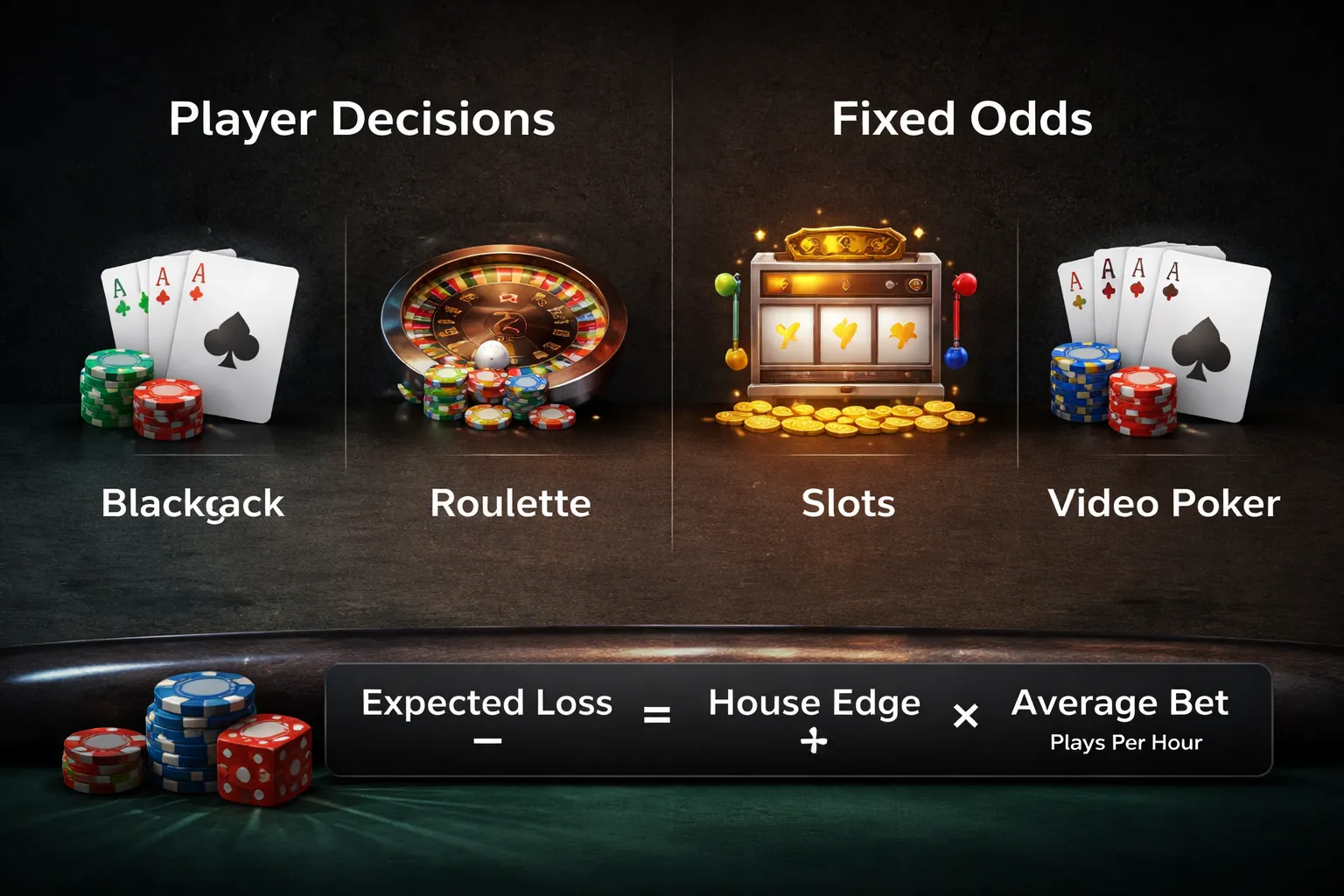
Decision games vs. no-decision games
Some casino games let your choices move the needle. Others don’t.
- Decision-heavy: blackjack and video poker. Correct strategy can shrink the casino edge; sloppy play widens it fast.
- Low-decision: roulette. Your “system” doesn’t change the math; bet selection mostly changes volatility.
- No-decision: slots. You choose denomination and lines; the RTP is baked in.
Typical theoretical ranges (RTP/house edge)
- Blackjack: with solid basic strategy and fair rules, edge can be low; with poor rules (6:5, tight doubling/splitting) it climbs quickly.
- Roulette: European wheels beat American wheels. Same game, different zeros, different deal.
- Slots: widest spread. The machine’s programmed RTP and bonus volatility dominate your results.
- Video poker: ranges depend on the paytable; small tweaks to full house/flush/two pair payouts often “shave” value. If you multitask, pick one variant and memorize one good paytable.
Bankroll fit: volatility matters
A “better” RTP can still feel worse if swings are brutal. Tight bankroll? Prefer lower volatility (many blackjack/roulette bet types). Larger bankroll and higher risk tolerance? High-volatility slots or aggressive VP paytables can produce longer droughts before wins.
What really drives expected loss
Expected loss ≈ (house edge) × (average bet) × (hands/spins per hour). Speed kills. A modest edge at high pace can cost more than a bigger edge at slow pace.
If chasing losses or playing past limits sounds familiar, see Gambling Addiction Signs: Warning Signs and Help Options.
For “deal-hunting” mindset parallels, compare tips om een auto te huren met vroegboekkorting, and for “interactive control” cues, see Camgirls Beobachter: Trends auf dem Radar and How Swingers Meet.
Spinoff Hub: Game-Specific Edge Calculators and Rule-by-Rule Breakdowns (Summary)
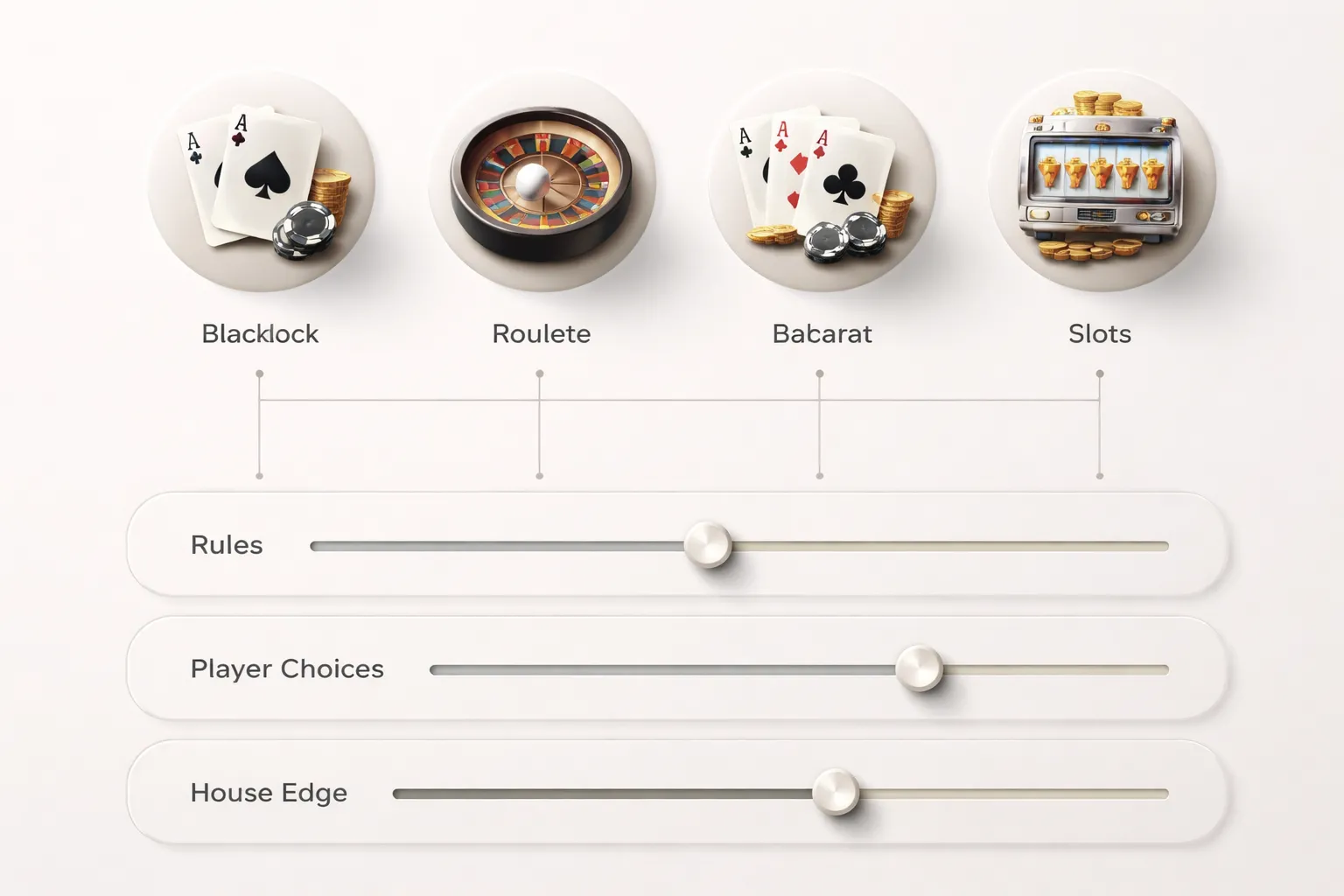
This hub is your quick jump-off point to edge calculators and rule-by-rule breakdowns for the games that matter. Use it to see how small rule tweaks (payouts, dealer actions, surrender, re-splits, side bets) shift the house edge—and how your choices (strategy accuracy, bet sizing, session pace) often move results even more. If you approach casinos like “deal-hunting,” you’ll recognize the same mindset in Vroegboekkorting Met Kortingscode: Extra Besparingen. If you’re drawn to interactive control cues, compare behavioral patterns in Was sind Camgirls? Eine Einführung in die Welt der Cam-Modelle, Camgirls Günstig: Sparsame Angebote, and Swingers Lifestyle Guide: Safety, Etiquette, and Consent. For the full math, examples, and game-specific calculators, we cover it step-by-step in our deep dive.
Read our detailed guide: Casino House Edge Explained: RTP, Rules & Calculators
FAQ: House Edge, RTP, and Player Choice
Is RTP the same as my chance of winning?
No. RTP is the long-run average return across many bets. Your chance of winning is the probability of a payout on a single spin/hand. A high RTP can still have long losing streaks due to variance.
Can any betting system beat roulette long-term?
No. Systems like Martingale only change bet sizing, not the wheel’s math. The house edge stays the same, and table limits plus bankroll limits eventually stop progress. In the long run, expected value remains negative.
Does playing longer increase my chances of profit if I’m ahead?
Usually the opposite. The longer you play a negative-EV game, the more your results drift toward the house edge. If you’re ahead, more play adds more risk of giving it back—especially in high-variance games.
Do slots in the same casino all have the same RTP?
No. RTP varies by title and sometimes by configuration. Two similar-looking slots can pay very differently. Check the game’s info screen, help menu, or posted paytable. If RTP isn’t shown, assume it’s not player-friendly.
What single rule change in blackjack hurts players the most?
Paying 6:5 on blackjack instead of 3:2. That one change can add roughly 1.4% to the house edge, dwarfing many other rule tweaks. Avoid 6:5 tables if you care about long-run value.
Is video poker always better odds than slots?
Not always, but often. Full-pay video poker with correct strategy can offer higher RTP than most slots. Bad paytables or poor play can drop RTP sharply. Like travel deals, compare the “terms” first: reispakketten met vroegboekkorting, incentive reizen, welke hotels, zonnebank handleiding.
Conclusion: Casinos Make Money Through Math—You Manage It Through Rules, Strategy, and Game Selection
Conclusion: Casinos Make Money Through Math—You Manage It Through Rules, Strategy, and Game Selection
Casino profit isn’t a mystery. It’s built into the rules: paytables, dealer procedures, and tiny edge tweaks that compound over time. Your job isn’t to “beat” the math—it’s to manage it by choosing games with fairer rules and playing them correctly.
Most sensitive to player choices: blackjack and video poker. Blackjack swings on rule sets (3:2 vs 6:5, dealer hits/stands, double rules) and decision quality. Video poker depends on paytables and precise strategy; one “almost full-pay” schedule can quietly gut RTP. Slots and roulette are far less responsive: you can pick better RTP variants, but your button-press doesn’t change the underlying edge.
- Scan rules first: prioritize 3:2 blackjack; avoid 6:5 if value matters.
- Check paytables: in video poker, “full-pay” is a specific promise, not a vibe.
- Choose low-edge options: baccarat banker, reasonable blackjack rules, higher-RTP machines.
- Confirm etiquette and flow: fewer mistakes, fewer disputes—see Casino Table Game Etiquette: Blackjack to Poker Rules.
- Treat terms like travel deals: compare conditions before you commit—De beste tijd om te boeken met vroegboekkorting.
Responsible play: expect negative EV, budget for entertainment, and set stop rules. If you need guardrails, read Privacy, Compliance & Self-Exclusion: What to Know. If your session is drifting into “anything goes,” step away—don’t chase, don’t bargain with variance.
Final tip: when two games feel equally fun, pick the one with the cleaner rules and the clearer paytable—small edges decide the long run.
Key Takeaways
Key Takeaways
- In het kort: House edge and RTP are long-run averages; in the short run, outcomes can look wildly different.
- Volatility explains those short-run swings: higher volatility means bigger wins and deeper downswings, even at the same RTP.
- Blackjack and video poker are the exceptions where rules and correct decisions can meaningfully reduce the casino edge.
- Roulette’s wheel rules set the edge; choosing different bet types mostly changes variance, not expectation.
- Slots are largely “priced in”: RTP is mostly fixed by the game; your choices usually shift volatility (denoms, lines, features) more than edge.
- Expected loss scales with speed of play as much as with house edge: more spins/hands per hour can matter more than tiny edge differences.
- Prefer games with clean rules, clear paytables, and transparent limits; confusion is an invisible tax.
- Set stop rules and don’t chase variance. For table behavior and rule basics, see Casino Etiquette: Poker Room and Table Game Rules.
-
Online vs Land-Based Casino Odds: Rules & House Edge
1 month ago -
Casino Betting Systems: Myths, Hot Streaks & “Due” Numbers
1 month ago -
Online vs In-Person Casino Odds: RNGs & Fair Play
1 month ago -
Casino Security, Fairness & Regulation Explained
1 month ago -
Signs of Gambling Addiction: Warning Signs & Help Options
1 month ago
-
-
- Is RTP the same as my chance of winning?
- Can any betting system beat roulette long-term?
- Does playing longer increase my chances of profit if I’m ahead?
- Do slots in the same casino all have the same RTP?
- What single rule change in blackjack hurts players the most?
- Is video poker always better odds than slots?
-
-
- Is RTP the same as my chance of winning?
- Can any betting system beat roulette long-term?
- Does playing longer increase my chances of profit if I’m ahead?
- Do slots in the same casino all have the same RTP?
- What single rule change in blackjack hurts players the most?
- Is video poker always better odds than slots?
-
Signs of Gambling Addiction: Warning Signs & Help Options
1 month ago -
Casino Betting Systems: Myths, Hot Streaks & “Due” Numbers
1 month ago -
Casino Systems Myth: Can You Really Gain an Edge?
1 month ago -
Online vs In-Person Casino Odds: RNGs & Fair Play
1 month ago -
Online vs Land-Based Casino Odds: Rules & House Edge
1 month ago
-
Online vs Land-Based Casino Odds: Rules & House Edge
1 month ago -
Casino Betting Systems: Myths, Hot Streaks & “Due” Numbers
1 month ago -
Online vs In-Person Casino Odds: RNGs & Fair Play
1 month ago -
RTP Explained: How to Use Return to Player to Choose Slots
1 month ago -
Casino Security, Fairness & Regulation Explained
1 month ago