Online vs Land-Based Casino Odds: What Changes?

Introduction: What People Mean by “Online vs Land-Based Odds”
Walk into a casino and you can see the wheel spin, the cards hit felt, the dealer pay out. Play online and it’s software, screens, and terms you rarely read. That contrast fuels a common belief: online odds must be “different,” and usually worse. Sometimes players blame “rigged” RNGs. Other times they point at faster play, autoplay, or bonus rules that feel like a trap.
This guide separates the math from the myths. We’ll compare what actually changes between online and land-based play: random number generators (and how they replace physical randomness), rule sets that shift the house edge, payout tables (especially on slots and video poker), and how those factors combine into the number that matters—expected return.
We’ll also show what doesn’t change: probability still governs long-run results, and the house edge still defines the cost of play. If you need the foundation first, start here: How Casino Game Odds Work: House Edge, Probability, and Payouts.
- Why it feels different: transparency, speed, and bonus conditions shape perception.
- What we’ll compare: RNGs, rules, payouts, and house edge.
- Key promise: clear, testable differences—no folklore.
How Casino Game Odds Work: House Edge, Probability, and Payouts (The Basics)
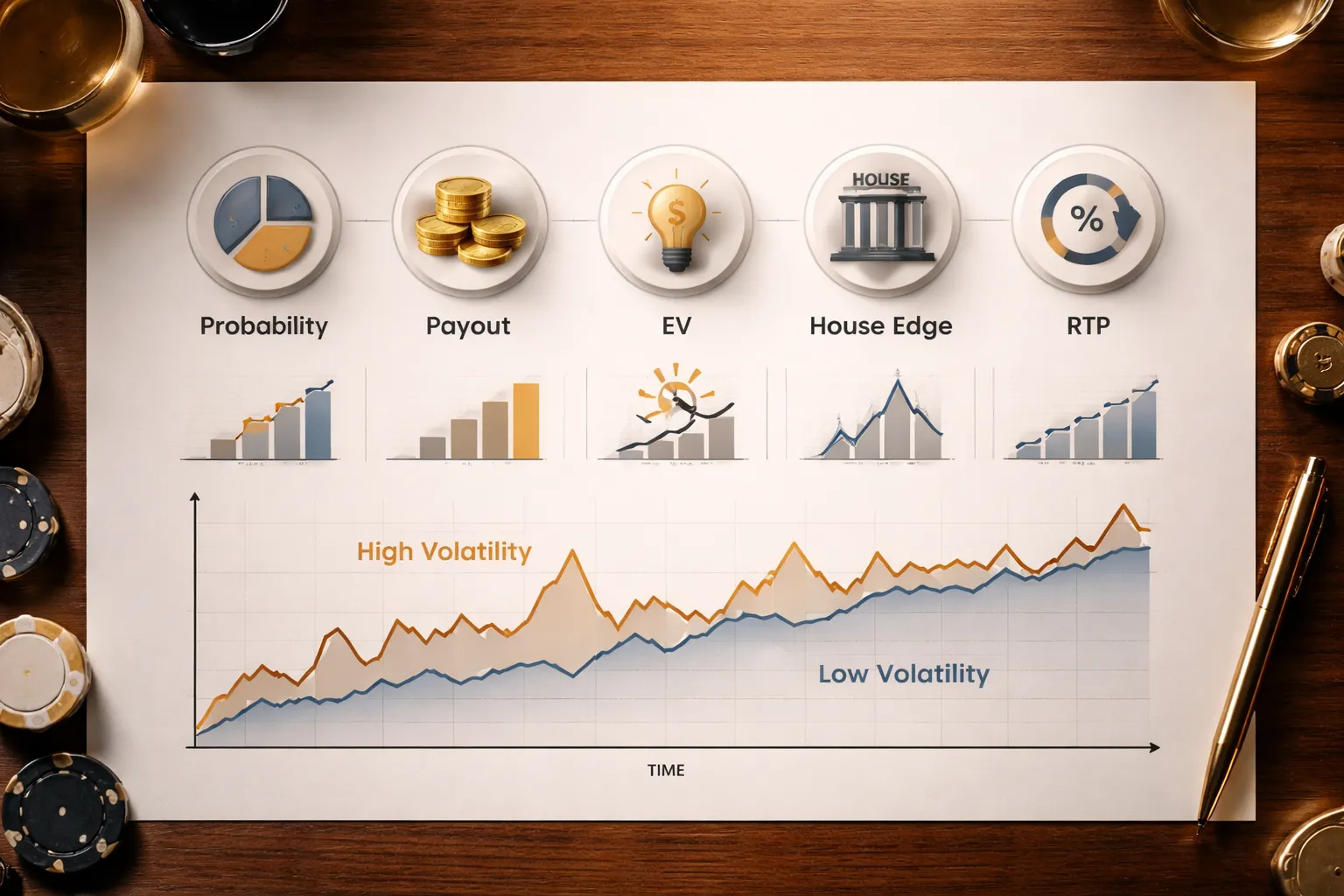
Probability vs Payout vs Expected Value (EV)
Probability is how often an outcome happens in the long run. Payout is what you get when it happens. Expected value (EV) combines both: EV = (chance of winning × win amount) − (chance of losing × loss amount). A game can “pay big” but still be a bad deal if the win is too rare.
House Edge (Simple Example)
Imagine a $1 bet that wins $2 (profit $1) 49% of the time and loses $1 51% of the time.
EV = (0.49 × $1) − (0.51 × $1) = −$0.02 per $1 bet. That 2-cent average loss is the house edge: 2%. It doesn’t predict your next spin. It predicts the long-run cost of playing.
RTP vs House Edge (And Why Both Are Marketed)
RTP (Return to Player) is the flip side of house edge.
- RTP = 100% − house edge
- House edge = 100% − RTP
So a 96% RTP slot has a 4% house edge. Casinos highlight RTP because it sounds like “what you get back.” House edge states the same math as “what you pay for entertainment.” For how fairness is monitored and tested, see Casino Security, Fairness & Regulation Explained.
Variance/Volatility: Why It Feels Like “Better/Worse Odds”
Variance is how swingy results are around the average. High-volatility games can have long losing stretches, then rare big hits. Low-volatility games pay smaller wins more often. Same house edge, different experience—so players often mistake volatility for “odds.”
Randomness Online vs In Person: RNGs, Shuffling, and What “Fair” Means

Randomness Online vs In Person: RNGs, Shuffling, and What “Fair” Means
Online casinos use certified Random Number Generators (RNGs) to produce unpredictable outcomes for slots, digital table games, and many video poker titles. In land-based casinos, randomness is physical: real shuffles, shoe penetration, dealer procedure, and human error. “Fair” doesn’t mean “you’ll win.” It means results aren’t manipulated, the game matches its published rules, and the long-run math (RTP/house edge) is consistent.
Where players get confused: speed and volume. Online play can generate far more outcomes per hour, so variance shows up faster—both hot streaks and brutal dry spells. In person, slower pace can make the same volatility feel “softer,” even if the edge is identical.
- Online fairness: RNG audits, game logs, and regulator testing.
- Land-based fairness: surveillance, chip/card controls, and procedural standards.
- Bottom line: “fair” is transparency + verified randomness, not better odds.
Read our detailed guide: Online vs In-Person Casino Odds: RNGs & Fair Play
Game Rules That Actually Change the Odds (Online vs Land-Based)

Game Rules That Actually Change the Odds (Online vs Land-Based)
Most “online vs casino” odds debates miss the real lever: the rule set. Some games run with tighter, more standardized rules online; some brick-and-mortar floors still offer legacy variants that can either help or hurt you. In blackjack, changes like dealer hits/stands on soft 17, surrender, double-after-split, and how many decks are used move the house edge more than the venue does. In roulette, single-zero vs double-zero is the entire story. In baccarat, side-bet pay tables (not the base game) decide how expensive the action gets. Slots vary by RTP and hit rate—sometimes the same title ships with different configurations depending on jurisdiction.
- Blackjack: S17 vs H17, surrender, DAS, decks, and cut-card depth.
- Roulette: European (1 zero) vs American (2 zeros).
- Baccarat: Side-bet pay tables, commission rules, and variants.
- Slots: RTP/volatility settings can differ by operator and region.
Want the “softer” feel without assuming better odds? Pair game selection with tools from Responsible Gambling Help: Limits, Tools & Support.
Read our detailed guide: Online vs Land-Based Casino Odds: Rules & House Edge
Read our detailed guide: Online vs Land-Based Casino Odds: Rules & House Edge
Payouts, Paytables, and Side Bets: Where Casinos Hide the Real Cost

Slots: RTP Ranges, Bonus Features, “Same Game” Problem
Online slots often publish RTP, but it’s not a single truth. Many titles ship with multiple RTP settings (for example, ~88% to ~96%+) and the operator chooses the version per region or license. Two casinos can host the “same” slot with different math.
Bonus features also move the cost around. Buy-bonus options, ante bets, or “extra chance” toggles can raise hit frequency while lowering payout efficiency. Volatility matters too: a higher RTP game can still feel worse short-term if the paytable concentrates value in rare jackpots.
Table Games: Side Bets and “Convenience” Bets
Land-based or online, the main bet can be fair-ish; the add-ons usually aren’t. Common margin traps:
- Blackjack side bets (Perfect Pairs, 21+3): higher house edge than basic strategy on the core hand.
- Roulette “neighbors,” special call bets, and covered sections: convenience packaging that often steers more chips into worse distributions.
- Baccarat Tie: big payout, bigger edge.
Bet Limits, Payout Caps, and the Hidden EV Shift
Online tables may cap winnings or limit max bets; land-based may restrict mid-shoe entry or spreading. If your approach relies on scaling (progressions, advantage swings, big-edge moments), caps can crush effective EV even when the posted rules look identical.
Comps Don’t Equal Better Odds
Free rooms, cashback, or “VIP” rewards are marketing, not math. Treat them like discounts, not proof of softer games—similar to how promos work on Vroegboekkorting.eu - Jouw Gids voor Kortingen or Waarom Vroegboekkorting Gebruiken? De Redenen. If you want a value comparison mindset, apply the same skepticism you’d use for Camgirls Günstig: Sparsame Angebote or risk rules like Swinging vs Open Relationships: Safety & Key Differences.
Live Dealer vs RNG Casino Games: Odds Similarities and Practical Differences

Odds Similarities, But Different Play Conditions
Live dealer and RNG versions usually keep the same core math: paytables, house edge, and rule sets are posted and auditable. What changes is the environment. Live tables often have fixed limits, table etiquette, dealer procedures, and occasional rule quirks (side bets, bet-behind, “no mid-shoe entry”) that don’t exist in solo RNG play.
Also expect real-world friction: more players, chat, dealer changeovers, and occasional stream hiccups. None of that “improves odds,” but it can change how you bet and how long you stay.
Speed, Players, Interruptions: What Live Dealer Changes
- More players slows rounds and reduces decisions per hour.
- Interruptions (disconnects, misdeals, camera checks) pause action.
- Rule presentation is less “click-clean” than RNG menus—read table rules before sitting.
Hands per Hour: Session Cost and Bankroll Risk
Expected loss per session is roughly: house edge × average bet × decisions per hour × time. Live games tend to run fewer hands/spins per hour than RNG. That can mean a lower expected loss per hour at the same stake—but also longer sessions, more temptation to chase, and more fatigue-driven mistakes.
Shuffling: CSM vs Shoe (and Advantage Play)
- CSM (continuous shuffling): kills most card-counting potential; steadier pace.
- Shoe with cut card: allows tracking/counting in theory, but live-online limits, mid-shoe rules, and table speed make edges hard to realize.
Think like discount math: promos are not “softer games.” If you want that mindset, see Bereken zelf je vroegboekkorting met deze handige calculator and Invloed van vroegboekkorting op de prijs van je vakantie.
Latency and UI: Not Odds, But Behavior
- Streaming delay can cause rushed bets near countdown end.
- UI friction (chip placement, confirmation) reduces misclicks for some, increases for others.
- Security mindset: treat account/device safety like personal risk rules—see Safety First: Sexual Health & Security in Swinging Beginners.
- Decision discipline: prep a plan like you’d prep for a test—How TestMCTest.com Can Help You Prep For Exams Faster.
How to Compare Odds in the Real World (A Quick Checklist)

Find the House Edge Fast (Where to Look)
- Land-based: read the rule card at the table, signage near the pit, and any printed paytables.
- Online: open the game info panel, help menu, and paytable screen before you place chips.
- Do the quick math: if the payout looks “off,” assume the house edge changed until proven otherwise.
Identify the Exact Variant (Small Labels, Big Impact)
- Roulette: European (single-zero) vs American (double-zero) vs triple-zero.
- Blackjack: check the main payout (3:2 vs 6:5), dealer rules (hits/stands soft 17), double/split limits.
- Video poker: verify the paytable name and top-line payouts (one “wrong” paytable can cut RTP hard).
Spot Red Flags Before You Bet
- Unclear paytables: missing payouts, vague “up to” language, or rules hidden behind multiple menus.
- Weird side bets: pricing/payouts that don’t match common versions; side bets often carry the worst edges.
- Extreme RTP ranges: slots that advertise a huge range (or no RTP at all) signal uncertainty in your expected return.
- Friction traps: rushed timers, last-second bet locks, or confusing chip confirmation can change outcomes.
Choose Transparent, Player-Favorable Rules
- Prefer games that show full rules and paytables upfront.
- Default to player-friendly standards: single-zero roulette, 3:2 blackjack, strong video poker paytables.
- Verify the operator’s oversight and fairness basics: Casino Regulation and Licensing: Rules, Security, Fairness.
- If gambling stops being “fun math,” pause and check: Gambling Addiction Signs: Warning Signs and Help Options.
Key Takeaways: What Actually Changes Between Online and Land-Based Odds
Key Takeaways: What Actually Changes Between Online and Land-Based Odds
- In het kort: The “where” matters less than the rules and payouts you’re offered.
- In het kort: Online and land-based games can be equally fair—just via different randomness (RNG vs physical).
- In het kort: Variants and side bets are the biggest hidden edge multipliers.
- In het kort: Speed of play changes how much you’re expected to lose per hour, even with the same house edge.
Odds don’t magically improve because a game is on a screen or on a felt. What moves the needle is the fine print: blackjack paying 3:2 vs 6:5, roulette single-zero vs double-zero, video poker paytables, baccarat commission rules, and slot RTP settings. Format is secondary; the math is in the rules.
Fairness is also not “online vs real.” Land-based casinos rely on physical processes (shuffle, spin, dice). Online casinos rely on RNGs and audits. Different mechanism, same goal: unpredictable outcomes. Your job is to choose operators and games that show rules and paytables clearly.
The real edge creep comes from choice architecture: endless variants, tempting side bets, and “fast modes.” A side bet can turn a low-edge table game into a high-edge grinder in one click.
Finally, consider tempo. Online sessions often run faster (auto-spin, instant dealing). If house edge stays constant but you play more hands/spins per hour, expected loss rises with volume.
If you want a quick mindset reset: treat gambling like “fun math.” If it stops being fun, pause. If you’re drifting into other online rabbit holes, compare with how other digital temptations are designed to keep you engaged—see Camgirls Stream: Digital und Direkt.
FAQ
Are online casinos “rigged” more than land-based casinos?
Not by default. Licensed sites use audited RNGs; physical casinos use regulated hardware and procedures. The real difference is pace and access: online play is faster and always available, so losses can stack quicker. For system myths, see Casino Systems Myth: Can You Really Gain an Edge?.
Do live dealer games have better odds than RNG games?
Sometimes. Live tables can offer better rule sets (especially blackjack), but side bets usually have high house edges. RNG versions can be excellent too—check the posted rules/paytables. Odds come from rules, not the camera.
Why do online slots list RTP but most land-based slots don’t?
Online regulation and competition push RTP disclosure, and the software can publish exact theoretical returns. Land-based rules vary by jurisdiction, and casinos often market “denomination” and “jackpots” instead. RTP is long-run math, not a short-term promise.
Is European roulette always better than American roulette?
Yes, when it’s single-zero (2.70% edge) versus double-zero American (5.26% edge) on standard bets. Even better is French roulette with “La Partage/En Prison” on even-money bets. Verify the wheel and rules before you play.
What blackjack rules should I look for to get the best odds?
Look for: dealer stands on soft 17 (S17), 3:2 blackjack (not 6:5), double after split (DAS), resplit allowed (including aces if possible), late surrender, fewer decks, and decent penetration. Always use basic strategy.
Do loyalty rewards/comps change the true expected value?
Slightly. Cashback, points, and comps can reduce net loss, but rarely flip games positive for most players. Treat rewards as a rebate on expected loss, not profit. If you’re optimizing spend elsewhere, compare planning timing like Wanneer Begint Vroegboekkorting voor Uw Reis?.
Conclusion: The One Thing to Check Before You Bet
Conclusion: The One Thing to Check Before You Bet
Online or land-based, the math doesn’t care where you sit. What changes is how often you’ll find the best version of a game—and how clearly the rules are shown. Your long-run results come down to one driver: rules and paytables determine the house edge.
Recap:
- Blackjack: 3:2 beats 6:5. Penetration matters. Side bets usually torch EV.
- Slots: RTP varies by title and jurisdiction. Same theme can pay differently.
- Roulette: Single-zero beats double-zero. Triple-zero is worse.
- Poker: Rake and fees matter more than “online vs casino.”
Action step: before you bet a cent, compare the exact variant (rules + paytable + fees). Then skip high-edge side bets unless you’re paying purely for entertainment.
If you’re chasing “extras,” treat them like travel perks: nice, but they don’t change the base price. For that mindset, see Ontvang extra's bij je vroegboekkorting and Groene vakanties met vroegboekkorting: Tips voor duurzame reizen.
Want deeper dives? Start with risk control and support: Gambling Addiction Help: Free Support, Signs & Treatment. If you’re browsing for adult entertainment instead of betting, this is a different lane: Camgirls Ohne Anmeldung: Anonymes Vergnügen.
Final tip: if you can’t find the rules or paytable in under 30 seconds, don’t play. Pick a game that shows its edge.
-
Online vs Land-Based Casino Odds: Rules & House Edge
1 month ago -
Casino Betting Systems: Myths, Hot Streaks & “Due” Numbers
1 month ago -
Online vs In-Person Casino Odds: RNGs & Fair Play
1 month ago -
Casino Security, Fairness & Regulation Explained
1 month ago -
Signs of Gambling Addiction: Warning Signs & Help Options
1 month ago
-
- Are online casinos “rigged” more than land-based casinos?
- Do live dealer games have better odds than RNG games?
- Why do online slots list RTP but most land-based slots don’t?
- Is European roulette always better than American roulette?
- What blackjack rules should I look for to get the best odds?
- Do loyalty rewards/comps change the true expected value?
-
- Are online casinos “rigged” more than land-based casinos?
- Do live dealer games have better odds than RNG games?
- Why do online slots list RTP but most land-based slots don’t?
- Is European roulette always better than American roulette?
- What blackjack rules should I look for to get the best odds?
- Do loyalty rewards/comps change the true expected value?
-
Signs of Gambling Addiction: Warning Signs & Help Options
1 month ago -
Casino Betting Systems: Myths, Hot Streaks & “Due” Numbers
1 month ago -
Casino Systems Myth: Can You Really Gain an Edge?
1 month ago -
Online vs In-Person Casino Odds: RNGs & Fair Play
1 month ago -
Online vs Land-Based Casino Odds: Rules & House Edge
1 month ago
-
Online vs Land-Based Casino Odds: Rules & House Edge
1 month ago -
Casino Betting Systems: Myths, Hot Streaks & “Due” Numbers
1 month ago -
Online vs In-Person Casino Odds: RNGs & Fair Play
1 month ago -
RTP Explained: How to Use Return to Player to Choose Slots
1 month ago -
Casino Security, Fairness & Regulation Explained
1 month ago