Per-Bet Rules for Casino Table Games: Step 3 Budgeting

Introduction: Why Per-Bet Rules Matter for Table Games
Most casino budgets fail for one reason: the bet size drifts. A few “just this once” raises at blackjack, roulette, or baccarat can torch a session faster than bad luck ever could. That’s why this section sits inside Step 3: Set Per-Bet Rules for a Gambling Budget: it turns a total bankroll into actionable limits per hand, per spin, per decision.
Table games behave differently than sports betting and slots. The pace is faster than sports, so losses (and wins) stack quickly. Minimums and table limits force your hand more than a slot’s flexible denominations. And variance can be sharp: short streaks can swing your balance hard even when the house edge is small. Per-bet rules keep those swings inside your plan.
This article covers practical guardrails: picking a base unit, handling minimums, setting raise rules, and deciding when to stop. It won’t sell “winning systems,” martingales, or magic progressions. If you’re unsure whether you’re still budgeting or sliding into chasing, read Gambling Addiction Warning Signs and How to Help. For fairness basics that affect expectations, see Online vs In-Person Casino Odds: RNGs & Fair Play.
Need a reminder that budgets travel with you? Deals like Vroegboekkorting Auto Huren: Goedkoop Rijden op Uw Bestemming and De beste campings met vroegboekkorting cut trip costs so gambling stays a line item, not the plan.
What Are Per-Bet Rules for Casino Table Games (Step 3)?
What Are Per-Bet Rules for Casino Table Games (Step 3)?
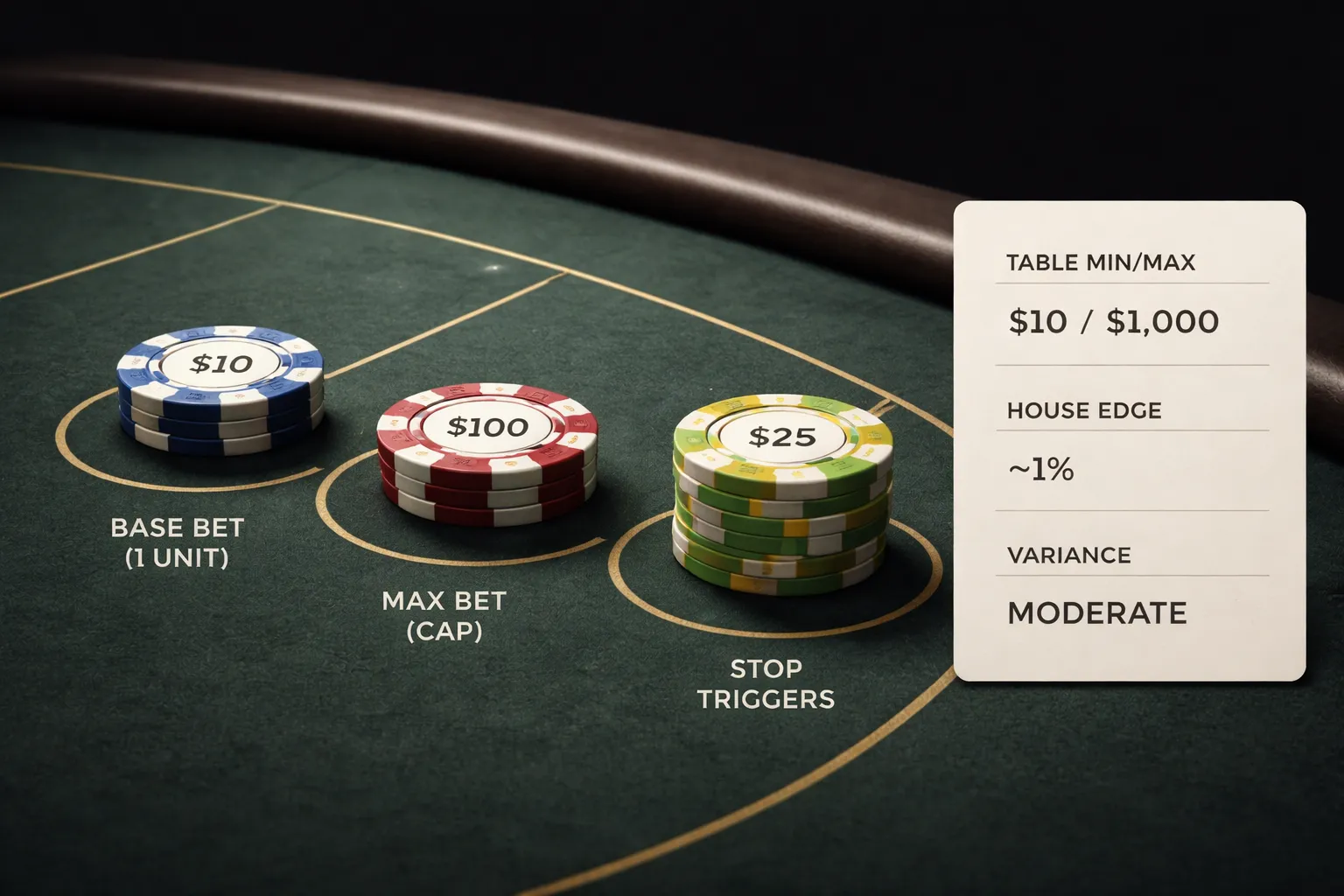
Per-bet rules are your pre-set cap and structure for each wager—locked in before you play and kept the same regardless of wins or losses. The goal is simple: every bet fits your plan, not your mood.
Core components
- Base bet (unit): your default wager size (example: 1 unit = $10). Most bets should stay here.
- Max bet: your hard ceiling per hand/round. No exceptions, even after a streak.
- Stop triggers: rules that end or pause betting (loss limit, win goal, tilt warning, time check).
- Session bankroll allocation: the portion of your total budget you bring to the table that session, divided into units.
How per-bet rules work with bankroll and time limits
Bankroll size answers “How much can I afford overall?” Session time limits answer “How long am I exposed to risk?” Per-bet rules answer “How much can any single outcome move me?” Used together, they prevent oversized bets from wrecking an otherwise sensible budget.
Key terms you’ll see at the table
- Table minimum/maximum: the casino’s allowed bet range; your unit must fit inside it.
- Units: a repeatable bet size that keeps decisions consistent.
- House edge: the built-in cost of play over time; it doesn’t disappear because you’re “due.”
- Volatility/variance: how violently results swing; higher variance demands smaller units and stricter max bets.
Keep travel savings separate so gambling stays a line item. Try Tips om een auto te huren met vroegboekkorting, Effectieve strategieën om vroegboekkorting te benutten, Welke Hotels Bieden Vroegboekkorting aan?, and Ontvang extra's bij je vroegboekkorting.
Set Your Baseline: Choose Units, Caps, and a Session Plan You Can Follow
Pick a Betting Unit You Won’t Break
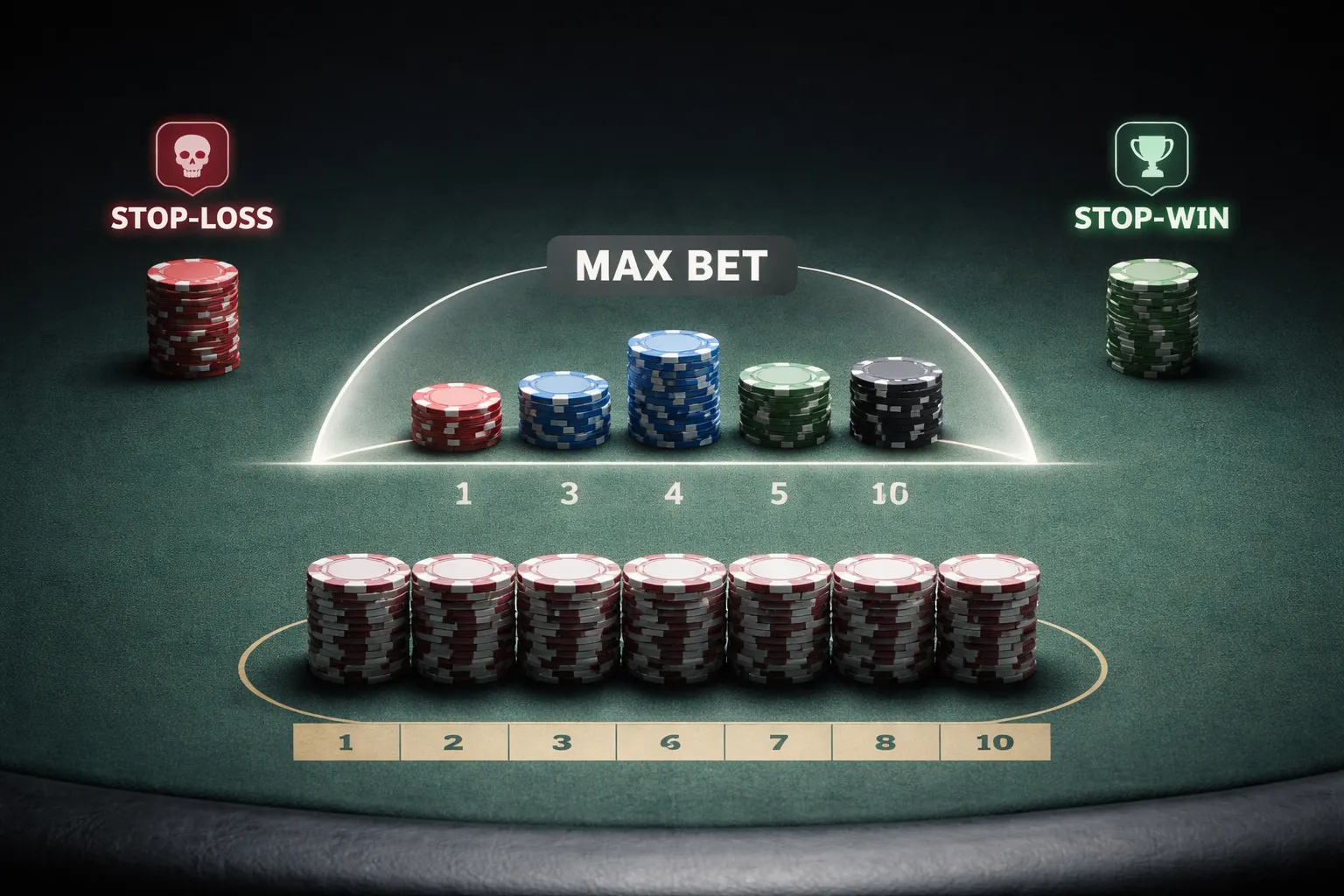
Start with your session bankroll, not your total savings. Set 1 unit = 1–2% of that session roll. Higher variance games (many side bets, long-shot payouts) demand smaller units. If you can’t handle a 10–20 unit downswing without tilting, your unit is too big.
Set a Hard Max Bet (and When It Applies)
Cap your total wager per round at 2–5 units. That includes the base bet plus side bets. Use the cap every hand/spin—no exceptions for “hot streaks,” no chasing, no “just this once.” If the table minimum forces you above your unit plan, you’re at the wrong table.
Build a Session Bankroll From Your Real Budget
Work top-down: monthly/weekly gambling budget → sessions. Example: $400/month, 8 sessions = $50 per session. Keep travel savings separate so gambling stays a clean line item—same logic as planning early-booking travel extras on a fixed spend (see Waarom Vroegboekkorting Gebruiken? De Redenen and Luxe hotels met vroegboekkorting: Luxe voor minder).
Match Table Minimums to Session Length
Estimate volume: blackjack ~60–100 hands/hour, roulette ~35–50 spins/hour. Decide your time. Then ensure your unit and cap survive the pace. Faster games punish oversized units.
One-Sentence Rules You Can Remember
- My unit is 1–2% of my session bankroll; my max bet is 3 units including side bets; I quit at -20 units or +15 units, and I never raise limits mid-session.
Stick to the rule set like a boundary agreement—clear, simple, non-negotiable (see Swingers Lifestyle Guide: Consent, Privacy & Safety).
Per-Bet Rules by Game: Blackjack, Roulette, Baccarat, and Poker Rooms
Blackjack
Base bet: 1 unit per hand. If the table is fast or you’re tilted, drop to 0.5–1 unit, not up.
Doubles/splits: Treat every double or split as pre-approved exposure. Rule: never risk more than 3 units total on one round. That means: 1 unit base + one double (2 units total), or a single split where each hand stays small. If you can’t afford the full double/split within the cap, don’t take it.
Side bets: Cap at 0.25 unit (or skip). Side bets count toward your 3-unit max.
No progressions: No Martingale, no “press after wins,” no “get even” raises. Same unit until you quit.
Roulette
Inside vs. outside: Inside bets spike variance; outside bets smooth it. If you play inside, cut unit size.
Flat betting: 1 unit per spin, always.
Max exposure per spin: 3 units total across all chips. Avoid stacking dozens of small bets that quietly exceed your cap.
Baccarat
Banker/Player: Flat bet 1 unit. Many players stick to Banker for slightly lower house edge, but your budget rule stays the same.
Tie: Treat as a side bet: 0–0.25 unit max, or “never.”
Commission planning: Banker wins pay less; your “units won” will lag. Don’t “fix” it by raising stakes.
Poker Rooms (Cash + Tournaments)
- Cash: Buy in for 20–40 units. One re-buy max per session.
- Tournaments: One bullet unless budgeted; add-ons count as a second bullet.
- Segregation: Keep poker bankroll separate from pit-game money, like keeping trip money separate with vroegboekkorting planning.
Quick Reference: Unit Examples
Keep rules non-negotiable—like boundaries in private spaces (see Camgirls Private Show: Intime Momente).
Risk Controls That Keep You from Chasing: Stop-Loss, Win Caps, and “No Escalation” Rules
Stop-Loss Rules (Session Loss Limit)
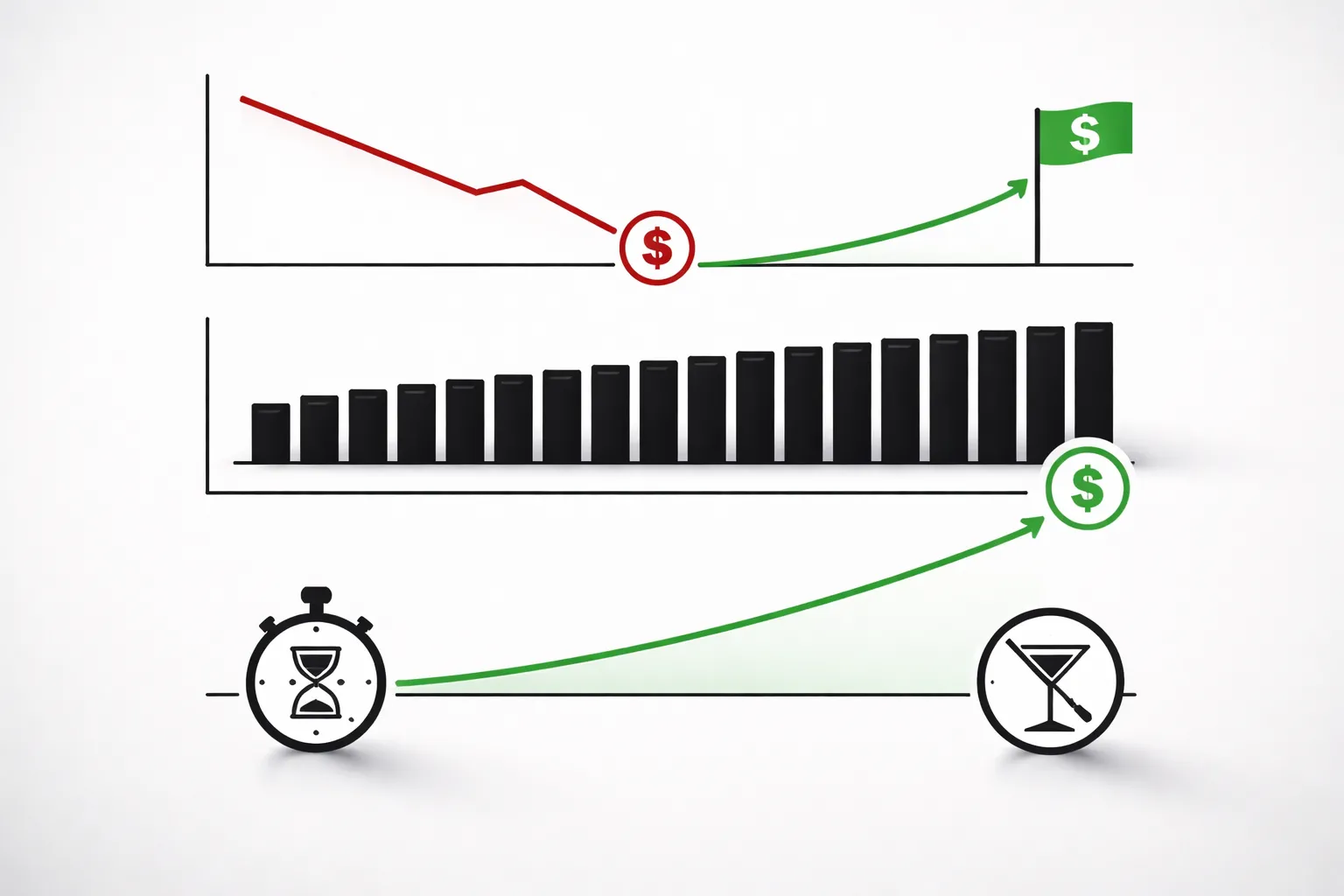
Set a hard loss limit before the first bet. Make it small enough to survive, large enough to avoid constant “one more hand” bargaining. A practical range is 20–40 units per session. If your unit is $10, your stop-loss is $200–$400. Hit it, stop. No “earning it back.”
- Realistic test: If losing that amount changes tomorrow’s bills, it’s too high.
- Execution: Keep only the session bankroll on you. Leave cards/ATM access out of reach.
Win Caps (Lock Profits on Purpose)
Win caps prevent the classic leak: giving back a good run. Use a simple target like +15–30 units. If you hit the cap early, you can either cash out or “downshift” to half-units and protect the win. This builds discipline the same way clear boundaries do in relationships (see Rules, Boundaries & Consent).
- Lock profits when you’re up fast, tired, drinking, or getting sloppy.
- Keep playing only if you’re calm, within rules, and still making clean decisions.
No Escalation (No Chasing, No “Tilt Bets”)
Ban martingale and anti-martingale. Your max bet is pre-set; it does not change because you’re down, up, angry, or “due.” If emotion is steering, you’re not playing—you’re reacting.
Trigger Rules (Big Loss, Big Win, Long Downswing)
- After a big loss: stand up, 10-minute break, then either reset to min bet or end session.
- After a big win: cash out the profit slice, then continue only with original stake.
- After a long downswing: cut bet size and cap remaining hands/spins.
Pace Controls (Breaks, Cash-Out Intervals, Alcohol Limits)
- Timer: break every 30–45 minutes.
- Cash-out checkpoints: review bankroll every 20–30 bets.
- Alcohol rule: no max bets after drinking; ideally, no drinking until you’re done.
Vetting matches and meeting safely work because rules are non-negotiable. Same mindset here. If you want to preserve “best moments” instead of rewriting them, see Camgirls Aufnahmen.
Common Mistakes (and Fixes) When Setting Per-Bet Rules for Table Games
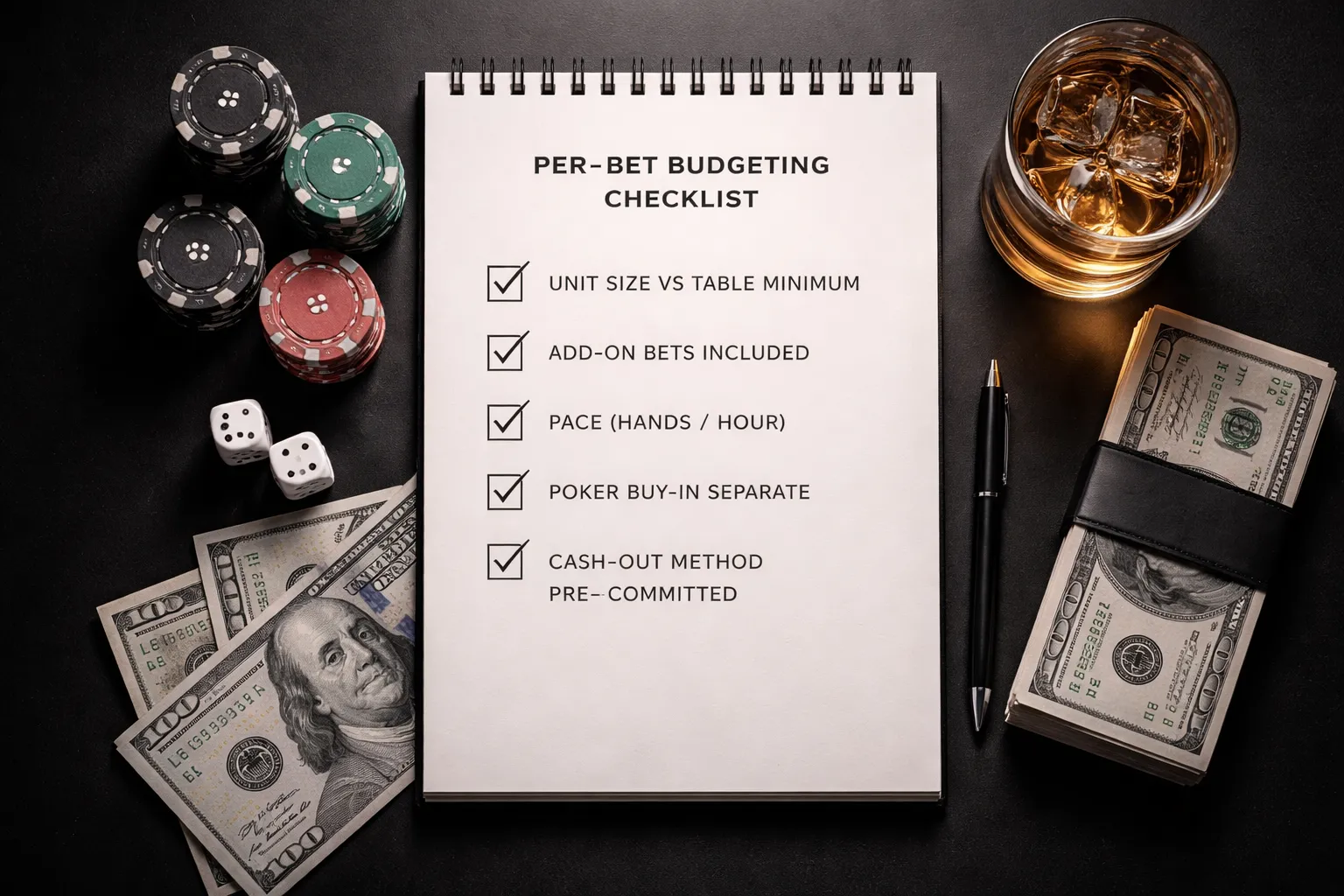
Setting a Unit That’s Too Large for the Table Minimums
If your “unit” is bigger than the minimum bet, you lose flexibility. You’re forced into high variance from the first hand.
- Fix: Pick a table where the minimum equals your unit (or less). If you can’t, reduce your session bankroll or choose a different game/venue with lower limits.
- Rule: Your base bet must be placeable on every hand without “rounding up.”
Forgetting Add-On Bets in Per-Hand Exposure
Insurance, side bets, and tipping can quietly double your true risk per hand.
- Fix: Define max per-hand exposure as: main bet + doubles/splits + insurance + side bets + planned tips.
- Rule: If an add-on happens, it must fit inside the same cap. Otherwise, it’s banned.
Overestimating How Long Your Bankroll Will Last (Game Pace)
“I have 200 units” means nothing if you play 80 hands/hour instead of 40. Faster games burn bankroll faster.
- Fix: Budget by bets per hour and set hard checkpoints every 20–30 bets.
- Rule: If pace increases, reduce bet size or shorten the session.
Treating Poker Buy-Ins Like Per-Hand Bets
Poker isn’t per-hand wagering. Your risk is the buy-in, plus rebuys, over hours.
- Fix: Separate bankroll logic: poker = buy-in caps and time caps; table games = per-hand caps.
- Rule: Predetermine max buy-ins (e.g., 1 bullet only) before sitting.
Not Pre-Committing to Cash-Out Methods
If you don’t decide how to stop, you won’t stop.
- Fix: Separate chips and cash. Lock profit away. Avoid the ATM entirely.
- Rule: One cash-in per session. No reloads. If you need more, you’re done.
For stop-controls that are truly non-negotiable, pair budgeting with self-exclusion rules. If your gambling income crosses into reporting reality, keep the admin clean with Belastingen voor webcam modellen.
Templates: Copy-and-Use Per-Bet Rule Sets for Casino Table Games
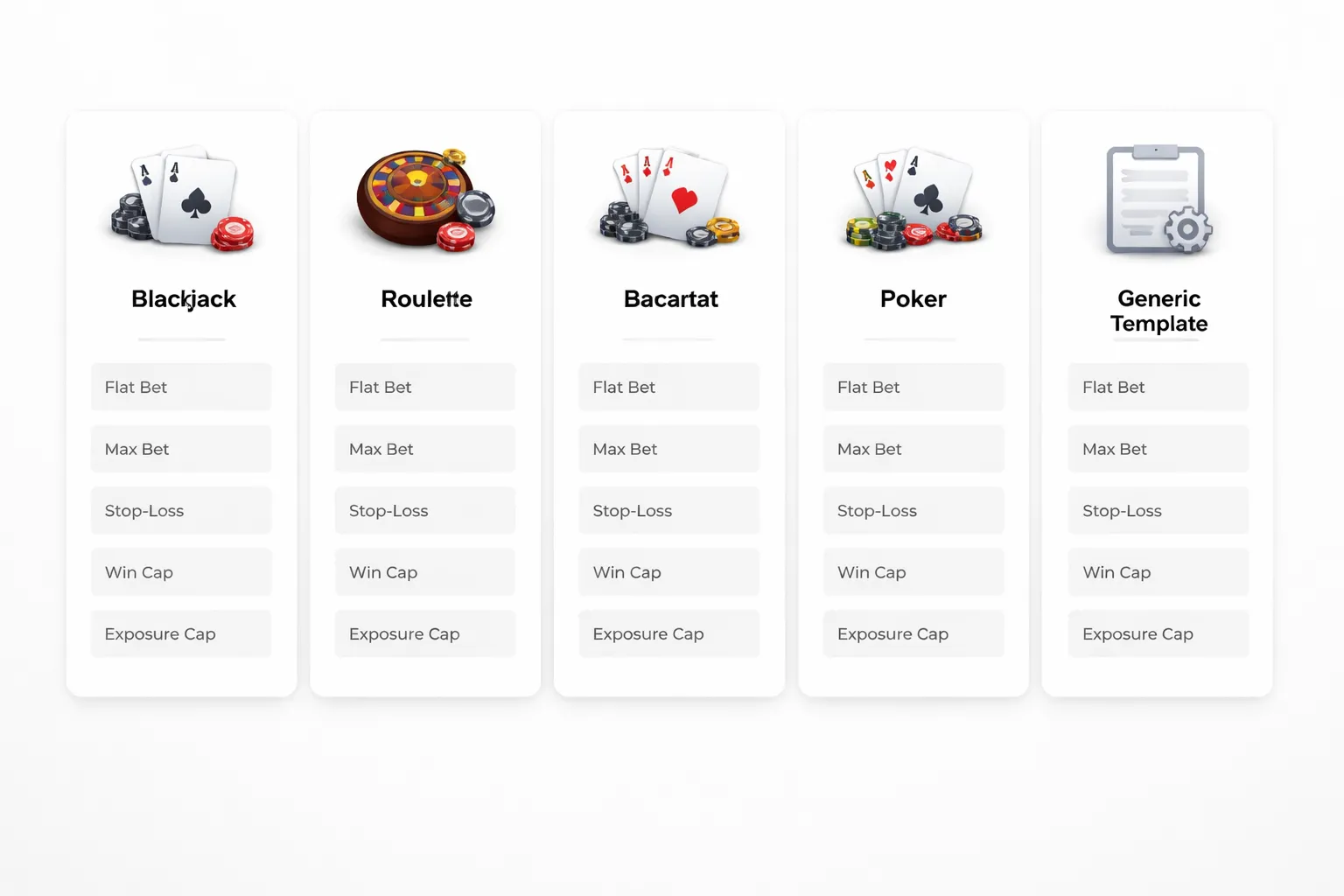
Simple Template: Flat Bet + Max Bet + Stop-Loss + Win Cap
- Flat bet: ___ units per hand/spin.
- Max bet: Never exceed ___ units (including presses).
- Stop-loss: Quit the session at -___ units or $___. No exceptions.
- Win cap: Quit the session at +___ units or $___. Lock profit away.
- Cash-in rule: One buy-in per session. No reloads.
Blackjack Template: Base Bet + Split/Double Cap + Side-Bet Ban/Limit
- Base bet: ___ units per hand.
- Max hand exposure: At any point, total on table ≤ ___ units.
- Splits: Max ___ split hands. No resplitting aces (or: max ___ times).
- Doubles: Max ___ doubles per round; double only up to ___ units.
- Side bets: Banned, or capped at ___ units/hand.
Roulette Template: Max Total Exposure per Spin + Outside-Bet-Only Option
- Per-spin exposure cap: Total chips on layout ≤ ___ units.
- Outside-only mode (optional): Even money + dozens/columns only. No straight-up/splits.
- Progressions: None. Flat stake only.
Baccarat Template: Banker-Only Flat Bet + No Tie Bets + Session Limits
- Bet type: Banker only.
- Stake: ___ units per hand, flat.
- Tie bets: Never.
- Session limits: Max ___ hands or ___ minutes, plus stop-loss/win cap from template.
Poker Room Template: Buy-In Cap, Re-Entry Rules, Quit Time, Profit Lock
- Buy-in cap: Max $__ or ___ big blinds per session.
- Re-entry: ___ re-buys max; only when stack < ___ BB. Otherwise, quit.
- Quit time: Hard stop at ___ minutes or by ___:__.
- Profit lock: After +___ BB, rack ___% and do not put it back in play.
Keep your “rules card” with other non-negotiables; if you drift into VIP-style upsells, read Camgirls VIP: Erstklassiger Service as a reminder to treat premium hooks like premium risk.
Key Takeaways: Step 3 Per-Bet Rules You Can Stick To
Key Takeaways: Step 3 Per-Bet Rules You Can Stick To
Write rules that survive tilt. Tie every decision to your session bankroll, not your mood, your last hand, or a “heater.” Keep them simple enough to follow under pressure.
- Units: Define 1 unit as 1%–2% of your session bankroll. Every bet is a multiple of units.
- Max bet: Cap any single bet at 2–3 units. No exceptions for “good spots.”
- Max exposure per round: Also cap total money at risk per hand/spin (including side bets, doubles, splits, and raises) at 5–6 units.
- Ban chasing systems: No Martingale, no “I’m due,” no progressive doubling. If you feel the urge, you’re done for the day.
- Stop-loss + win cap: Stop-loss at -20 to -30 units. Win cap at +15 to +25 units. Hit either: cash out.
- Game-specific pacing: Fast games (roulette, blackjack) need tighter exposure caps; slow games (baccarat, craps) can use slightly wider time limits instead.
- Poker structure: Treat buy-ins like ammunition: 1 buy-in = 100 BB. Re-entry rules beat “one more shot.”
Use this fill-in card and keep it with your non-negotiables:
Re-entry: ___ re-buys max; only when stack < ___ BB. Otherwise, quit.
Quit time: Hard stop at ___ minutes or by ___:__.
Profit lock: After +___ BB, rack ___% and do not put it back in play.
If you drift into VIP-style upsells, reread Camgirls Neuheiten: Entdecke die Trends as a reminder: premium hooks are premium risk.
- In het kort: Bet in fixed units tied to your session bankroll.
- In het kort: Set a max bet and a max total exposure per hand/spin.
- In het kort: Ban chasing systems; use stop-loss and win caps instead.
- In het kort: Tailor rules to each game’s pace and variance (and poker’s buy-in structure).
FAQ
What’s a good per-bet size for blackjack or roulette if I’m on a budget?
Use fixed units: 1–2% of your session bankroll per bet. If you can’t cover normal variance, drop to the table minimum or switch games. Roulette needs smaller units than blackjack because swings are harsher.
Should I increase my bet after I’m up (or down)?
No. Keep unit size fixed to bankroll, not emotion. When you’re up, lock it in with a win cap; when you’re down, stop with a stop-loss. Chasing systems turn “premium hooks” into premium risk.
How do I handle splits, doubles, and side bets within my max bet rule?
Set a max total exposure per hand/spin. Example: if your max exposure is 4 units, a split (2 units) plus a double (2 units) hits the cap. Side bets must be inside that same cap.
Is a stop-loss or a win cap more important for discipline?
Stop-loss. It prevents the worst decisions: chasing, tilt, and “one more hand.” Add a win cap to protect profit, but never let it justify raising bet size. Discipline is rules, not vibes.
How are per-bet rules different for poker cash games vs. tournaments?
Cash: buy in deep enough to handle variance; treat “per-bet” as max table stake and reload limits. Tournaments: your buy-in is the unit; manage risk by limiting entries and total buy-ins per day.
Do table minimums change how I should set my budget?
Yes. If the minimum forces you above 2% per bet, you’re under-rolled for that table. Lower the stakes, shorten the session, or leave. For planning money rules, see Vroegboekkorting.eu - Jouw Gids voor Kortingen.
Conclusion: Turn Per-Bet Rules into a Habit (Not a Hope)
Conclusion: Turn Per-Bet Rules into a Habit (Not a Hope)
Step 3 is simple: keep your betting consistent and protect yourself from impulse decisions. Your per-bet rule is the guardrail. It keeps a cold streak from turning into “just one more” and a hot streak from turning into overconfidence.
One next step: write your rules down before you play, then bring only the session bankroll that fits those rules. No extra cash. No extra transfers. If the money isn’t on you, you can’t break your plan in a moment of emotion.
- Set the unit: 1–2% of session bankroll per bet (or less).
- Set the stop points: stop-loss, win-cap, and a hard reload limit.
- Match the table: if the minimum forces you above your % cap, change tables or end the session.
These per-bet rules work best when they connect to the rest of your system: time limits (to prevent fatigue betting) and tracking (to see whether you’re actually staying inside your plan). If you want a planning mindset that treats rules as non-negotiable agreements, borrow the same “boundaries-first” logic from Swinging Etiquette 101: Rules, Boundaries & Agreements.
For planning money rules, see Reispakketten met vroegboekkorting: Het meest uit je boeking halen.
Final tip: pre-commit to leaving when your rule triggers—then treat walking away as the win.
-
Online vs Land-Based Casino Odds: Rules & House Edge
1 month ago -
Casino Betting Systems: Myths, Hot Streaks & “Due” Numbers
1 month ago -
Online vs In-Person Casino Odds: RNGs & Fair Play
1 month ago -
Casino Security, Fairness & Regulation Explained
1 month ago -
Signs of Gambling Addiction: Warning Signs & Help Options
1 month ago
-
- Simple Template: Flat Bet + Max Bet + Stop-Loss + Win Cap
- Blackjack Template: Base Bet + Split/Double Cap + Side-Bet Ban/Limit
- Roulette Template: Max Total Exposure per Spin + Outside-Bet-Only Option
- Baccarat Template: Banker-Only Flat Bet + No Tie Bets + Session Limits
- Poker Room Template: Buy-In Cap, Re-Entry Rules, Quit Time, Profit Lock
-
- What’s a good per-bet size for blackjack or roulette if I’m on a budget?
- Should I increase my bet after I’m up (or down)?
- How do I handle splits, doubles, and side bets within my max bet rule?
- Is a stop-loss or a win cap more important for discipline?
- How are per-bet rules different for poker cash games vs. tournaments?
- Do table minimums change how I should set my budget?
-
- Simple Template: Flat Bet + Max Bet + Stop-Loss + Win Cap
- Blackjack Template: Base Bet + Split/Double Cap + Side-Bet Ban/Limit
- Roulette Template: Max Total Exposure per Spin + Outside-Bet-Only Option
- Baccarat Template: Banker-Only Flat Bet + No Tie Bets + Session Limits
- Poker Room Template: Buy-In Cap, Re-Entry Rules, Quit Time, Profit Lock
-
- What’s a good per-bet size for blackjack or roulette if I’m on a budget?
- Should I increase my bet after I’m up (or down)?
- How do I handle splits, doubles, and side bets within my max bet rule?
- Is a stop-loss or a win cap more important for discipline?
- How are per-bet rules different for poker cash games vs. tournaments?
- Do table minimums change how I should set my budget?
-
Signs of Gambling Addiction: Warning Signs & Help Options
1 month ago -
Casino Betting Systems: Myths, Hot Streaks & “Due” Numbers
1 month ago -
Casino Systems Myth: Can You Really Gain an Edge?
1 month ago -
Online vs In-Person Casino Odds: RNGs & Fair Play
1 month ago -
Online vs Land-Based Casino Odds: Rules & House Edge
1 month ago
-
Online vs Land-Based Casino Odds: Rules & House Edge
1 month ago -
Casino Betting Systems: Myths, Hot Streaks & “Due” Numbers
1 month ago -
Online vs In-Person Casino Odds: RNGs & Fair Play
1 month ago -
RTP Explained: How to Use Return to Player to Choose Slots
1 month ago -
Casino Security, Fairness & Regulation Explained
1 month ago