Security, Fairness, and Regulation: How Casinos Keep Games Legit - What Is a Casino and How Does It Work? A Beginner’s Guide

Casinos handle cash, cards, and personal data. That attracts cheaters and fraud. If security fails, you lose money. If fairness fails, you lose trust. This section explains how casinos keep games legit, and what you should check before you play. It is part of our larger guide, What Is a Casino and How Does It Work? A Beginner’s Guide.
You will learn the basics of casino surveillance and access control, game integrity checks, and how staff spot collusion and advantage play. You will also learn how regulators audit games, verify payouts, and enforce rules. You will leave with a simple checklist for choosing safer, fairer casinos, online or on-site. For a deeper look at game math and testing, read Fairness in Casino Games: RNGs, Odds, House Edge, and Return-to-Player (RTP).
What Is a Casino and How Does It Work? The Basics for Beginners
What a Casino Is
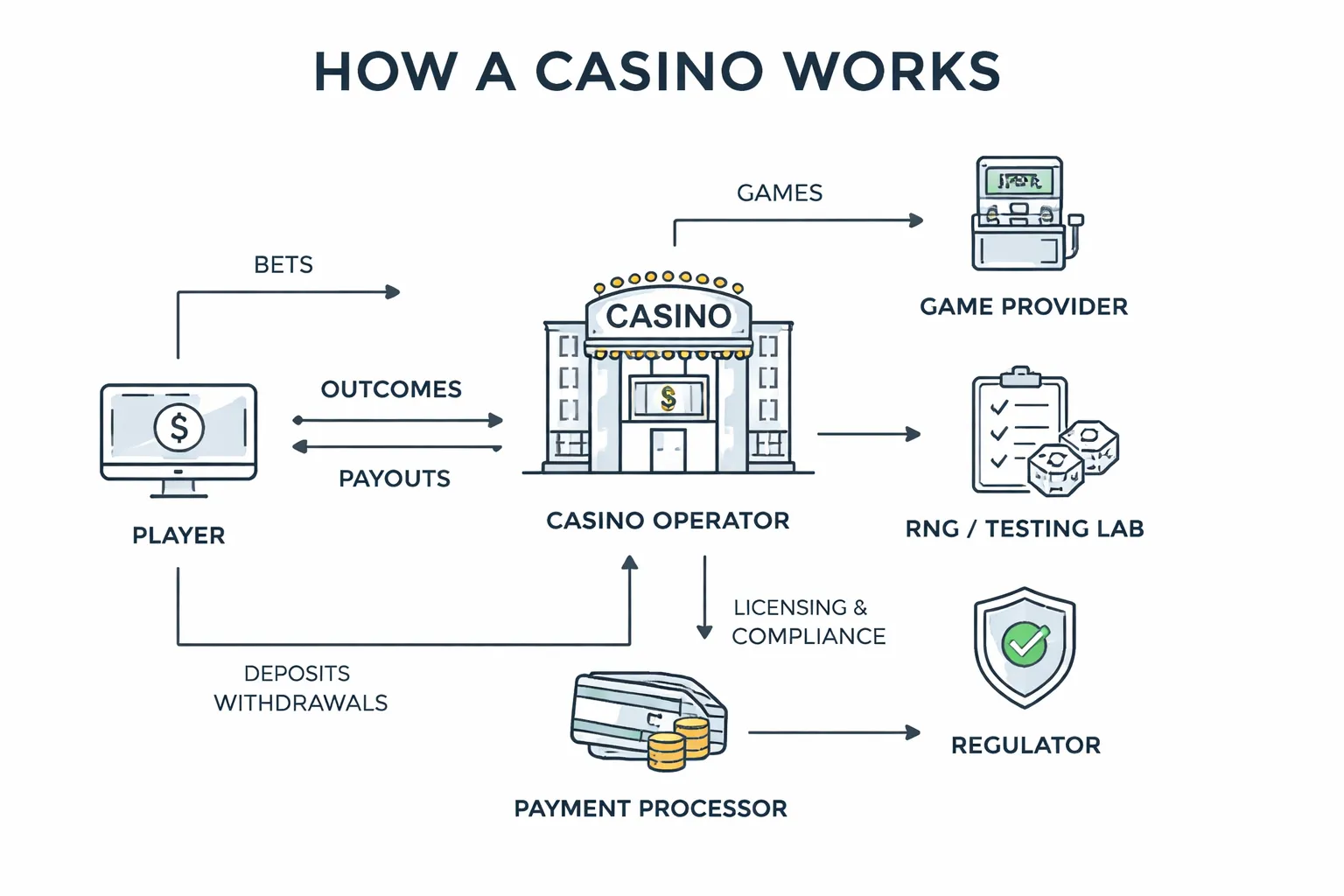
A casino is a business that offers wagering on games with set rules, controlled payouts, and monitored play. You place a bet. The game produces an outcome. The casino pays winners under its rules and keeps losing bets.
Land-based casinos run games on a physical floor. You use cash, chips, or a player card. Staff supervise tables and machines. Surveillance records activity.
Online casinos run games through software. You use an account and digital payments. The platform records every bet, result, and payout. The casino relies on licensing, game testing, and security controls to keep play fair and secure.
How Casinos Make Money
Casinos price games with a mathematical advantage called the house edge. Over many bets, that edge becomes predictable revenue. Short-term results swing. Long-term results trend toward the math.
- House edge sets the expected cost of play. Example, a 5% house edge means you expect to lose about $5 per $100 wagered over time.
- Volume drives profit. More bets per hour and more players increase total expected revenue.
- Hold is what the casino keeps after paying winners. It varies by game and by player behavior.
- Comps and loyalty return a small part of your expected loss as rewards. Casinos use them to increase play frequency and session length.
| Term | What it means | Why it matters to you |
|---|---|---|
| House edge | Casino advantage built into the rules | Lower edge usually means lower long-run cost |
| RTP | Average return to players over time, usually for slots | Higher RTP usually means less loss over many spins |
| Volatility | How payouts cluster, small frequent wins vs rare big wins | Affects bankroll swings, not the long-run edge |
| Comps | Rewards tied to theoretical loss and play level | Value varies, do not treat them as profit |
Common Game Types and What “Legit” Means
Different games need different fairness checks. “Legit” means the rules match what you see, outcomes come from approved systems, and payouts follow published tables.
- Slots. Legit slots use certified RNG outcomes and fixed paytables. The displayed RTP and game rules match the approved version. The operator cannot change results spin by spin.
- Table games. Legit blackjack, roulette, and baccarat use standard procedures, posted table limits, and clear rules for payouts and side bets. Land-based games rely on trained dealers and surveillance. Online versions rely on audited game code or live dealer controls.
- Poker. Poker differs because you play against other players. Legit poker needs fair shuffling or RNG, anti-collusion systems, and clear rake fees. The casino earns from rake and tournament fees, not from beating you.
- Sports betting. Legit sportsbooks post transparent odds, apply published settlement rules, and pay out based on official results. You still face risks like line moves and limits, but the grading rules should stay consistent.
Casino Operator vs Game Providers (Online)
Online casinos often split responsibilities between the operator and the game provider.
- Operator. Runs the website, handles payments, verifies identity, sets deposit and loss limits, manages bonuses, and processes withdrawals. The operator also manages customer support and responsible gambling tools.
- Game provider. Builds the slot or table game software, sets the math model and RTP variants, and supplies game updates. Reputable providers submit games for testing and certification.
For you, this split matters when something goes wrong. A game dispute may involve the provider’s game logs. A payout dispute usually sits with the operator. Your best protection starts with a clear license, published terms, and a track record of timely withdrawals.
Security in Casinos: How They Prevent Cheating, Fraud, and Crime

Physical security on the casino floor
Land based casinos run on control. They watch tables, people, and cash in real time. Your goal as a player is simple, know what they monitor and why.
- CCTV coverage: Cameras track table action, chip stacks, payouts, entrances, and cashier windows. Surveillance staff can zoom, record, and replay hands to resolve disputes and spot cheating patterns.
- Pit bosses and floor staff: Supervisors watch betting, payouts, and dealer behavior. They step in fast when a play pattern looks like collusion or an advantage play crosses house policy.
- Access control: Staff areas use badges, key codes, and logged doors. Restricted rooms include the count room, surveillance, cage back office, and slot drop zones.
- Chip security: Modern chips use RFID or embedded markings. Staff track high value chips, verify fills and credits, and flag chips that appear in the wrong pit or session.
Game protection at tables
Table games face the highest risk. Casinos rely on repeatable procedures. These rules reduce hidden information and limit dealer manipulation.
- Shuffle and cut procedures: Dealers follow fixed steps, then offer a cut. Some pits use automatic shufflers to reduce hand exposure and false shuffles.
- Card handling controls: Dealers keep cards in view, use consistent pitch and sweep motions, and avoid exposing faces. Floors review video when a card flash claim appears.
- Bet monitoring: Staff watch late bets, past posting, and chip pinching. Cameras verify when the betting window closed and what you placed on the layout.
- Dealer controls: Dealers rotate shifts, take breaks, and work under constant observation. Supervisors approve large payouts and verify complex results.
Cash and payment security
Cash creates risk. Casinos treat cash like inventory. They count it, log it, and move it with separation of duties.
- The cage: Cashiers verify chips, IDs, and large transactions. Transactions create audit trails, especially above reporting thresholds set by local law.
- Counting rooms: Slot drops and table drops go to secured count rooms. Teams count under camera coverage with dual control, meaning one person cannot complete the process alone.
- Armored transport: Casinos move large cash loads and deposits via armored carriers on fixed protocols.
- Anti counterfeit measures: Staff use UV and magnetic checks, bill validators, and counterfeit detection tools. They also watch for counterfeit chips and altered tickets.
Online casino security
Online casinos cannot rely on cameras. They rely on identity checks, encrypted traffic, and transaction monitoring. Your risk shifts to account takeover and payment fraud.
- Encryption in transit: HTTPS and modern TLS protect logins and payments from interception on public networks.
- Account security: Strong passwords, 2FA, device checks, and session timeouts reduce hijacking. You should enable 2FA where available and avoid shared devices.
- Fraud detection: Operators score activity for unusual deposits, rapid bonus cycling, multiple accounts, and abnormal betting patterns. They also flag suspicious IP ranges and device fingerprints.
- Geolocation tools: Licensed sites use location checks to block play from restricted regions. Some require GPS, Wi-Fi triangulation, or approved location plugins.
Common threats and how casinos respond
Most cheating looks simple. The impact can be large. Casinos focus on patterns, not single hands.
- Card marking: Cheats scratch, bend, ink, or shade cards to identify ranks. Casinos respond with frequent deck changes, strict card inspections, and shoe and discard controls.
- Collusion: Two or more players share information or coordinate bets, common in poker and some table games. Casinos respond with table change controls, player tracking, and video review across seats and sessions.
- Device based cheating: Hidden cameras, earpieces, and readers target card edges or roulette outcomes. Casinos respond with detector sweeps, table design changes, and staff training to spot unnatural hand positions and pacing.
- Bonus abuse: Players exploit promotions with multi accounts, matched betting, or low risk turnover loops. Online operators respond with KYC checks, wagering rule enforcement, and limits on promo eligibility.
- Chargebacks and payment fraud: Stolen cards or friendly fraud can reverse deposits after play. Operators respond with 3DS checks, velocity limits, withdrawal holds, and source of funds reviews.
If you face a dispute, security systems matter. Video, dealer logs, and game logs can confirm what happened. Pair that with licensed terms and independent testing, covered in fairness in casino games.
Fairness in Casino Games: RNGs, Odds, House Edge, and Return-to-Player (RTP)
Fair play in casinos comes down to math and audit trails. Slots and many online games run on RNGs. A certified lab tests the code, the seed controls, and the output distribution. You still face variance. RNG fairness does not mean steady wins.
Table games use fixed rules and known probabilities. That is where odds, house edge, and RTP matter. RTP shows the long-run return to players, usually over millions of rounds. House edge shows the casino’s long-run share. A 96% RTP does not mean you get 96 back in a short session. It describes a massive sample.
Use these numbers to compare games, set expectations, and manage your bankroll. Check the game info panel, paytable, and the license footer. Match the claims to independent test reports when available.
Read our detailed guide: Fairness in Casino Games: RNGs, Odds, House Edge, and Return-to-Player (RTP) - Security, Fairness, and Regulation: How Casinos Keep Games Legit - What Is a Casino and How Does It Work? A Beginner’s Guide
Regulation and Licensing: Who Oversees Casinos and What Rules They Must Follow
A casino stays legit when a regulator sets the rules and enforces them. Your safest first check is the license. Look for it in the site footer and confirm it on the regulator’s public register. A real license ties the operator to audits, compliance checks, and penalties. It also sets standards for player protection, fairness testing, and complaint handling. Rules differ by jurisdiction, so you should match the license to your country and the casino’s allowed markets. If the casino blocks your region, or hides its corporate name, treat that as a risk signal. If it offers self-exclusion, deposit limits, and clear terms, you can expect tighter oversight.
- License verification: Match the license number and legal entity on the regulator site.
- Game testing: Look for independent lab reports and published RTP details.
- Player protection: Check self-exclusion, limits, and KYC rules.
- Disputes: Confirm a formal complaints path and escalation option.
Read our detailed guide: Regulation and Licensing: Who Oversees Casinos and What Rules They Must Follow - Security, Fairness, and Regulation: How Casinos Keep Games Legit - What Is a Casino and How Does It Work? A Beginner’s Guide
Audits, Compliance, and Dispute Resolution: How “Legit” Is Verified Over Time
Internal controls and operational procedures
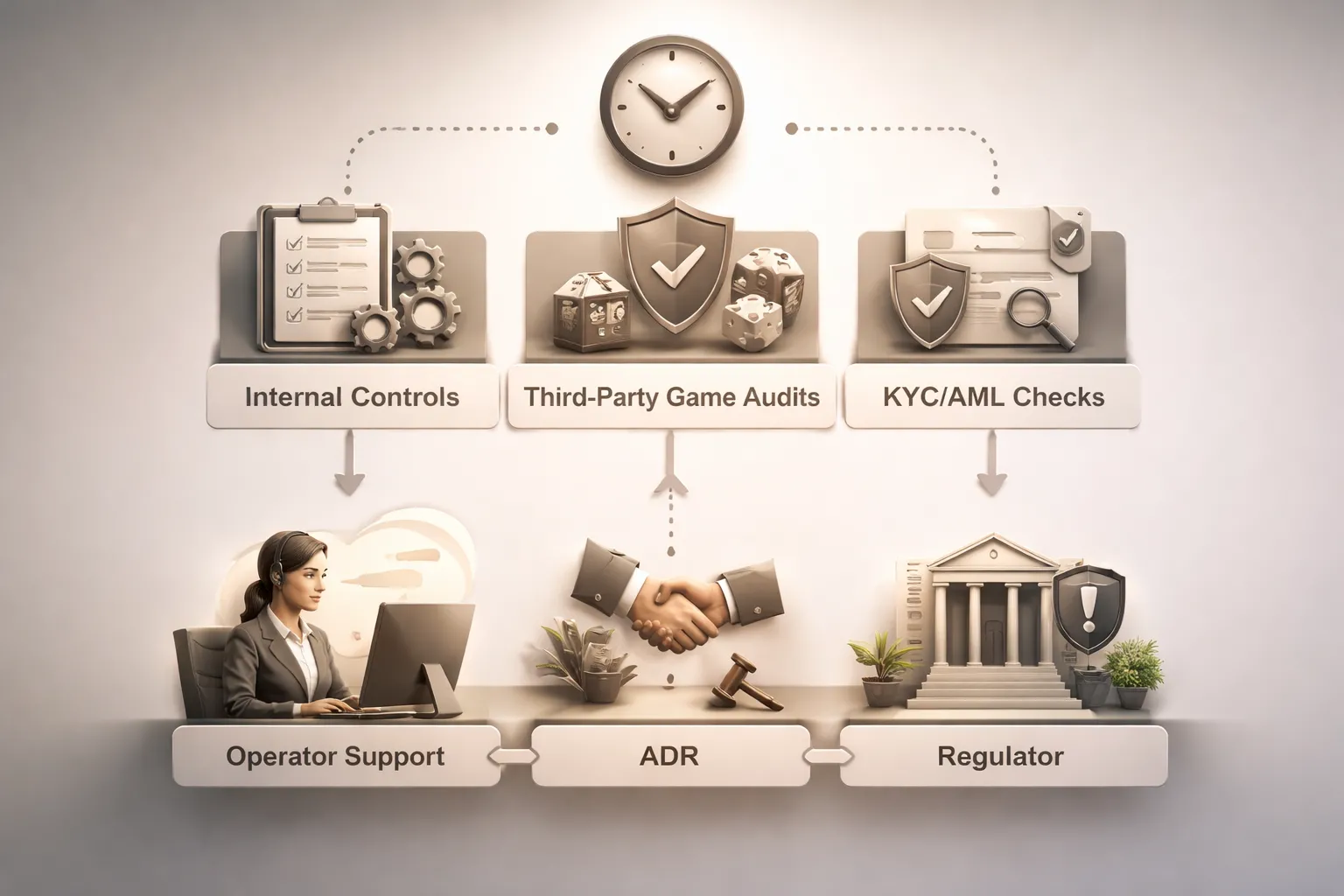
Legit casinos run on repeatable processes, and written controls. They log money movement, game changes, and access to key systems.
- Land-based controls: count-room procedures, dual control for cash handling, CCTV coverage, table drop and slot drop logs, supervisor approvals for voids and refunds, strict chip and cage reconciliations.
- Online controls: controlled access to admin panels, change management for game configuration, segregation of duties between finance and support, monitoring for fraud and bonus abuse, reconciliation between payment providers and player ledgers.
- Data controls: retention of betting logs and account history, time stamped records, audit trails for adjustments.
Game and payout audits: what gets checked and how often
Audits verify that game math, payout processes, and financial records match what the casino claims. You should see proof in certificates, test reports, and published RTP info.
- RNG and game math: labs test randomness, game rules, and expected return (RTP) against the game’s specification.
- Payout integrity: auditors review payout logs, voids, manual adjustments, and jackpot rules. They check that promotions follow stated terms.
- System security: reviews cover access control, incident response, and platform hardening. Some operators also run penetration tests.
- Financial reconciliations: checks align player balances, casino ledgers, and payment processor reports. Auditors look for gaps and unexplained adjustments.
- Frequency: testing can occur before launch, after major updates, and on a recurring schedule set by the license. Some items run continuously through monitoring and exception reports.
KYC and AML basics
KYC and AML rules focus on identity, funding, and suspicious patterns. If a casino enforces them, you see friction at sign-up, cashout, or high-risk activity.
- Identity checks: name, date of birth, address, and ID verification. Some casinos also verify device, phone, or payment ownership.
- Source-of-funds triggers: requests for payslips, bank statements, or proof of savings can trigger after large deposits, large withdrawals, rapid turnover, or inconsistent account history.
- Risk signals: repeated chargebacks, many cards, many accounts, VPN misuse where prohibited, unusual betting patterns, fast in and out movement of funds.
- Reporting: casinos file suspicious activity reports with the relevant authority when thresholds or patterns trigger internal rules.
Handling complaints: support, ADR, and regulator escalation
A legit operator gives you a clear path from support to formal complaint, then to an outside body if needed. You should follow the path in order and keep proof.
- Operator support: start with live chat or email. Ask for a ticket number and a written summary of the decision.
- Formal complaint: submit the issue in writing with dates, amounts, game names, and supporting files. Use the operator’s published complaints process.
- ADR or mediator: some licenses require an approved Alternative Dispute Resolution service. ADR reviews evidence and issues a decision under its rules.
- Regulator escalation: if ADR applies and you still have grounds, escalate to the regulator. Regulators focus on compliance breaches, not every payout disagreement.
What you can do to protect yourself
- Verify the license: match the license number and company name on the casino site with the regulator’s public register.
- Read key rules: withdrawal limits, KYC timing, bonus wagering, maximum cashout clauses, restricted games, and void terms.
- Keep records: screenshots of balances and terms, transaction IDs, chat transcripts, emails, and game round references when available.
- Control exposure: set deposit limits, session limits, and cooling-off tools. Use self-exclusion if you need it.
- Avoid red flags: unclear ownership, missing complaint steps, no test certificates, or pressure to deposit to “unlock” withdrawals.
- In het kort: Casinos use licensed rules, audited software, and strict controls to keep games fair.
- In het kort: Regulators set standards for payouts, RNG integrity, and complaint handling, then enforce them.
- In het kort: Security teams monitor fraud, collusion, and money laundering in real time.
- In het kort: Your best protection is verification, documentation, and disciplined limits.
Key Takeaways: How Casinos Keep Games Legit
- Licensing sets the baseline. A real casino operates under a gambling license. The license forces identity checks, player fund rules, and clear terms. It also creates a regulator you can complain to.
- Independent testing checks game math. Labs test RNG-based games and game rules. They verify that outcomes follow the expected probabilities and that game code matches the certified version.
- Audits back up the numbers. Operators track wagers, wins, bonuses, and withdrawals. Auditors and regulators review logs and reports. This helps spot manipulation, reporting gaps, and payout issues.
- RNG integrity controls randomness. Slot and digital table outcomes come from an RNG. Casinos and labs use controls like seed management, version control, and change logs to prevent tampering.
- Physical security protects live games. Cameras cover tables, cages, and count rooms. Dealers follow procedures for shuffles, payouts, and disputes. Pit bosses and surveillance review incidents fast.
- Anti-fraud systems target player abuse and operator risk. Tools flag multi-accounting, bonus abuse, chip dumping, and collusion. Teams review patterns, device data, and betting histories.
- AML rules limit dirty money. Casinos run KYC checks and monitor transactions. They flag unusual deposits, rapid turnover, and linked accounts. They can freeze activity until you verify funds and identity.
- Dispute steps create accountability. Legit operators document game rounds and transactions. They keep timelines for support and escalations. Regulators can demand records and issue penalties.
- You still control your risk. Pick licensed sites. Check test certificates. Save receipts and round IDs. Use deposit limits and cooling-off tools.
| Control | What it protects | What you should check |
|---|---|---|
| License and regulator | Rules, player rights, enforcement | License number, regulator site, complaint route |
| Game testing lab | RNG integrity, game math | Recent certificate, matching operator name and domain |
| Audit trail and logs | Payout accuracy, dispute evidence | Transaction IDs, game round references, clear statements |
| Surveillance and procedures | Cheating at tables, cash handling errors | Clear dispute process, posted house rules, staff oversight |
| Fraud and AML monitoring | Collusion, bonus abuse, illegal funds | KYC steps, limits, transparent source-of-funds requests |
FAQ: Security, Fairness, and Regulation in Casinos
How do casinos prove games are fair?
Licensed casinos use certified Random Number Generators for slots and online games, and standard procedures for table games. Independent labs test RTP and RNG output. You can check the casino’s license number, test lab seal, and game rules. Keep screenshots and round IDs.
What is RNG and why does it matter?
An RNG creates unpredictable results for each spin or hand in digital games. A good RNG passes statistical tests and runs continuously. It matters because it prevents patterns you can exploit. Look for lab testing from iTech Labs, eCOGRA, GLI, or BMM.
Who regulates casinos?
Government regulators issue licenses and enforce rules. They audit payments, game integrity, and responsible gambling controls. Examples include the UKGC, MGA, and state gaming commissions in the US. If a casino has no clear regulator, your protection drops.
How do casinos stop cheating at tables?
They use trained dealers, pit bosses, and surveillance. They track chip movement, payouts, and player behavior. Many tables use card-handling rules, shuffle procedures, and restricted device policies. If you spot an error, ask for a supervisor fast.
What security does a casino use on payments?
They log deposits, withdrawals, and gameplay events. You see this as transaction IDs, timestamps, and game round references. These records support payout checks and disputes. Use your own record, receipts, bank statements, and the exact amount and time.
What is KYC and why do casinos ask for documents?
KYC means Know Your Customer. Casinos verify your identity to prevent fraud and illegal funds. You may need an ID, proof of address, and payment method proof. Delays often come from mismatched names, expired documents, or unclear photos.
What is AML and how does it affect your account?
AML means Anti Money Laundering. Casinos monitor unusual deposits, fast turnover, and linked accounts. They can request source-of-funds proof and set limits. If you refuse, they may freeze withdrawals. Keep clean records and avoid moving funds through others.
How do casinos detect collusion and bonus abuse?
They track device IDs, IP patterns, betting behavior, and shared payment methods. They compare play across accounts and time windows. If you run multiple accounts or coordinate with others, they can void bonuses. Read bonus terms before you opt in.
What should you do if you think a game or payout is wrong?
Stop play and collect evidence. Save screenshots, round IDs, transaction IDs, and chat logs. Ask support for a written case number. Escalate to the casino’s complaints process. If unresolved, file with the regulator or ADR body listed in the site footer.
Can a casino change odds or “turn down” your wins?
For regulated RNG games, the game provider sets the math model and RTP. Casinos cannot change outcomes per player inside certified games. They can change bonus offers, limits, or availability by market. Stick to licensed sites and known game providers.
What red flags show weak regulation or security?
No license details, no company address, or fake seals. Slow support with no case tracking. Withdrawal rules that change mid-process. Requests for unusual payment routes. No dispute policy. If you see these, reduce exposure and withdraw what you can.
Conclusion: Choosing Safer, Fairer Places to Play
Conclusion: Choosing Safer, Fairer Places to Play
You control most of your risk. Pick casinos that prove security, fairness, and accountability.
- Confirm the license. Check the regulator name, license number, and company address. Match the details on the regulator site.
- Use known game providers. Stick to studios with a public track record. Avoid unknown brands with no audit or RNG details.
- Look for audit proof. Find an independent testing lab name and report date. Outdated or missing reports mean higher risk.
- Read withdrawal rules before you deposit. Check limits, fees, verification steps, and timelines. Save a screenshot of key terms.
- Choose payment methods with traceability. Use cards, bank transfer, or major e-wallets. Avoid requests to route payments through third parties.
- Test support early. Ask one clear question. Expect a ticket number and a written record.
- Set hard limits. Use deposit limits, loss limits, and time limits. Treat them as part of your bankroll plan.
Final tip. Do a 10 minute check before your first deposit. License, audit, withdrawal terms, support test. If one part fails, move on.
-
Fairness in Casino Games: RNGs, Odds, House Edge, and Return-to-Player (RTP) - Security, Fairness, and Regulation: How Casinos Keep Games Legit - What Is a Casino and How Does It Work? A Beginner’s Guide
1 week ago -
Regulation and Licensing: Who Oversees Casinos and What Rules They Must Follow - Security, Fairness, and Regulation: How Casinos Keep Games Legit - What Is a Casino and How Does It Work? A Beginner’s Guide
1 week ago
-
-
-
- How do casinos prove games are fair?
- What is RNG and why does it matter?
- Who regulates casinos?
- How do casinos stop cheating at tables?
- What security does a casino use on payments?
- What is KYC and why do casinos ask for documents?
- What is AML and how does it affect your account?
- How do casinos detect collusion and bonus abuse?
- What should you do if you think a game or payout is wrong?
- Can a casino change odds or “turn down” your wins?
- What red flags show weak regulation or security?
-
-
-
- How do casinos prove games are fair?
- What is RNG and why does it matter?
- Who regulates casinos?
- How do casinos stop cheating at tables?
- What security does a casino use on payments?
- What is KYC and why do casinos ask for documents?
- What is AML and how does it affect your account?
- How do casinos detect collusion and bonus abuse?
- What should you do if you think a game or payout is wrong?
- Can a casino change odds or “turn down” your wins?
- What red flags show weak regulation or security?
-
Fairness in Casino Games: RNGs, Odds, House Edge, and Return-to-Player (RTP) - Security, Fairness, and Regulation: How Casinos Keep Games Legit - What Is a Casino and How Does It Work? A Beginner’s Guide
1 week ago -
Regulation and Licensing: Who Oversees Casinos and What Rules They Must Follow - Security, Fairness, and Regulation: How Casinos Keep Games Legit - What Is a Casino and How Does It Work? A Beginner’s Guide
1 week ago -
What Is a Casino and How Does It Work? A Beginner’s Guide
1 week ago -
How Casinos Make Money: House Edge, RTP, and the Math Behind It
1 week ago -
Casino Terminology Glossary: House Edge, RTP, Variance, and More
1 week ago
-
RTP Explained: How to Use Return to Player to Choose Slots
1 week ago -
What Is a Casino and How Does It Work? A Beginner’s Guide
1 week ago -
Casino RNG Explained: How Random Number Generators Work
1 week ago -
How to Set a Gambling Budget (and Stick to It)
1 week ago -
Responsible Gambling Tips: Limits, Tools, and Safer Play
1 week ago