What Is a Casino and How Does It Work? A Beginner’s Guide

Casinos sell games with a built in edge. You bring money, pick a game, place a bet, and take a result. The rules stay fixed. The math drives the long run outcome.
This guide explains what a casino is, how casino games work, and why the house edge matters. You will learn key terms like odds, payouts, volatility, and RTP. You will also learn how to read a pay table, how casinos handle cash, chips, and credit, and how to set a basic budget before you play.
If you want a fast start, use our best casino game for beginners guide. If you want to avoid bad thinking, read the gambler’s fallacy and casino myths vs facts. For slots, start with RTP explained.
What Is a Casino and How Does It Work? (Definition & Basics)
Definition, Casino vs Gambling Venue vs Online Casino
A casino is a gambling business that offers games with set rules, set payouts, and a built-in mathematical advantage for the house.
A gambling venue is a broader term. It can include a casino, a sportsbook, a bingo hall, a card room, a lottery retailer, or a racetrack. Some venues offer only one type of betting.
An online casino is the digital version. You play through a website or app. The games run on software, and deposits and withdrawals run through payment processors. Game rules and payout logic stay the same, but the random results come from code.
If you want quick definitions for common terms, use our casino terminology glossary.
Core Components of a Casino
- Games, slots, table games, and sometimes a sportsbook or poker room.
- Game operators, dealers and supervisors in land-based casinos, software and live dealers in online casinos.
- Payments, cashier cages, ATMs, chip systems, and player accounts online.
- Rules and limits, minimum bets, maximum bets, payout tables, and game procedures.
- Controls and compliance, licensing, game testing, surveillance, and anti-fraud systems.
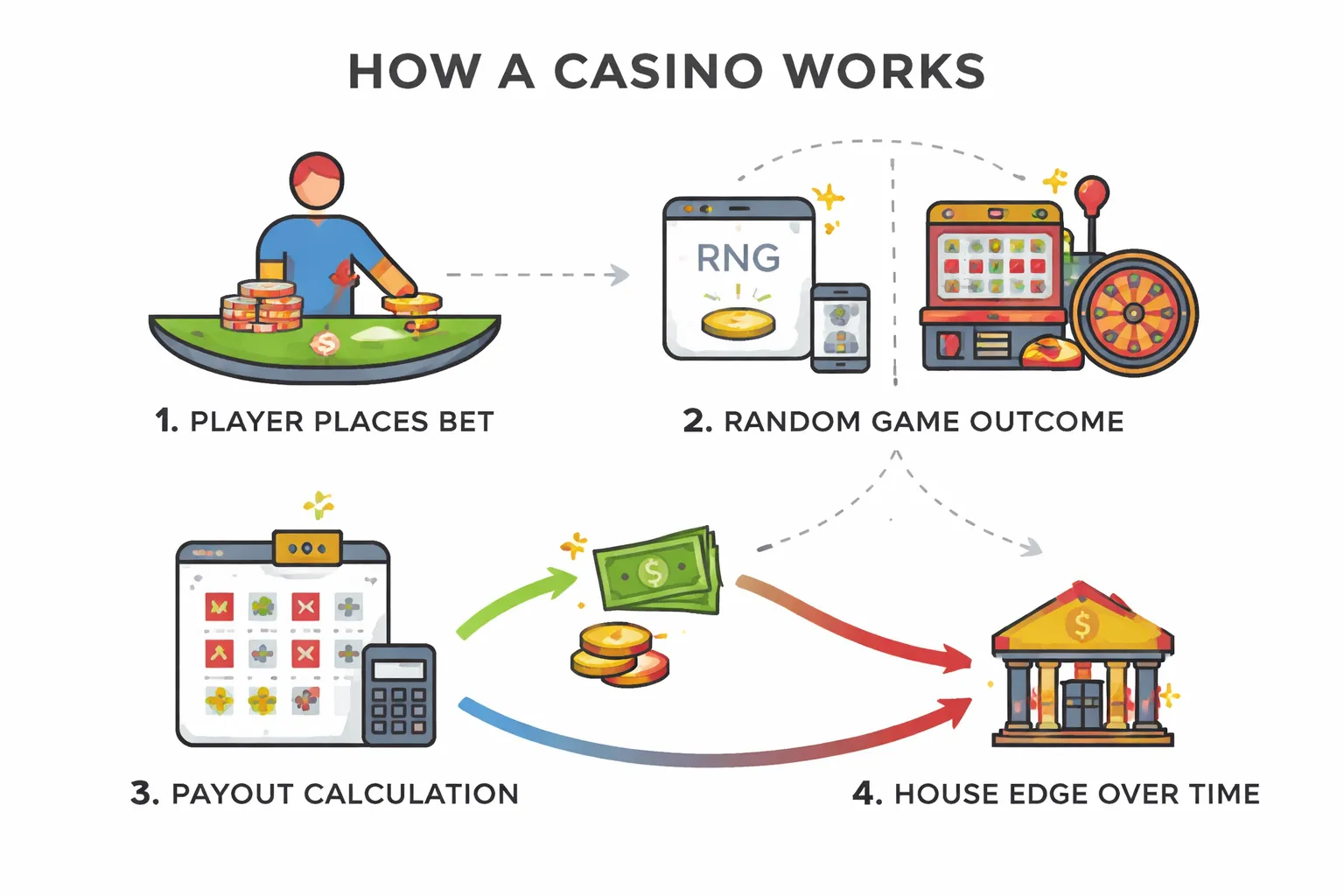
How a Casino Works, Step by Step
- You choose a game and a stake. The rules define what outcomes pay and how much.
- The game generates an outcome, from cards, dice, a wheel, or an RNG.
- The casino settles the bet, you win a payout or you lose your stake.
- Over many bets, the math favors the house by a small percentage per game.
How Casinos Make Money, House Edge Plus Volume
Casinos make money through house edge. House edge is the average percentage the casino expects to keep from total money wagered, over the long run.
Casinos also rely on volume. More bets per hour and more players increase total wagered, which increases expected casino revenue.
Example math. If a game has a 2% house edge and players wager $100,000 total, the casino’s expected hold is about $2,000 over time. Results vary in the short run.
House edge differs by game and rule set. For a quick comparison, see which casino games have the best odds.
Randomness Basics, RNG vs Physical Randomness
Land-based casinos use physical randomness. Cards come from shuffled decks, dice bounce off back walls, and roulette balls spin around a wheel. Procedures aim to reduce predictability, not to guarantee outcomes.
Online casinos use an RNG, a random number generator. The RNG produces numbers that map to outcomes, like a slot stop position or a card draw. Licensed sites use audited RNGs and game logs. That helps prove the results follow the designed probabilities.
Random does not mean “due.” Past results do not change the next result. If you want clear examples, read the gambler’s fallacy explained.
Rules, Payouts, and Compliance Basics
Every game runs on written rules. The rules set bet options, how wins get calculated, and what happens in edge cases, like dealer mistakes or disconnected sessions online.
Casinos also follow compliance rules. These include age checks, identity checks online, anti-money laundering controls, and responsible gambling tools. The goal is to run a controlled betting environment where outcomes, payments, and disputes follow a defined process.
Types of Casinos: Land-Based, Online, and Hybrid Venues
Land-Based Casinos
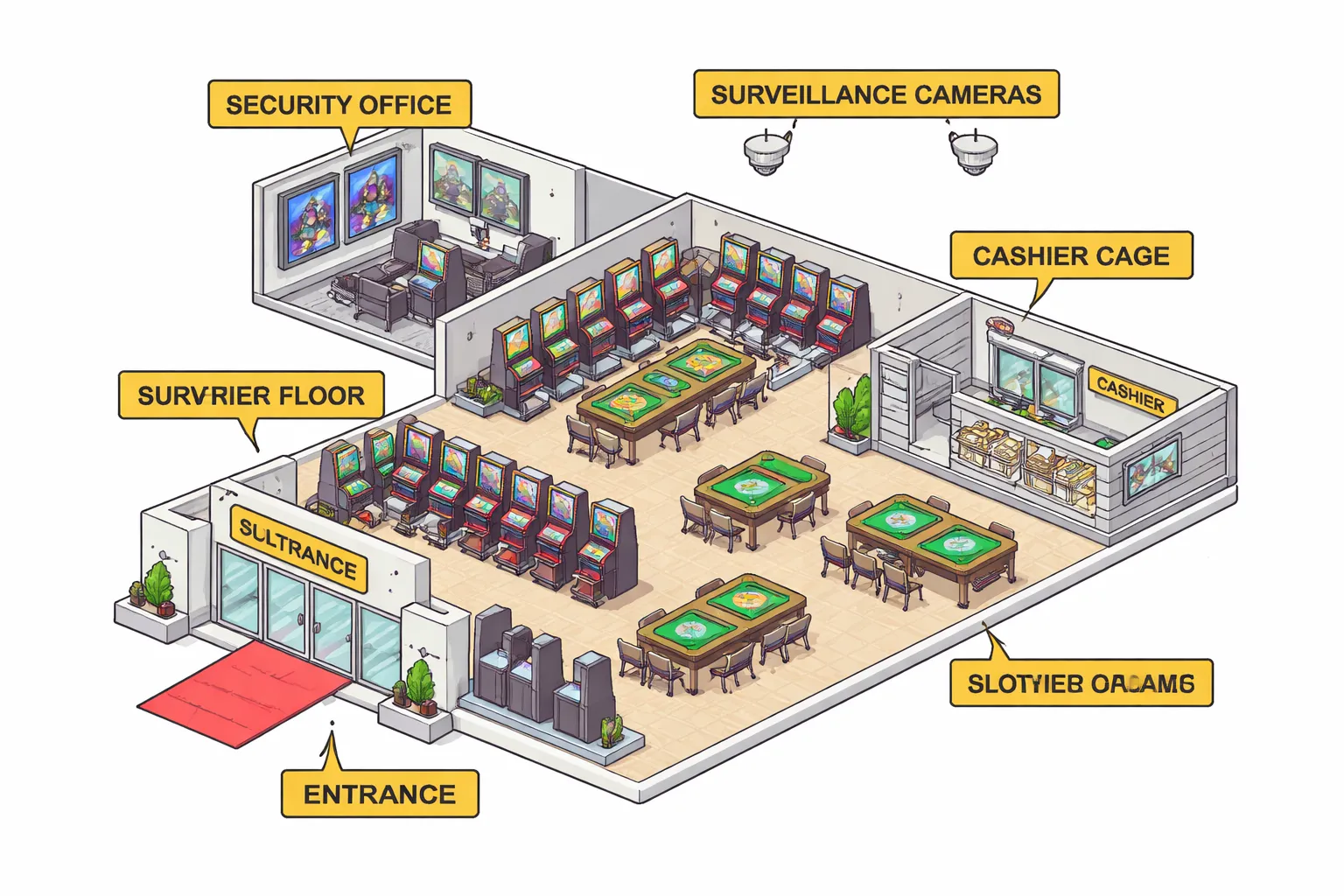
A land-based casino runs inside a physical venue. Your experience depends on the floor layout, staff, and in-person controls.
- Layout: You enter a main gaming floor. Slots usually take most of the space. Table games sit in grouped areas, often called pits.
- Table pits: Each pit holds several tables, like blackjack, roulette, baccarat, and poker variants. A pit boss supervises dealers, handles disputes, and approves higher limits.
- Slots floor: Slots run on configured paytables and machine settings. Denominations and max bets vary by machine and section.
- Cage: The cage handles cash in, cash out, chips, and some account services. This is where large payouts, markers, and ID checks often happen.
- Security: Cameras cover tables, slots, cage, and entrances. Staff track suspicious play, chip movement, and rule violations.
Rules can differ by property and even by table. Check the posted rules and paytables before you sit down. Use your game’s rules page if you need a checklist.
Online Casinos
An online casino runs through a website or app. The operator handles accounts, payments, and compliance checks. Game providers supply the software.
- Websites and apps: You create an account, verify identity, and fund your balance. The cashier controls deposits, withdrawals, and limits.
- Game providers: Most games come from third-party studios. Each game runs on a random number generator, called an RNG, and uses a defined RTP and rule set.
- Live dealer studios: Live games stream real tables from a studio or casino floor. You place bets in an app interface. A dealer runs the game on camera. The studio team monitors the feed and resolves some disputes.
- Controls and logs: Online play creates detailed bet logs, time stamps, and session history. These records often decide disputes, including disconnects.
Online rules can change by game version. One blackjack title can differ from another. Read the rules and paytable inside the game before you bet.
Hybrid Casinos
Hybrid models connect a land-based venue with an online platform. You get shared branding, shared rewards, or a shared account.
- Loyalty across venues: You earn points on-property and online under one program. Some operators let you redeem rewards in either channel.
- Omnichannel accounts: You may use one login for wallet access, rewards, and responsible gambling tools. In some regions, the wallet stays separate due to regulation.
- Shared offers: Operators use the same player tracking system to issue comps, free play, and targeted promos based on your activity.
What Changes for You as a Player
| Factor | Land-Based | Online | Hybrid |
|---|---|---|---|
| Convenience | Travel, hours, and crowds matter. | Play anywhere within approved locations. | Switch between channels with one program. |
| Limits | Limits set per table or area. Higher limits need staff approval. | Limits set per game, stake, and account tools. You can set deposit and loss caps. | Limits may coordinate through one profile, or stay separate by rule. |
| Game speed | Dealer pace and table flow slow play. | RNG games run fast. Autoplay and turbo modes increase volume. | Speed changes by channel, rewards stay linked. |
| Payout methods | Cash, chips, cage payouts, and sometimes checks. | Cards, bank transfer, e-wallets, and other local methods. Withdrawals can take time due to checks. | Rewards and offers can follow you. Cashout rules still depend on the channel. |
If you want to compare games across formats, focus on the rules and paytables first. Then check RTP and house edge so you know what the math supports.
How Casino Games Work: Categories, Rules, and Odds (Beginner Overview)
Game Categories You Will See
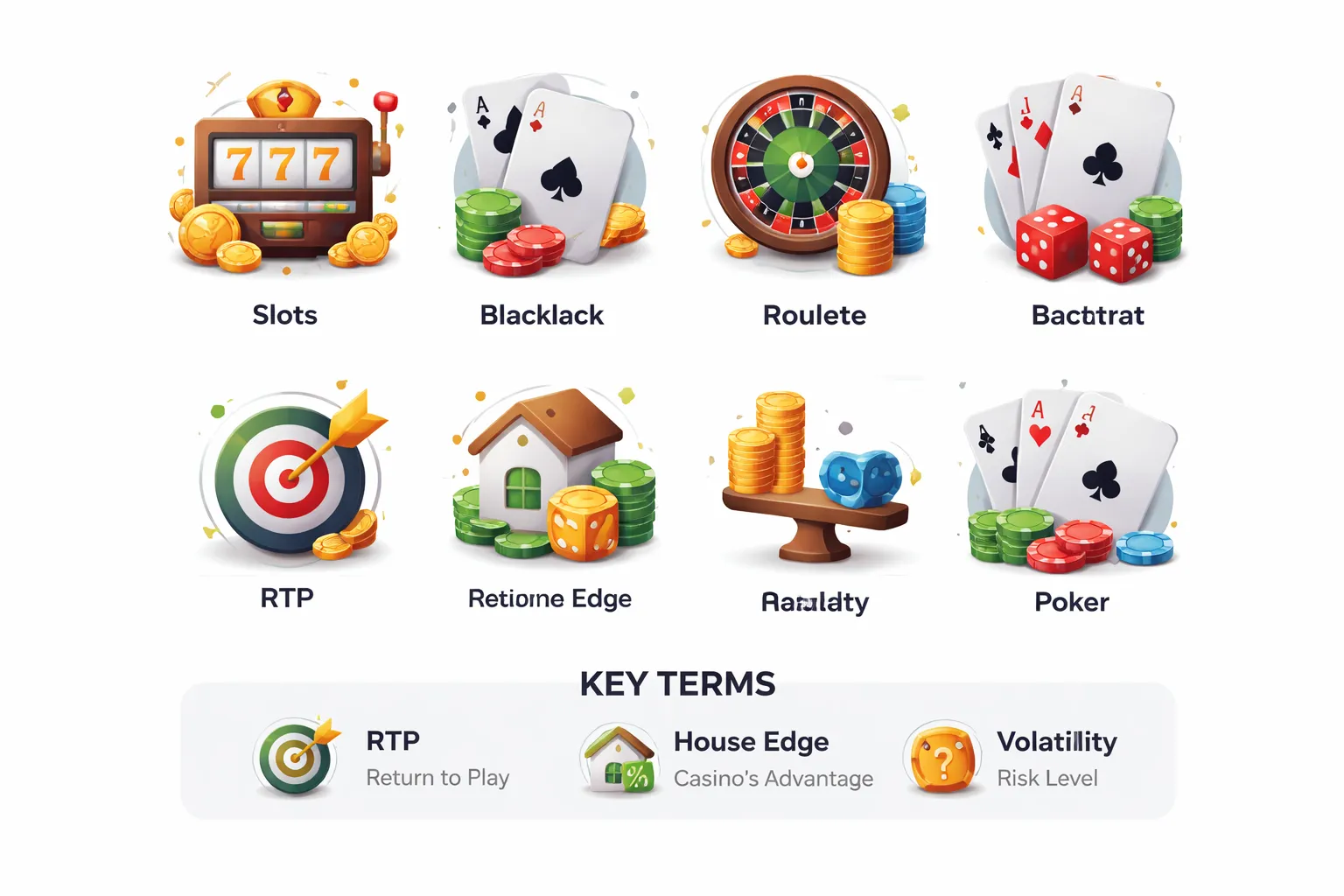
Casinos group games by how they run and how you place bets. Learn the category first. Then read the rules and paytable.
- Slots, you spin reels, match symbols, get paid by the paytable. Features can add free spins or bonus rounds.
- Table games, you bet against the house using set rules, dealer runs the game. Examples include blackjack, roulette, baccarat, craps.
- Poker rooms, you play other players. The house takes a fee called a rake or charges a tournament entry fee.
- Specialty games, simple bets with fast results. Examples include keno, bingo, scratch cards, wheel games.
- Live dealer, real dealers on video, you place bets on a digital interface. Rules follow the table version.
Chance vs Skill: Where Strategy Matters
Most casino games run on fixed math. Some let you reduce your disadvantage with correct decisions.
- High strategy impact, blackjack and poker. In blackjack, your choices change the outcome. In poker, skill drives long-term results, but variance stays high.
- Low strategy impact, slots, roulette, baccarat, most specialty games. You choose bet size and sometimes side bets. You cannot change the base odds.
- Medium impact, craps. You cannot control the dice, but bet selection changes the house edge.
If you want an easy entry point, use a short ruleset and clear payouts. See best casino game for beginners.
How Odds Work in Plain Terms
Every game has a built-in cost. You measure it with house edge or RTP. You can estimate what the math supports over time.
- RTP (Return to Player), the long-run percentage paid back. Example, 96% RTP means the game returns about $96 per $100 wagered over a huge sample. Your short-run results can differ.
- House edge, the casino advantage. It equals 100% minus RTP for a simple wager. Example, 96% RTP equals a 4% house edge.
- Volatility and variance, how swingy results feel. High volatility means fewer wins and bigger gaps between payouts. Low volatility means more frequent small wins.
- Bankroll, the money you set aside for play. Treat it as spend money. Set a stop-loss and a stop-win before you start.
Rules, paytables, and side bets change the edge. Provider settings can change it too. See casino game providers explained.
Common Games at a Glance: Rules and Typical Odds
| Game | How it works | Where the edge comes from | Typical house edge range |
|---|---|---|---|
| Slots | Spin, symbols land, payouts follow the paytable and bonus rules. | Programmed payout math and feature design. | Often 2% to 10%+, varies by title and setting. |
| Blackjack | Beat the dealer without going over 21. You decide hit, stand, double, split. | Rules like blackjack payout, dealer hit or stand, decks used. | About 0.5% to 2%+ depending on rules and play. |
| Roulette | Ball lands on a number. You bet on numbers or groups. | Zeroes on the wheel. | European 2.70%, American 5.26%. |
| Baccarat | Bet on Player, Banker, or Tie. Hand totals follow fixed draw rules. | Commission and payout structure. | Banker about 1.06%, Player about 1.24%, Tie is much higher. |
| Craps | Dice game with many bet types. Core bets center on the pass line and point. | Different payouts per bet type. | Best bets about 1.36% to 1.41%, many side bets are far higher. |
| Poker | You play other players. The casino takes a rake or entry fee. | Rake and game toughness, not house edge. | No fixed house edge, your win rate must beat the rake. |
If you want a ranked list by math, use which casino games have the best odds.
Beginner Rules to Keep You Out of Trouble
- Read the paytable and table rules before you bet.
- Avoid side bets until you know their edge and volatility.
- Use flat stakes while you learn. Do not chase losses.
- Track time and spend. Your bankroll ends the session.
- Know the basic behavior rules at tables and poker rooms. Use casino etiquette.
Casino Economics: Payouts, House Edge, Promotions, and Loyalty Programs
How Payouts Are Set: Paytables, Odds, and Expected Value
Every game has a payout structure. You see it in the paytable, the felt, or the help screen.
The payout plus the odds of winning set your long-term cost. Casinos call this the house edge. You feel it as average loss over time.
Expected value is the math behind it. You can treat it as your average result per $1 bet if you repeated the same wager many times.
- Better paytables reduce the house edge. Example, blackjack rules and payouts change your cost.
- Side bets often pay less than the risk. They can look exciting, but they usually carry a higher edge.
- Small rule changes matter. Example, roulette has different edges in European vs American wheels because of the extra zero.
Do this before you sit down. Read the paytable and table rules. If you want the full math breakdown, start with how casino game odds work.
| Term | What it means for you | Where to check |
|---|---|---|
| Paytable | What each win pays | Machine screen, table signage, game help |
| House edge | Your average loss rate over time | Game rules, paytable, published odds |
| Volatility | How swingy results feel | Slot info, side bet rules, game guides |
Comps and Loyalty: Points, Tiers, Cashback, Free Play, Room and Food Offers
Comps are rebates funded by your expected loss. The casino gives back a slice of what it expects to earn from your play.
Loyalty programs track your betting. You earn points based on coin-in on slots and average bet and time on tables. The exact formula varies by property.
- Points. You earn points that convert to free play, dining credit, or gift cards.
- Tiers. Higher tiers unlock better multipliers and perks, like priority lines and waived resort fees.
- Cashback. Some programs return a percent of losses or coin-in, often with caps.
- Free play. Promo credit that must be wagered, and it may not be withdrawable as cash until you convert it through play.
- Rooms and food offers. Casinos use these to get you on property where you keep playing.
Use comps as a discount, not a reason to bet more. If you raise your stakes to chase a tier, you usually pay more than you get back.
Bonuses Online: Welcome Offers, Free Spins, Reloads, Wagering Requirements
Online casinos use bonuses to get you to sign up and deposit. The value depends on the terms.
- Welcome bonus. A match on your first deposit, sometimes spread across multiple deposits.
- Free spins. Spins on specific slots, often with limits on max winnings or withdrawal.
- Reload bonus. A smaller match on later deposits, tied to promo codes or set days.
Wagering requirements set how much you must bet before you can withdraw bonus-related funds.
- Example in plain English. A $100 bonus with 30x wagering means you must place $3,000 in bets before cashing out bonus money.
- Game weighting. Slots may count 100 percent, table games may count less or be excluded.
- Time limits. Many bonuses expire in days, not months.
- Max bet rules. If you bet over the limit, you can void the bonus.
For slots, understand how outcomes get generated, since bonus play still runs on the same underlying system. See how casino RNG works.
Why Casinos Offer Promotions: Acquisition, Retention, and Player Value
Promotions are marketing with math behind them. Casinos spend promo dollars to earn more in expected profit.
- Acquisition. They use sign-up offers and discounted rooms to get you to try the product.
- Retention. They use bounce-back offers, free play, and tier perks to keep you returning.
- Player value. They estimate your expected loss over time, then offer comps that stay below that number.
Use this to protect yourself. Compare the value of an offer to the extra money it pushes you to wager. Keep your session bankroll rules. Choose games with better odds when you can. For a direct comparison, see poker vs blackjack vs baccarat odds and the easiest casino games to learn.
Security, Fairness, and Regulation: How Casinos Keep Games Legit

Casinos stay in business because math favors them, but they still need trust. You need to know what keeps games honest. Start with rules and audits. Regulators license operators, test equipment, and can fine or shut down violators. On the floor, security teams track chips, cash, and behavior with cameras and access controls. In the games, procedures reduce cheating, dealer errors, and collusion. In slots and online-style systems, labs test random number generators and verify payout settings like RTP. You can use this knowledge. Check a casino’s license, look for posted rules, and stick to games with clear odds and published pay tables. Skip “systems” and streak myths.
Read our detailed guide: Security, Fairness, and Regulation: How Casinos Keep Games Legit - What Is a Casino and How Does It Work? A Beginner’s Guide
A Beginner’s Casino Walkthrough: What to Expect and How to Start
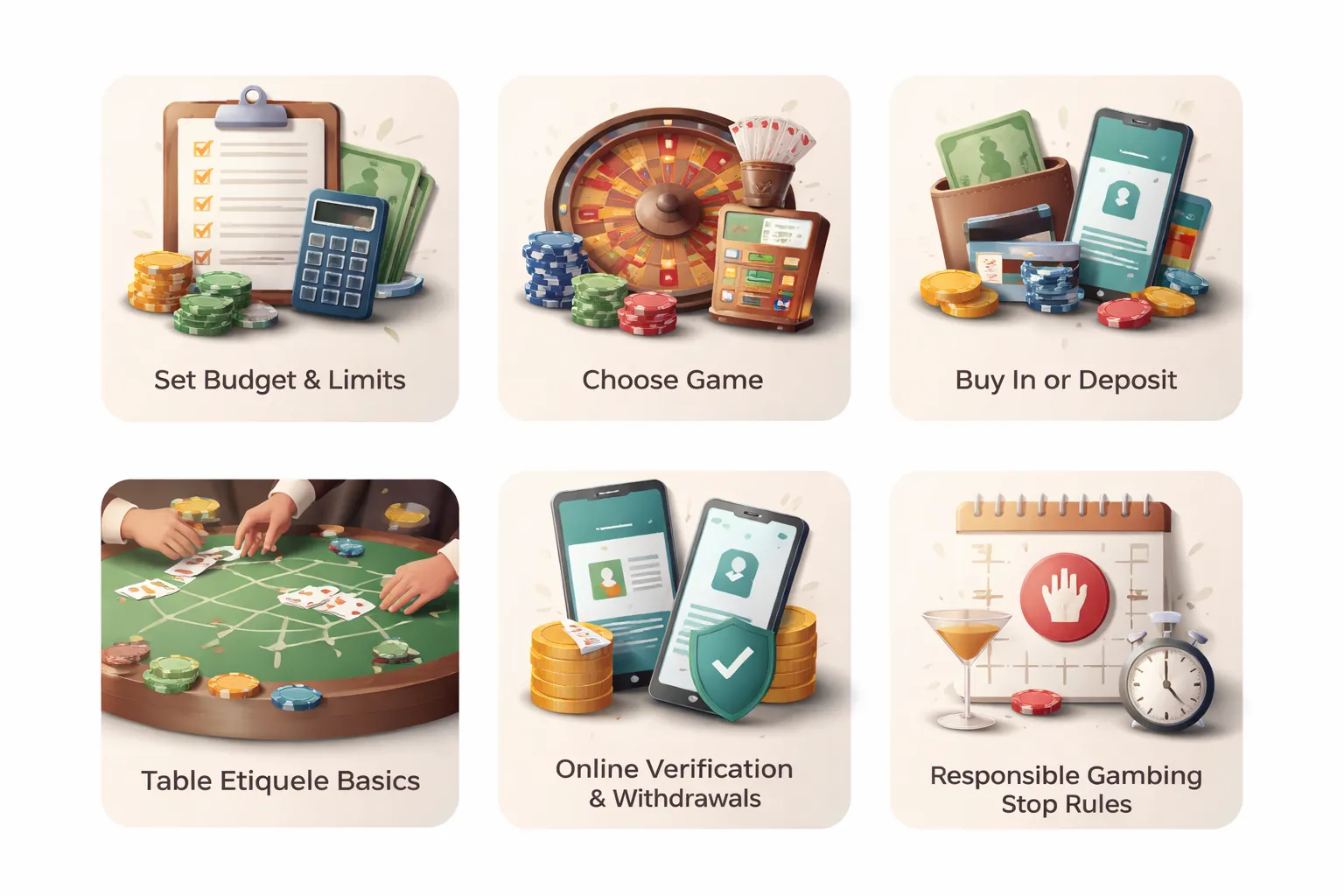
Before you play: set a budget, understand limits, and choose games
Decide your spend before you arrive or log in. Treat it as a fee for entertainment. Do not chase losses.
- Set a loss limit. Pick a number you can lose with no impact on bills or savings.
- Set a time limit. Use a phone timer. End the session when it ends.
- Set a win cap. Decide what “up enough” means, then cash out.
- Know table minimums. Minimum bets control how long your bankroll lasts.
- Pick games with clear rules and published payouts. Learn house edge basics first, then choose.
If you want a fast way to compare game value, read How Casino Game Odds Work: House Edge, Probability, and Payouts.
For easy starts, use games with simple decision rules. See Best Casino Game for Beginners: The Easiest Games to Learn First.
How to buy in or deposit: cash, cards, e-wallets, bank transfers, crypto
Land-based casinos use a cage and ATMs. Online casinos use cashier pages. Fees and speed vary by method.
| Method | Typical speed | What to watch |
|---|---|---|
| Cash (casino cage) | Instant | Bring ID, keep receipts, set a hard cash cap. |
| Debit card | Instant | Bank blocks are common, fees may apply, withdrawals may not go back to the card. |
| Credit card | Instant | Often treated as a cash advance with interest and extra fees. Avoid if possible. |
| E-wallets (where available) | Instant deposits, fast withdrawals | Extra account setup, possible wallet fees, name must match your casino account. |
| Bank transfer | Slower | Good for larger amounts, longer withdrawal times, stricter verification. |
| Crypto (where legal) | Often fast | Price swings, network fees, wrong-address risk, local rules vary. |
Online, read deposit and withdrawal terms before you fund your account. Check wagering rules on bonuses. Check minimum withdrawal amounts.
At the table: etiquette basics, minimum bets, tipping, asking for help
Start by watching one full round. Then buy in. Use clean bills and place them on the table. Do not hand cash to the dealer unless the game rules allow it. The dealer will convert it to chips.
- Follow the posted minimum and maximum bets. Ask the dealer if the sign is unclear.
- Touch your chips only when it is your turn. Keep your hands visible.
- Do not slow the game. If you need time, step back and switch to a lower-pressure game.
- Use clear signals. In blackjack, keep your hand signals consistent. In craps, keep hands off the layout after “no more bets.”
- Ask for help early. Say you are new and ask what actions you can take. Dealers explain rules, they do not give strategy.
- Track your session. Count cash in, cash out, and time played. Do not rely on memory.
Tipping depends on local norms and your budget. Tip when you want to, and when you can afford it. Common methods include placing a small bet for the dealer or giving a chip after a win. Keep tips separate from your bankroll.
Online play basics: account setup, verification, selecting games, withdrawing
Use a licensed site in your region. Then keep your account details consistent. Most withdrawal problems come from mismatched names, addresses, or payment ownership.
- Create your account. Use your legal name. Use one account only.
- Turn on security. Use a strong password and two-factor authentication if offered.
- Complete verification early. Expect ID, proof of address, and sometimes payment proof. Upload clear images.
- Select games with published information. Check RTP on slots and pay tables on table games.
- Start with low stakes. Use demo mode if available, then move to real money.
- Withdraw with the same method when possible. Sites often return funds to the original deposit route first.
If you play slots, learn how RTP works and where to find it. Use RTP Explained: How to Use Return to Player to Choose Slots.
If you want a deeper check on who builds the games you play, see Casino Game Providers Explained.
Responsible gambling checklist: time limits, loss limits, and when to stop
- Set a stop-loss. Leave when you hit it. No exceptions.
- Set a session timer. End on time, even if you feel “close.”
- Keep stakes stable. Do not increase bets to recover losses.
- Avoid alcohol or keep it minimal. Impaired decisions cost money.
- Do not borrow to gamble. Do not use rent or bill money.
- Take breaks. Step away each hour. Recheck your bankroll.
- Stop if you feel out of control. If you hide play, lie about losses, or feel panic, end the session and seek support.
Use built-in tools online. Turn on deposit limits, loss limits, cooling-off periods, and self-exclusion if you need them.
- In het kort: A casino makes money because each game has a built-in house edge.
- You play with chips, cash, or a digital balance, then you settle wins and losses at the table, machine, or cashier.
- Rules, payouts, and limits set your risk per bet, and your session length affects how fast variance hits your bankroll.
- RTP and house edge are the key numbers. Use them to compare games and set realistic expectations. See RTP explained and best odds by house edge.
- Some games let skill and decisions affect results, others do not. Compare formats in poker vs blackjack vs baccarat odds.
- Online casinos add software, RNGs, and live dealers. Game providers and auditing affect trust and consistency. Read who makes the games.
- Responsible play starts with a budget, hard stop limits, and breaks. Do not chase losses. Use deposit limits, loss limits, cooling-off, and self-exclusion.
FAQ
What is a casino?
A casino is a venue or website that offers gambling games for money. You place bets on games with set rules and payouts. The casino earns from a built-in mathematical advantage called the house edge. Some games add commissions, fees, or lower payout tables.
How does a casino make money?
The casino makes money through house edge and pricing. On table games, edge comes from rules and payouts. On slots, edge comes from the paytable and RTP. Some games add a commission, like baccarat. Over many bets, the math favors the house.
What is house edge?
House edge is the average percentage the casino expects to keep from total wagers over time. If a game has a 2% house edge, the long-run expected loss is about $2 per $100 wagered. Learn more at how casino odds work.
What is RTP on slots?
RTP means Return to Player. It is the long-run average percent a slot returns across many spins. An RTP of 96% implies a 4% house edge. Your short-term results can vary a lot. Use RTP to compare games, not to predict outcomes.
Are casino games rigged?
Licensed casinos rely on audited software and controlled equipment. Online slots use RNGs to generate outcomes. Live dealer games use real cards and wheels with monitoring. Risk rises with unlicensed sites. Check licensing, game providers, and independent testing reports.
What is an RNG in online casinos?
An RNG is a random number generator. It produces outcomes for games like slots and digital table games. Good RNGs undergo testing to confirm randomness and consistency with the game rules. Read how casino RNGs work.
Do skill and strategy matter?
Yes, but only in some games. Poker rewards decision-making and opponent reading. Blackjack strategy can reduce house edge, but you still face variance. Baccarat and roulette offer few meaningful decisions. Pick games based on whether you want skill, simplicity, or speed.
Which casino games have the best odds?
Games with low house edge give you better long-run value. Blackjack with correct basic strategy often ranks near the top. Some baccarat bets and some video poker paytables can also be strong. See best odds by house edge.
What is variance, and why does it matter?
Variance describes how much results swing around the average. High variance games can pay big, but you can lose faster in the short run. Low variance games tend to produce smaller swings. Match variance to your bankroll and session length.
How do I set a safe gambling budget?
Set a fixed bankroll you can afford to lose. Split it into session limits. Use deposit limits, loss limits, and time reminders. Set a hard stop and quit when you hit it. Take breaks. Do not chase losses. Use cooling-off or self-exclusion if needed.
What should I check before playing at an online casino?
Check licensing, ownership, and payment methods. Review withdrawal limits, fees, and verification rules. Look for reputable game providers and independent testing. Confirm support hours and responsible gambling tools. Read the bonus terms line by line, especially wagering and game exclusions.
Conclusion
Conclusion
A casino runs on math. The house edge gives the operator a long-term profit. Variance decides short-term swings. Your job is to control what you can.
- Pick low-edge games. Learn the basics first and start with simple rules. See best casino game for beginners.
- Know the odds. Check house edge and payout rules before you bet. Use how casino game odds work.
- Skip bad thinking. Past results do not change your next outcome. Read the gambler’s fallacy explained.
- Set hard limits. Decide your budget, time limit, and stop-loss. Treat losses as final.
- Check the rules before you play. Confirm licensing, withdrawals, fees, and bonus terms. Walk away if terms look unclear.
- Act like a pro in person. Follow table rules, tip when appropriate, and keep the pace. Use casino etiquette 101.
Final tip. Make your limits first, then pick your game. If you cannot follow your limits, stop and use cooling-off or self-exclusion.
-
RTP Explained: How to Use Return to Player to Choose Slots
1 week ago -
Casino RNG Explained: How Random Number Generators Work
1 week ago -
The Gambler’s Fallacy Explained (With Simple Examples)
1 week ago -
Casino Myths vs Facts: Hot Streaks, “Due” Numbers, and Luck Explained
1 week ago -
Casino Etiquette 101: Rules and Tips for First-Time Visitors
1 week ago
-
-
- Before you play: set a budget, understand limits, and choose games
- How to buy in or deposit: cash, cards, e-wallets, bank transfers, crypto
- At the table: etiquette basics, minimum bets, tipping, asking for help
- Online play basics: account setup, verification, selecting games, withdrawing
- Responsible gambling checklist: time limits, loss limits, and when to stop
-
- What is a casino?
- How does a casino make money?
- What is house edge?
- What is RTP on slots?
- Are casino games rigged?
- What is an RNG in online casinos?
- Do skill and strategy matter?
- Which casino games have the best odds?
- What is variance, and why does it matter?
- How do I set a safe gambling budget?
- What should I check before playing at an online casino?
-
-
- Before you play: set a budget, understand limits, and choose games
- How to buy in or deposit: cash, cards, e-wallets, bank transfers, crypto
- At the table: etiquette basics, minimum bets, tipping, asking for help
- Online play basics: account setup, verification, selecting games, withdrawing
- Responsible gambling checklist: time limits, loss limits, and when to stop
-
- What is a casino?
- How does a casino make money?
- What is house edge?
- What is RTP on slots?
- Are casino games rigged?
- What is an RNG in online casinos?
- Do skill and strategy matter?
- Which casino games have the best odds?
- What is variance, and why does it matter?
- How do I set a safe gambling budget?
- What should I check before playing at an online casino?
-
Fairness in Casino Games: RNGs, Odds, House Edge, and Return-to-Player (RTP) - Security, Fairness, and Regulation: How Casinos Keep Games Legit - What Is a Casino and How Does It Work? A Beginner’s Guide
1 week ago -
Regulation and Licensing: Who Oversees Casinos and What Rules They Must Follow - Security, Fairness, and Regulation: How Casinos Keep Games Legit - What Is a Casino and How Does It Work? A Beginner’s Guide
1 week ago -
Security, Fairness, and Regulation: How Casinos Keep Games Legit - What Is a Casino and How Does It Work? A Beginner’s Guide
1 week ago -
How Casinos Make Money: House Edge, RTP, and the Math Behind It
1 week ago -
Casino Terminology Glossary: House Edge, RTP, Variance, and More
1 week ago
-
Security, Fairness, and Regulation: How Casinos Keep Games Legit - What Is a Casino and How Does It Work? A Beginner’s Guide
1 week ago -
RTP Explained: How to Use Return to Player to Choose Slots
1 week ago -
Casino RNG Explained: How Random Number Generators Work
1 week ago -
How to Set a Gambling Budget (and Stick to It)
1 week ago -
Responsible Gambling Tips: Limits, Tools, and Safer Play
1 week ago