Casino RNG Explained: How Random Number Generators Work

Every online casino game depends on one system. The random number generator, or RNG. It picks the outcomes for slots, digital table games, and many live dealer side bets. If you understand RNGs, you can spot what you can control and what you cannot.
This guide explains how casino RNGs work, step by step. You will learn the difference between true RNGs and pseudo RNGs, how casinos test and certify RNG results, and what “random” means in practice. You will also learn how RNG links to return to player, house edge, and volatility, so you can judge risk before you bet. Pair this with game rules and paytables, plus odds by house edge, if you want a clearer view of your expected results.
What is random number generator (RNG) explained for casinos?
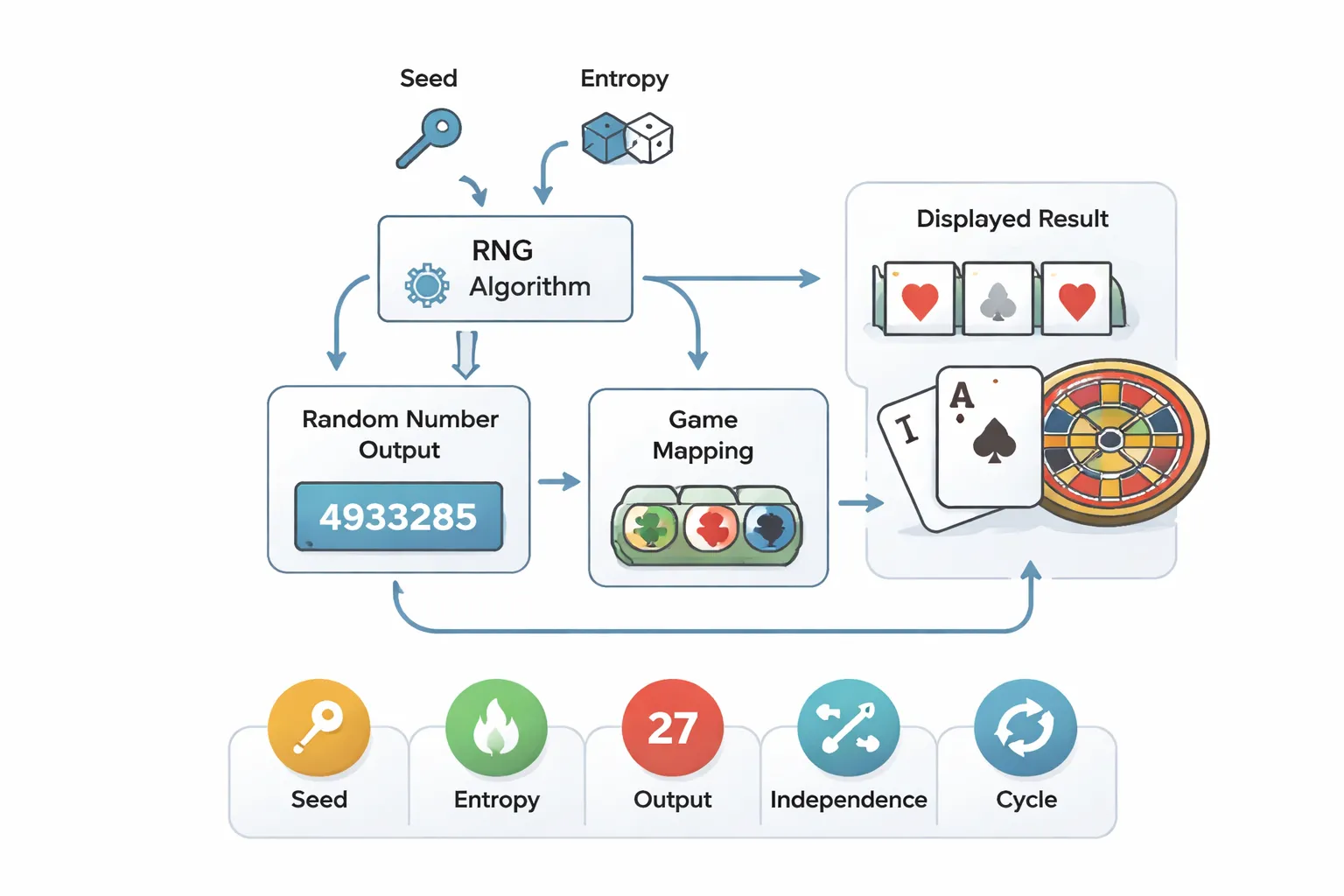
Plain-English definition of an RNG in casino games
RNG means random number generator. In casino games, it is the system that creates numbers your game uses to decide results.
In an online slot, the RNG picks a number. The game maps that number to a reel stop. The symbols you see come after the number.
In RNG roulette, the RNG picks a number from 0 to 36, or 0 to 37 with double zero. The wheel graphic follows the pick.
An RNG does not “watch” your balance, your bet size, or your last spins. It just outputs numbers. The game rules and paytable convert those numbers into wins and losses. If you want the math behind that conversion, use house edge, probability, and payouts and rules and paytables.
Where RNGs are used
- Online casinos, slots, video poker, RNG blackjack, RNG roulette, RNG baccarat, crash-style games, instant win games.
- Electronic gaming machines in land casinos, slot machines, video poker terminals, many electronic roulette terminals.
- Some digital table games, stadium games, and hybrid terminals that show a “table” interface but use software outcomes.
Game type matters. A slot RNG drives every spin. A video poker RNG selects the next cards from a virtual deck. A digital roulette RNG selects the winning pocket.
RNG vs live dealer outcomes
Live dealer games use physical randomness. A dealer shuffles and deals real cards. A wheel spins and a ball drops. Humans and physics drive the result.
Some live dealer systems add tech to manage the game feed and read outcomes. The outcome still comes from the physical cards or wheel. The RNG does not decide the winner.
If you chase patterns, you will make bad calls in both formats. Past results do not change the next result. See the gambler’s fallacy and myths vs facts.
Key terms you will see in RNG discussions
- Seed, the starting value the RNG uses to begin producing numbers. Change the seed, you change the sequence.
- Entropy, the input that adds unpredictability. True RNGs draw entropy from physical sources. Pseudo RNGs use math plus a seed.
- Output, the stream of numbers the RNG produces. The game maps the output to cards, reel stops, or outcomes.
- Cycle, how long a pseudo RNG runs before it repeats the sequence. Longer cycles reduce repeat risk in practice.
- Independence, each result stands alone. Your last spin does not change your next spin. Good RNG design aims for outputs that behave like independent draws.
How casino RNGs work (from randomness to game outcomes)
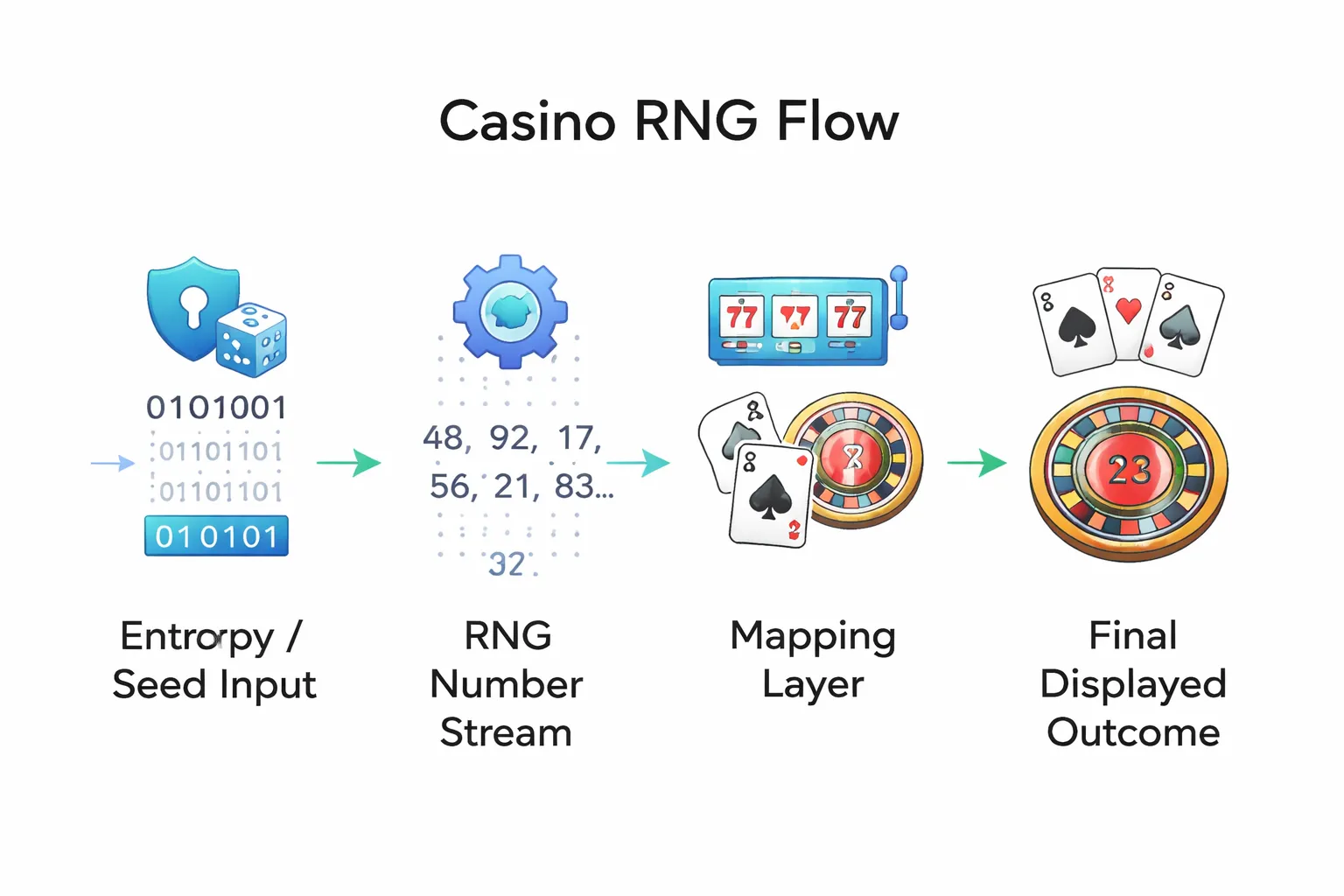
Step-by-step, from randomness to outcome
Casino games follow the same core flow. The RNG creates numbers. The game turns those numbers into a result. The screen shows the result.
- Entropy or seed: The system sets a starting state. It can come from hardware noise, system timers, or a stored seed. This state drives the next outputs.
- Number stream: The RNG generates a stream of values. Each value falls within a defined range, like 0 to 4,294,967,295 for a 32-bit output.
- Mapping: The game converts the raw value into a game event. That event can be a reel stop, a card order, or a roulette number.
- Result displayed: The client plays an animation, then reveals what the mapping already decided.
Continuous vs event-based RNG generation
Many casino RNGs run continuously. They keep producing numbers even when you do nothing. When you click spin or deal, the game grabs the next value in the stream and maps it to an outcome.
Some systems act closer to event-based. They generate or request random values when you place a bet. Online games often do this on the server side, then send the confirmed result to your device to display.
For you, the key point stays the same. Your timing selects which RNG output the game uses. Your past results do not change the next output.
Mapping examples you can picture
- Slots, reel positions: The RNG output maps to a stop index on each reel. Most modern slots use virtual reels, which means each visible symbol can appear multiple times in the stop table. That weighting shapes hit frequency and payout patterns. RTP comes from these weights and the paytable, not from the spin animation. For more on RTP, see /rtp-explained-how-to-use-return-to-player-to-choose-slots.html.
- Virtual cards, shuffles: The game assigns each card a position using random values, then deals from the top. Good implementations avoid modulo bias by discarding out-of-range values instead of forcing a remainder.
- Roulette numbers: The RNG output maps to one of 37 or 38 outcomes, depending on the wheel. The mapping must keep each number at the same probability. The house edge comes from the payout rules, not from the RNG. See /how-casinos-make-money-house-edge-rtp-and-the-math-behind-it.html and /which-casino-games-have-the-best-odds-ranked-by-house-edge.html.
Why the outcome is set when you click
The game locks the result at the moment you commit the action. That action can be spin, deal, or hit. The RNG value gets pulled, mapped, and recorded.
The animation runs after that. It does not search for a win. It does not “almost hit” then change. It just reveals the decision already made.
Types of RNGs used in casinos: PRNG vs TRNG (and why it matters)
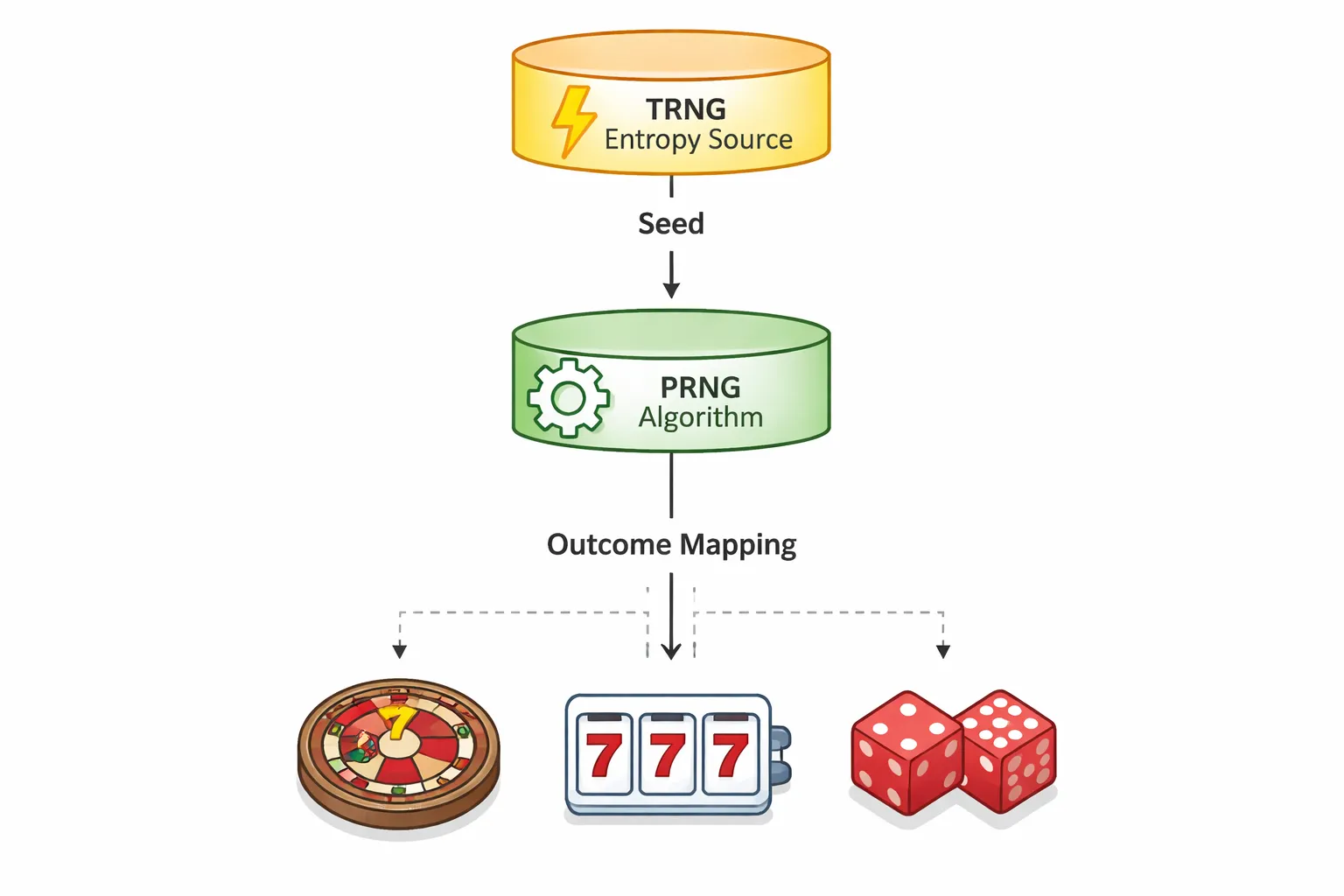
PRNG vs TRNG, the two RNG types you will see
Casinos use two main RNG types, pseudo-random number generators, and true random number generators. Both can produce results that look random in play. The difference sits under the hood, in how numbers get created and verified.
PRNG basics, fast, repeatable, and built for games
A PRNG is software. It uses an algorithm to generate a stream of numbers.
It starts from a seed value. From that seed, the next numbers follow a fixed path. Same seed, same sequence. That makes a PRNG deterministic.
In casino games, you do not know the seed, and you cannot observe enough internal state to predict outcomes. What you see is statistical randomness, meaning the output passes strong tests for randomness even though the process is mechanical.
- Algorithm, the math that turns one state into the next.
- Seed, the starting input that sets the initial state.
- Determinism, repeatable output if you repeat the same setup.
- Statistical quality, how well the output matches expected random patterns over large samples.
PRNGs run fast. They scale across many games and many players. That is why you see them everywhere in online casinos.
TRNG basics, physical entropy as the source
A TRNG uses hardware to measure unpredictable physical events. It converts that noise into bits, then into numbers.
- Electronic noise, noise from circuits, diodes, or resistors.
- Timing jitter, tiny variations in clock timing.
- Photon or quantum sources, in some high-end devices.
TRNG output is non-deterministic. You cannot replay the same sequence by reusing a seed, because the source comes from the physical world.
TRNGs can run slower and cost more to deploy and monitor. Many systems use TRNGs where they matter most, then rely on PRNGs for high-volume output.
Hybrid systems, TRNG seeding a PRNG
Many casino stacks use a hybrid approach. A TRNG feeds fresh entropy into a PRNG.
- TRNG generates entropy bits.
- The system uses those bits to seed or reseed a PRNG.
- The PRNG produces the next game values at high speed.
This setup gives you two benefits, strong unpredictability from the seed, and fast number generation during play.
Why it matters to you as a player
You should care less about the label and more about proof of quality.
- Independent testing, the RNG and game math get tested by accredited labs.
- Certification reports, the operator and provider should list test labs and license details.
- Provider reputation, established studios face more scrutiny and audits. See casino game providers.
- Game rules and paytables, your real edge comes from rules, limits, and payouts. Use rules and paytables.
- RTP and house edge, these control long-run cost, not the RNG type. Use RTP and house edge.
A good PRNG beats a bad TRNG. The audits, the implementation, and the controls matter more than the marketing term.
| Feature | PRNG | TRNG |
|---|---|---|
| Source | Algorithm and internal state | Physical entropy measured by hardware |
| Deterministic | Yes, same seed yields same sequence | No, output depends on physical noise |
| Speed | Very fast | Often slower |
| Typical casino use | Main number stream for games | Seeding, reseeding, key security, some land-based systems |
| What you should check | Lab testing, certification, provider, license | Lab testing, certification, entropy handling, monitoring |
RNG fairness, RTP, and common myths players believe
RNG fairness is not RTP
The RNG decides outcomes. RTP defines how much a game pays back over time. They connect, but they are not the same thing.
RNG fairness means each spin or hand comes from the same rules and the same random process. No memory. No pattern you can use.
RTP comes from the game’s math model. Designers set reel maps, symbol weights, bonus frequency, and paytable values to target a long-run return.
RTP shows up only over huge samples. Think millions of spins. Your session can land far above or below the stated RTP.
- RNG answers, what happened on this spin.
- RTP answers, what you should expect across a massive number of spins.
- Short-term results mainly reflect variance, not the RTP.
How RTP gets measured in practice
Labs and regulators verify outcomes match the approved math. They run large simulations and statistical checks. They also review game code, configuration files, and change controls.
- RTP testing uses large datasets, not small play sessions.
- Certification targets compliance with the approved model, not your personal results.
- Different RTP versions can exist, if the regulator allows multiple settings.
If you want a fast comparison across games, use house edge and RTP rankings, see which casino games have the best odds.
Independence of spins, why “due to hit” and “hot or cold” are myths
Modern slots and most online casino games use independent trials. Each spin starts fresh. Past outcomes do not change future odds.
- “Due” is a myth. A long losing run does not increase the chance of a win next spin.
- “Hot” and “cold” is a myth. A recent jackpot does not make a jackpot less likely next spin.
- Stopping a reel at a certain time does not change the RNG result in properly built games.
If you want the common claims broken down, use casino myths vs facts.
Near-misses, streaks, and why randomness feels unfair
Random sequences cluster. You will see streaks. You will see droughts. That can look rigged, even when it is normal.
Slots also use near-miss visuals. You might see two bonus symbols and miss the third. That feeling comes from presentation, not from the RNG “almost” giving you a win.
- Variance means results swing around the long-run average.
- High volatility games pay less often, but can pay bigger when they hit.
- Low volatility games hit more often, but usually pay smaller.
Your bankroll and session length matter more than most players think. Short sessions amplify swings.
Can casinos turn down a slot in real time
In regulated markets, legal changes follow strict controls. Operators can select from approved RTP settings only if the jurisdiction allows it. They cannot freely tune payouts on the fly without leaving audit trails.
- Most jurisdictions require approved RTP configurations and logged changes.
- Some require the RTP setting to stay fixed for long periods, or for the life of the game install.
- Online platforms often lock configurations at the game provider level, then regulators audit operator access.
Illegal manipulation exists in unlicensed environments. That is why your best defense stays simple, play licensed casinos, check the game provider, look for lab certification, and avoid sites with no regulator.
RNG testing, certification, and regulation (how fairness is verified)
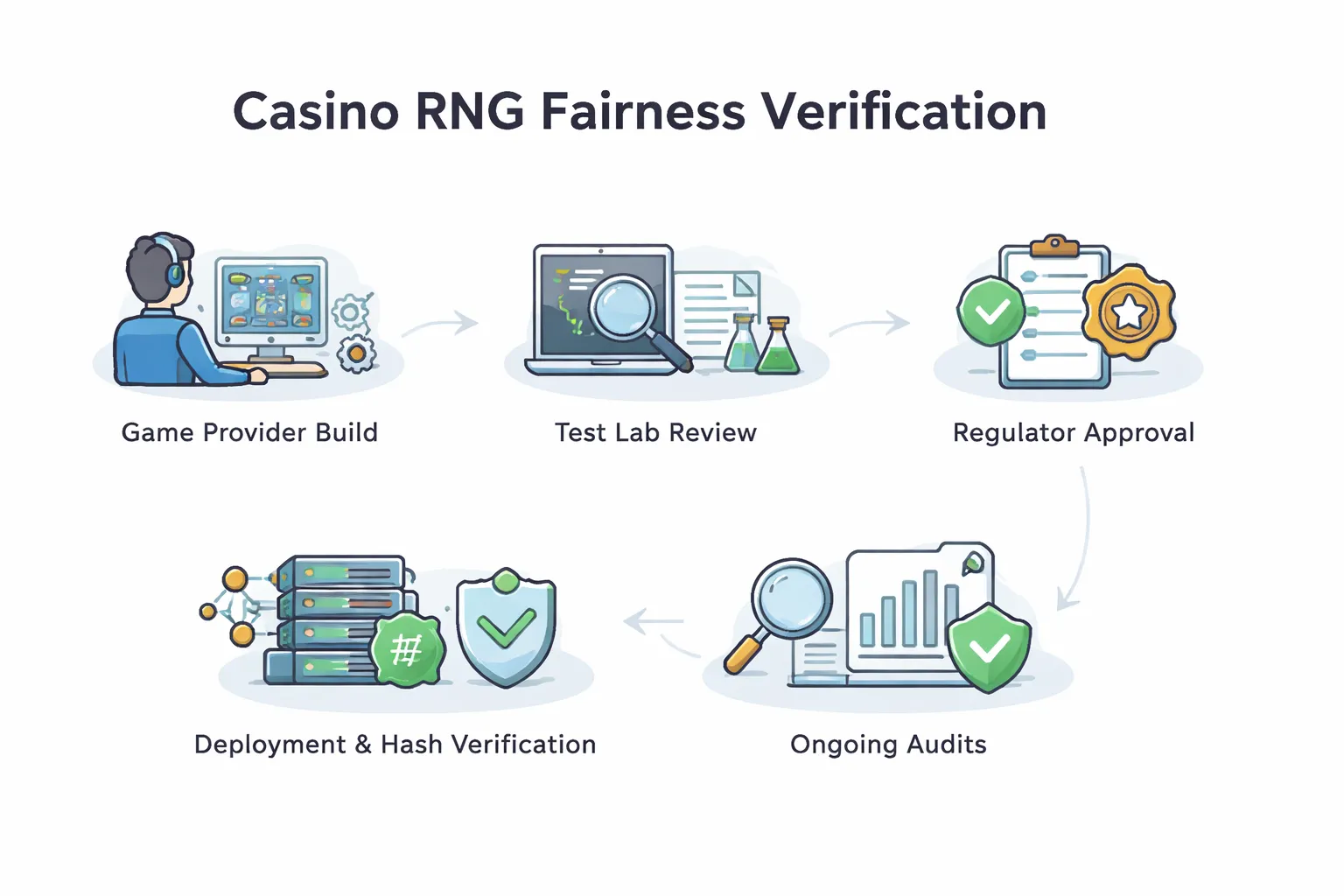
Fair RNGs do not rely on trust. They rely on proof. Labs test the math, the code, and the output. Regulators control who can change settings, when they can change them, and how changes get logged. You should know what to look for, and what those seals mean.
- Independent test labs review source code, builds, and configuration controls.
- Statistical testing checks output for bias and predictable patterns across large samples.
- Game math checks confirm RTP and odds match the published rules.
- Deployment controls verify the approved build matches what runs on the live server.
- Ongoing audits check updates, patches, and access logs.
In practice, fairness verification comes down to licensing and paperwork you can verify. Match the casino license to a real regulator. Check the game provider name. Look for lab certificates tied to specific game versions. If a site hides this, treat it as a risk. If you want a quick reset on bad beliefs about patterns and “due” outcomes, read The Gambler’s Fallacy Explained (With Simple Examples).
Read our detailed guide: RNG testing, certification, and regulation (how fairness is verified) - Casino RNG Explained: How Random Number Generators Work
Where RNG is used across casino game categories (quick guide)
Slots
Slots use an RNG to pick an outcome for each spin. The screen animation comes after.
- Reel mapping. The game maps RNG numbers to symbols on each reel. This mapping drives hit rate and payout distribution.
- Virtual reels. Many slots use virtual reel strips, not the visible symbols you see. Some symbols appear more often on the strip, others appear less. That is how rarity gets built in.
- Paytables and bonus rules. The paytable sets payouts for symbol combinations. Bonus triggers and bonus outcomes also come from RNG draws, based on the game’s coded rules.
- RTP and variance. RTP describes the long run return. Variance describes how clustered wins feel in the short run. If you need definitions, use our casino terminology glossary, and our guide on slot volatility and variance.
Virtual table games (RNG versions of blackjack, roulette, baccarat, craps)
These games use RNG to replace physical random events. The rules stay the same, the random source changes.
- Card games. The RNG drives shuffling and dealing. The system selects cards from a virtual deck using a sampling method that avoids bias and repeats.
- Roulette. The RNG selects a number from 0 to 36, plus 00 where used. The wheel spin you see is a display of that result.
- Craps. The RNG selects dice results, typically as two values from 1 to 6. The table layout and payouts follow standard rules.
Keno, bingo, and lottery-style games
These games rely on number draws. Fairness depends on how the system samples numbers.
- Keno. The RNG draws a set of numbers from a range, like 20 numbers from 1 to 80. The key point is unbiased sampling without repeats where rules require it.
- Bingo. The RNG draws balls from a virtual pool and removes each ball after it hits, so it cannot repeat in the same round.
- Lottery-style instant wins. The RNG selects outcomes from a defined pool or probability table. Some games use finite pools, others use pure probability, the math sits in the game rules.
Live casino
Live dealer games use physical randomness for the main game. RNG shows up in specific add-ons.
- Physical outcomes. The dealer deals real cards. The wheel spins in real time. Those results do not come from software RNG.
- RNG-based features. Side bets, multipliers, prize drops, and bonus wheels can use RNG, depending on the provider. Read the game info and paytable, and check the lab certificate for that exact game version.
- Game rules still matter. House edge and payout structure drive your expected results. Myths about “due” outcomes do not help you. Use our myths vs facts guide if you want a clean reset.
| Game category | What RNG controls | What you should check |
|---|---|---|
| Slots | Symbol selection, bonus triggers, bonus outcomes | RTP, variance, game rules, lab certificate for the exact version |
| Virtual table games | Shuffle, deal, number selection, dice results | Rules, payout table, provider, certification |
| Keno, bingo, lottery-style | Number draws and non-repeating sampling where required | Draw method, pool rules, payout structure, certification |
| Live casino | Usually side features, not the main physical outcome | Game info for side bets and modifiers, version-specific lab report |
- In het kort: RNGs generate numbers for each game event, then the game rules convert those numbers into outcomes.
- In het kort: A good RNG stays unpredictable, uniform, and independent from spin to spin, hand to hand, and draw to draw.
- In het kort: Certification matters. You want an RNG and game build tested by an accredited lab, with a clear report scope.
- In het kort: RTP and house edge come from the math model and payout table, not from “hot” or “cold” streaks.
- In het kort: Slots and virtual table games rely on RNG for the main outcome. Live casino uses RNG mainly for side bets and modifiers.
- In het kort: Your best checks are simple. Verify the provider, game version, lab certificate, RTP, and rules.
Practical checklist for you:
- Open the game info. Confirm the stated RTP and volatility, if shown.
- Find the certification link or lab name, then match it to the exact game title and version.
- Check what the test covers. RNG only, or RNG plus game logic and payout mapping.
- Read the rules and paytable. This is where the odds get locked in.
- For live games, separate the physical outcome from RNG-based side features.
- Compare games using RTP and house edge, not recent results.
If you want a fast way to shortlist slots, use RTP first, then confirm the certificate and rules. For tables, focus on house edge and rule set. For deeper comparisons, see /rtp-explained-how-to-use-return-to-player-to-choose-slots.html and /casino-odds-comparison-poker-vs-blackjack-vs-baccarat.html.
FAQ
What does a casino RNG do?
An RNG outputs numbers on every spin, hand, or draw. The game maps those numbers to symbols, cards, or roulette pockets. The RNG keeps running whether you bet or not. Your click only captures the next result.
Are online casino RNGs truly random?
Most use a pseudo-random number generator. It creates unpredictable sequences from a starting seed. Auditors test results for bias and repeatability. For you, the key is certification and published RTP, not the “type” of RNG.
Can I predict or time an RNG?
No. Modern RNGs cycle fast and use large state spaces. Timing tricks fail because you cannot know the internal state or exact capture moment. Past results do not help. Focus on RTP, rules, and bankroll limits.
Do hot and cold streaks mean the RNG is rigged?
No. Streaks happen in random data. Short sessions exaggerate runs. Use large samples and certified reports if you want to judge fairness. For slots, compare RTP and volatility, not recent spins.
Does changing bet size affect RNG outcomes?
No. Bet size changes payout size, not the random pick. Some features use different reel sets or paytables, but the RNG still selects the outcome. Always read the rules for feature triggers and bet requirements.
Is the RNG the same as RTP?
No. RNG picks outcomes. RTP describes the long-run payback across many spins. A fair RNG can still produce a low RTP game. Use RTP to shortlist slots, then verify certification. See RTP explained.
How do auditors test RNG fairness?
They run statistical tests on large output samples, check for bias, and confirm game mapping matches the approved design. They also verify build versions and settings. Look for named labs and current certificates in the game info.
Can casinos change RNG settings to target players?
Licensed casinos cannot legally change certified RNG behavior per player. They can choose which game version to offer and set optional parameters when allowed. You should still verify the license, the lab certificate, and the game rules.
Do live dealer games use an RNG?
Usually no. Live roulette uses a physical wheel. Live blackjack uses real cards. Some studios add RNG-based side bets or multipliers. Treat those side features like slots, check RTP terms and independent testing.
What should I check before playing an RNG game?
- RTP and rules, including bonus and feature terms.
- Volatility for bankroll fit. See slot volatility.
- Provider and build. See game providers.
- Certificate from a known test lab, with date and version.
Which games rely most on RNG?
Slots, video poker, digital table games, and instant-win games rely on RNG for every outcome. For classic tables, house edge comes from rules and payoffs. Use odds comparisons when choosing table games. See casino odds comparison.
Conclusion
RNG decides results in most online casino games. You cannot predict it, and you cannot influence it.
You can still make better choices. Check the game paytable and rules. Confirm RTP, volatility, and max win. Verify the provider and a current test lab certificate. Use the details to match your bankroll and risk tolerance.
- Learn the basics of casino operations in What Is a Casino and How Does It Work? A Beginner’s Guide.
- Know who builds the software in Casino Game Providers Explained.
- Spot key rule lines and payout traps in How to Read Casino Game Rules and Paytables.
Final tip. Pick one game. Read the paytable. Set a loss limit and a win stop. Quit when you hit either number.
-
RTP Explained: How to Use Return to Player to Choose Slots
1 week ago -
What Is a Casino and How Does It Work? A Beginner’s Guide
1 week ago -
The Gambler’s Fallacy Explained (With Simple Examples)
1 week ago -
Casino Etiquette 101: Rules and Tips for First-Time Visitors
1 week ago -
Casino Myths vs Facts: Hot Streaks, “Due” Numbers, and Luck Explained
1 week ago
-
-
- What does a casino RNG do?
- Are online casino RNGs truly random?
- Can I predict or time an RNG?
- Do hot and cold streaks mean the RNG is rigged?
- Does changing bet size affect RNG outcomes?
- Is the RNG the same as RTP?
- How do auditors test RNG fairness?
- Can casinos change RNG settings to target players?
- Do live dealer games use an RNG?
- What should I check before playing an RNG game?
- Which games rely most on RNG?
-
-
-
- What does a casino RNG do?
- Are online casino RNGs truly random?
- Can I predict or time an RNG?
- Do hot and cold streaks mean the RNG is rigged?
- Does changing bet size affect RNG outcomes?
- Is the RNG the same as RTP?
- How do auditors test RNG fairness?
- Can casinos change RNG settings to target players?
- Do live dealer games use an RNG?
- What should I check before playing an RNG game?
- Which games rely most on RNG?
-
-
Fairness in Casino Games: RNGs, Odds, House Edge, and Return-to-Player (RTP) - Security, Fairness, and Regulation: How Casinos Keep Games Legit - What Is a Casino and How Does It Work? A Beginner’s Guide
1 week ago -
Regulation and Licensing: Who Oversees Casinos and What Rules They Must Follow - Security, Fairness, and Regulation: How Casinos Keep Games Legit - What Is a Casino and How Does It Work? A Beginner’s Guide
1 week ago -
Security, Fairness, and Regulation: How Casinos Keep Games Legit - What Is a Casino and How Does It Work? A Beginner’s Guide
1 week ago -
What Is a Casino and How Does It Work? A Beginner’s Guide
1 week ago -
How Casinos Make Money: House Edge, RTP, and the Math Behind It
1 week ago
-
Security, Fairness, and Regulation: How Casinos Keep Games Legit - What Is a Casino and How Does It Work? A Beginner’s Guide
1 week ago -
RTP Explained: How to Use Return to Player to Choose Slots
1 week ago -
What Is a Casino and How Does It Work? A Beginner’s Guide
1 week ago -
How to Set a Gambling Budget (and Stick to It)
1 week ago -
Responsible Gambling Tips: Limits, Tools, and Safer Play
1 week ago