RTP Explained: How to Use Return to Player to Choose Slots

RTP tells you how much a slot returns to players over the long run. It is a percentage based on millions of spins. Higher RTP means lower house edge, but it does not remove risk. You still face variance and bankroll swings.
This guide shows you how to read RTP numbers, convert RTP into house edge, and compare slots fast. You will learn where to find RTP in game info and casino menus, what RTP ranges matter, and when RTP can change by jurisdiction or operator settings. You will also learn how RTP works with volatility so you can pick games that match your budget and goals.
If you want definitions for related terms, use our casino terminology glossary.
RTP explained and how to use it to choose slots: the plain-English meaning
What RTP means in plain English
RTP stands for Return to Player. It tells you how much a slot pays back over the long run.
RTP shows as a percentage. Example, 96% RTP means the game returns about $96 for every $100 wagered, across a huge number of spins.
What RTP does and does not tell you
RTP is a long-run average. It describes millions of spins, across many players, over time.
It does not predict your next session. In the short term, you can win big, lose fast, or hover near even.
Use RTP to compare games, not to forecast outcomes. The RNG drives each spin. For details, see /casino-rng-explained-how-random-number-generators-work.html.
RTP vs house edge, convert it fast
RTP and house edge are two sides of the same math.
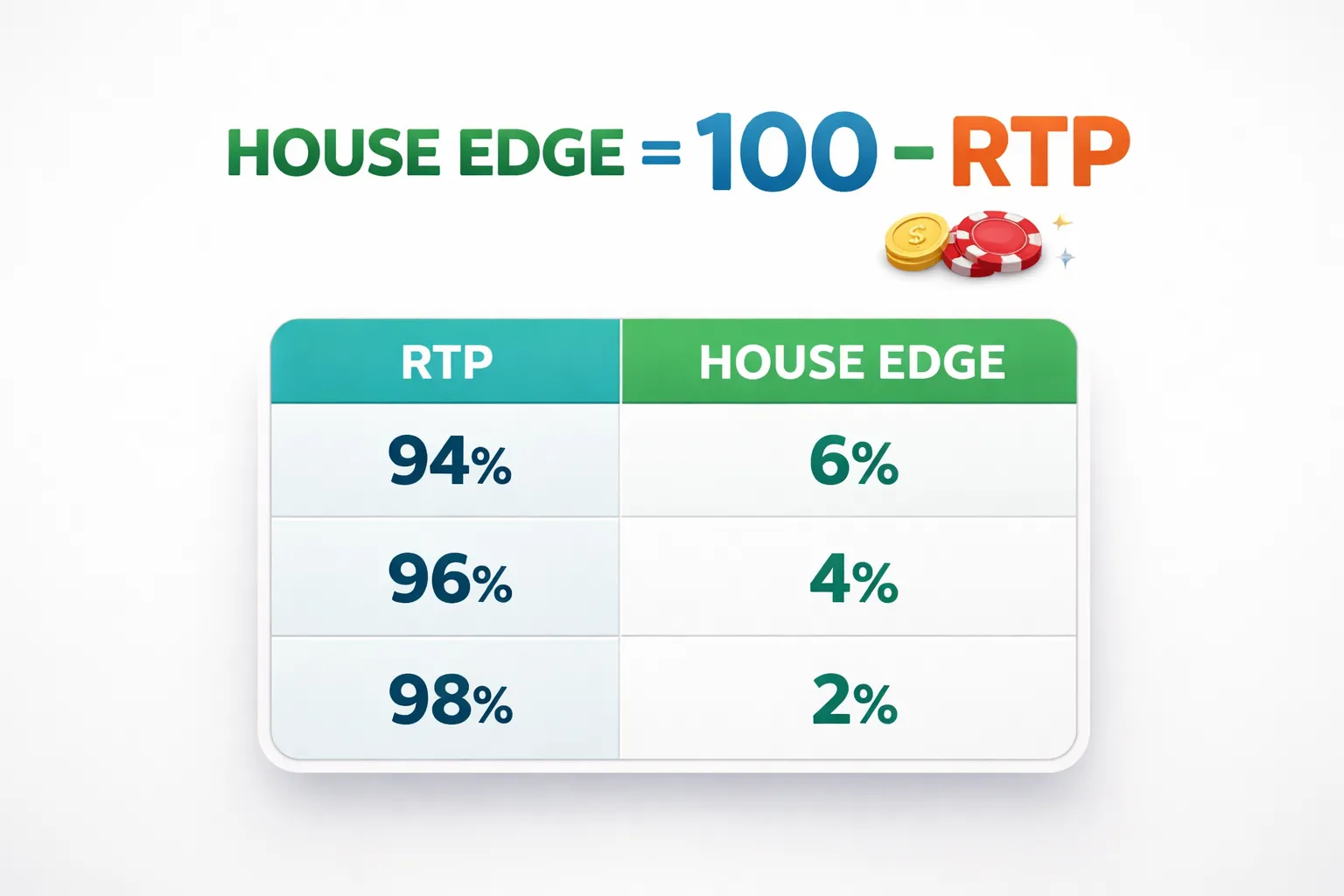
- House edge (%) = 100% - RTP (%)
- RTP (%) = 100% - house edge (%)
If a slot has 96% RTP, the house edge is 4%. That 4% is the casino’s theoretical advantage over the long run.
| RTP | House edge | What it means per $100 wagered |
|---|---|---|
| 94% | 6% | About $6 theoretical loss |
| 96% | 4% | About $4 theoretical loss |
| 98% | 2% | About $2 theoretical loss |
Use house edge when you compare different casino games. Start here, /which-casino-games-have-the-best-odds-ranked-by-house-edge.html.
How to use RTP to choose slots
- Pick higher RTP first. All else equal, 96% beats 94%.
- Look at the gap. A 1% RTP difference equals $1 per $100 wagered in the long-run average.
- Match RTP with volatility. RTP tells you the average, volatility tells you the ride. High volatility can still mean long losing stretches, even with strong RTP.
- Check the exact version. Some slots ship with multiple RTP settings. Casinos can offer a lower or higher config.
RTP in slots vs RTP in table games
Slots often show a wide RTP range because the provider can build different payout models, then allow operators to pick an RTP setting.
Table games tend to cluster tighter because rules and optimal strategy set the edge. Your choices matter more than the label. Blackjack can swing based on rules and play. Baccarat stays closer across tables.
If you want a direct comparison across poker, blackjack, and baccarat, use /casino-odds-comparison-poker-vs-blackjack-vs-baccarat.html.
How slot RTP is set and calculated (and why the number can differ by casino)
Slot RTP starts in the math model. The studio sets reel symbols, hit frequency, bonus triggers, and payout weights. Then they run large simulations to estimate the long-run return. Many modern slots ship with multiple RTP profiles, like 92 percent, 94 percent, or 96 percent. The casino picks one during configuration, then locks it in.
That is why the same game can show different RTP numbers across casinos. Regulation also matters. Some markets require a minimum RTP, some require the displayed RTP to match the deployed profile, and some allow more flexibility. A casino can also change which RTP version it offers by jurisdiction, channel, or game lobby, even when the slot name looks identical.
If you want to sanity check what you see, learn how RNG output maps to outcomes and why short sessions can mislead you. Use our RNG explainer for the mechanics.
Read our detailed guide: How slot RTP is set and calculated (and why the number can differ by casino) - RTP Explained: How to Use Return to Player to Choose Slots
What’s a good RTP? Benchmarks, tiers, and real-world expectations
Common RTP ranges and what they imply
RTP tells you the long-run payback rate of a slot. Higher RTP usually means a smaller house edge. It does not tell you how a short session will go.
| Published RTP | What it usually means for you | Typical use cases |
|---|---|---|
| Under 94% | High house edge. Your bankroll drains faster at the same bet size. | Some older titles, some branded games, some casino-specific RTP cuts. |
| 94% to 95.9% | Common “low-to-mid” band. You can still get big wins, but you pay more for playtime. | Many mainstream video slots in mixed RTP lobbies. |
| 96% to 97.9% | Strong for most markets. Better value per spin. Longer expected playtime at the same budget. | Many player-friendly releases, some “high RTP” versions by top studios. |
| 98%+ | Elite. Great on paper. Often comes with design trade-offs or limited availability. | Select titles, specific jurisdictions, bonus-buy modes in some games, rare “high RTP” configs. |
Use RTP as a filter. Then check volatility, max win, bonus rules, and bet size. Our guide on slot volatility and variance helps you match the risk level to your budget.
A practical “sweet spot” for most players
For most players, 96% to 97% works well. You get decent value without chasing rare 98%+ versions that you may not even have access to.
Ultra-high RTP is rare because casinos and studios price games for a target margin. Many platforms also offer multiple RTP settings. The same slot can show different RTP values by casino, jurisdiction, or channel.
Do not treat a high RTP as a promise of quick profit. RNG output stays random per spin. Short runs swing hard. Use our RNG explainer if you want the mechanics, and avoid “due” thinking from the gambler’s fallacy.
RTP trends by slot type
- Classic slots (3 reels). Often simple math models. RTP varies a lot by operator. Many sit in the mid-90s, some lower.
- Modern video slots. Most cluster around 95% to 97%. This is where you see the widest choice of high-RTP options.
- Megaways and high-ways games. RTP often sits in the mid-90s to high-96s, but volatility tends to run high. Expect bigger swings and longer dry spells.
- Jackpot and progressive slots. Base-game RTP can look lower because part of the return funds the jackpot pool. Some games publish two figures, one for base RTP and one including jackpot contribution.
Do not compare jackpot RTP to non-jackpot RTP without checking what the number includes. If the payback depends on a jackpot you may never hit, your real session results will often track closer to the base game.
Highest-RTP slots: why they run high, and what you trade
Very high RTP usually comes from one or more of these choices:
- Lower hit rate on big features. The game returns value through fewer, larger events. That raises volatility.
- Smaller max win caps. Some high-RTP games limit the top payout to control risk.
- Flatter bonus structure. Fewer extreme multipliers, more steady returns.
- Specific RTP configurations. The casino runs a high-RTP version for one market and a lower one elsewhere.
When you see 98%+, verify the exact RTP setting inside the game info panel. Then decide if the volatility profile fits your goals and your bankroll. Ignore “hot” and “due” claims. Use the facts in our casino myths vs facts guide.
RTP vs volatility: how to pair payout percentage with the right risk level
Volatility explained: hit frequency, payout distribution, and bankroll swings
RTP tells you the long-run payout percentage. Volatility tells you how that payout arrives.
- Hit frequency. How often you land any win. High hit frequency feels busy, but many wins can be small.
- Payout distribution. Where the value sits. Low volatility spreads value across many small and mid wins. High volatility concentrates value in rare big hits.
- Bankroll swings. How fast your balance moves up or down. Higher volatility creates deeper downswings and sharper spikes.
RTP answers “how much” over time. Volatility answers “how rough” on the way there. For definitions, see our casino terminology glossary.
Why two 96% RTP slots can feel completely different
Two slots can both show 96% RTP and still play nothing alike.
- Slot A pays frequent 0.2x to 1x wins and occasional 10x to 30x hits.
- Slot B pays long stretches of nothing, then rare 100x to 1,000x hits.
Both can average out to 96% over a huge sample. Your session results will differ because the variance differs. If you want the deeper breakdown, use our slot volatility and variance guide.
Low vs medium vs high volatility: who each style suits
- Low volatility. Better for smaller bankrolls, longer playtime, and steadier results. You trade away big top prizes.
- Medium volatility. A balance of base-game wins and feature-driven payouts. Fits most casual sessions.
- High volatility. Better if you can handle long losing runs and you chase big multipliers. You need stricter bankroll control.
Match volatility to how many spins you plan to play and how much drawdown you can accept. Do not match it to your mood.
How features change variance without changing RTP much
Many mechanics shift payouts into rarer, bigger events. The RTP can stay similar, but the ride gets rougher.
- Free spins. Often concentrate value in the bonus. Base game can feel dry.
- Multipliers. Increase the size gap between normal wins and peak wins. Variance rises.
- Expanding symbols, reels, and respins. Create clustered payouts. You see streaks instead of smooth returns.
- Bonus buys. You pay to skip the low-return base game portion of your session. RTP may change by mode, and variance usually increases because results hinge on fewer events.
- Progressive or must-drop style prizes. Add rare, high-value outcomes. They can dominate the distribution.
Check the info panel for RTP by feature or mode when the game offers it. Some titles list separate RTP values for base game and buys.
Practical pairings: RTP plus volatility for common goals
| Your goal | RTP target | Volatility target | How to play it |
|---|---|---|---|
| Maximize playtime on a tight bankroll | 96% to 98%+ | Low | Use smaller bets, avoid bonus buys, favor higher hit frequency. |
| Balanced sessions with a shot at a solid win | 96% to 97% | Medium | Stay consistent with bet size, expect normal swings, chase features but do not force them. |
| Hunt big hits and accept long dead stretches | 96% to 97%+ | High | Increase bankroll buffer, lower bet relative to bankroll, set a hard stop-loss. |
| Short session, fast results | 96%+ | Medium to high | Expect higher variance per minute, avoid raising stakes after losses. |
| Feature-focused play | Verify mode-specific RTP | Usually higher than base game | Read buy rules and RTP, treat each buy as a high-variance bet. |
Use RTP to filter for better long-run value. Use volatility to pick the risk level you can afford. Pair both, then set a bankroll limit and stick to it.
How to use RTP to choose slots: a step-by-step selection checklist
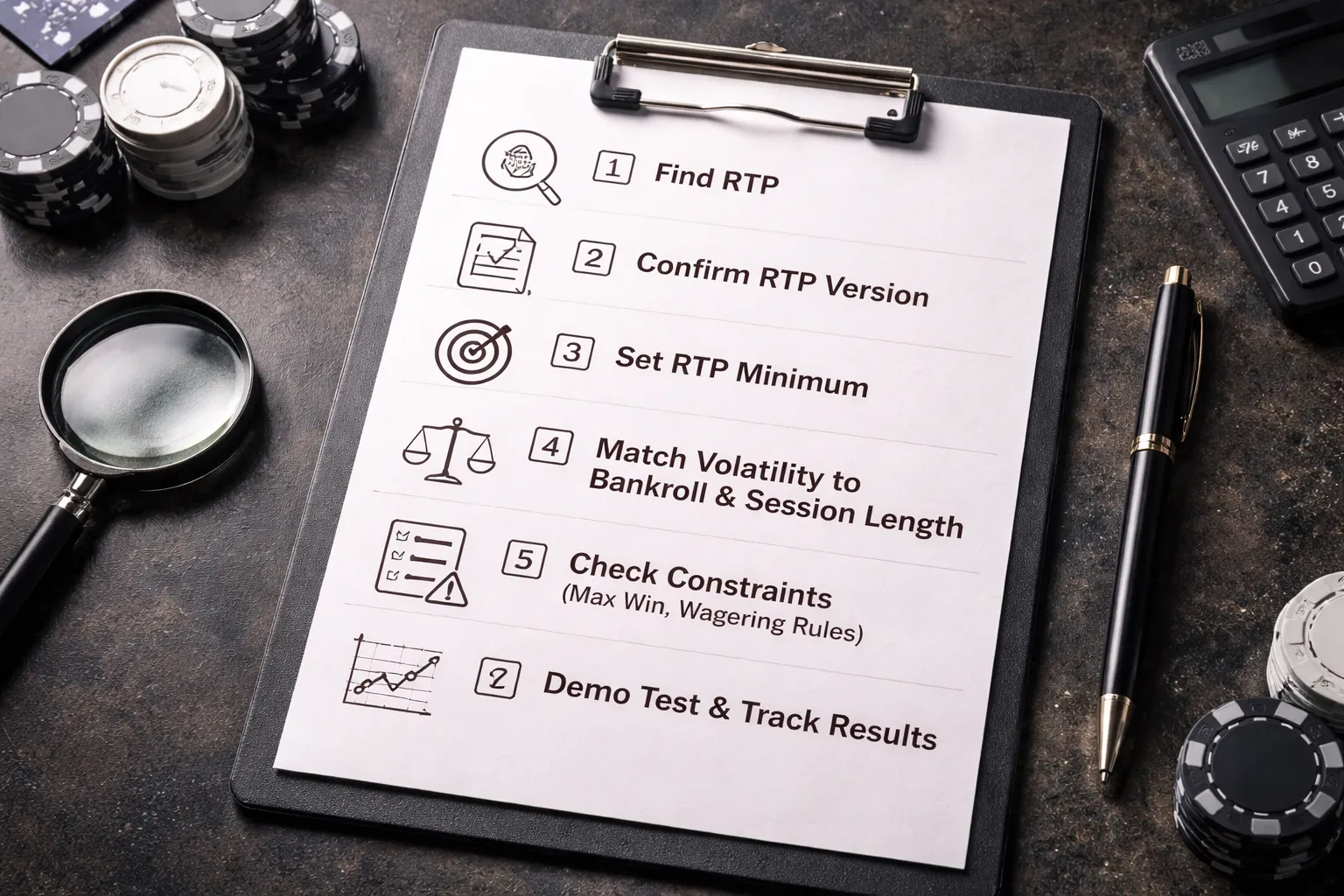
Step 1: Find the RTP number
Start with the game itself. Many slots show RTP inside the info menu.
- In-game info button: Look for “RTP”, “Return to Player”, or “Theoretical payout”.
- Paytable and rules screen: Some games list RTP near the bottom of the rules.
- Casino help pages: Some casinos publish RTP per game in their support section.
- Provider RTP sheets: Studios often publish a spec sheet. Use it to verify the possible RTP settings for that title. Learn the basics in Casino Game Providers Explained.
If you cannot find an RTP value, skip the game. You cannot compare what you cannot verify.
Step 2: Check for multiple RTP versions and confirm the casino’s version
Many slots ship with several RTP configurations. The casino selects one.
- Search the rules screen for a specific value like 96.2%, 94.0%, or 92.0%.
- Match the value to the exact game build you play. Same name does not always mean same RTP.
- If the rules page lists a range, treat it as unknown until you confirm the exact number.
- If you play bonus buys or special modes, check if the mode has its own RTP.
If the casino will not disclose the configured RTP, move on.
Step 3: Set your RTP minimum and filter fast
Pick a cutoff and apply it every time. This stops you from chasing “hot” games.
- Common cutoffs: 96%+ for stricter filtering, 95%+ if your options are limited.
- Use the same standard across casinos so you can compare like with like.
- When you want better long-run value, RTP matters more than themes and features.
If you also play table games, compare baseline edges across games in Casino Odds Comparison: Poker vs Blackjack vs Baccarat.
Step 4: Match volatility to your bankroll, session length, and goals
RTP tells you expected return. Volatility tells you how rough the ride gets.
- Small bankroll, short session: Prefer low to medium volatility. You reduce the chance of fast bust-outs.
- Larger bankroll, longer session: Medium to high volatility can fit if you accept long losing runs.
- Entertainment-first play: Pick volatility that matches your comfort. Do not force high variance to chase big hits.
Set your stake so you can handle the game’s swings. Do not raise bets after losses. That feeds bad thinking. If you want a reset, read The Gambler’s Fallacy Explained.
Step 5: Check caps and constraints before you commit
Details can matter more than the headline RTP.
- Max win cap: A hard cap can reduce upside on high-hit sessions. Note the cap in multiples of your bet.
- Bet limits: Check min and max bet. Make sure your planned stake fits your bankroll plan.
- Bonus wagering rules: A high RTP slot can still be a poor choice under strict wagering, max bet rules, or excluded contributions.
- Feature buy rules: Treat each buy as a high-variance bet. Confirm the buy price, mode RTP, and any win cap.
Do this check first when you play with bonus funds. Constraints change the real cost of play.
Step 6: Sanity-check with demo play, then track results without reading too much into them
Use demo mode to confirm feel and mechanics. Do not use it to “prove” RTP.
- Verify hit frequency feels consistent with the game’s volatility label.
- Confirm the casino shows the same RTP in demo and real mode, if displayed.
- Run a simple log in real play. Track game name, RTP version, volatility, bet size, and session outcome.
- Judge your process, not short-term results. Variance dominates small samples.
Common RTP myths and mistakes that lead to bad slot picks
Myth: RTP guarantees your personal outcome
RTP describes long-run performance across a huge number of spins. It does not predict your session. It does not protect your bankroll.
You can play a 96% RTP slot and lose fast. You can play a 94% RTP slot and win big. Variance controls short sessions.
Use RTP as a filter, not a promise. Combine it with volatility, limits, and your time horizon.
Myth: A slot that hasn’t paid is “due” (gambler’s fallacy)
Past spins do not change the odds of the next spin. Each spin resolves from the same math model.
A cold streak does not mean a hot streak comes next. A big win does not “use up” future wins.
If you catch yourself chasing “due” payouts, stop. Switch games or stop the session. Learn the pattern behind this mistake in The Gambler’s Fallacy Explained (With Simple Examples).
Mistake: Ignoring volatility and bankroll fit
Two slots can share the same RTP and play nothing alike. Volatility decides how bumpy the ride gets.
- High volatility: longer dry spells, larger swing size, bigger bankroll needs.
- Low volatility: more frequent small hits, smaller swings, slower bankroll decay.
Bad pick pattern: you choose a high volatility slot because the RTP looks good, then you underfund the session and tilt after a downswing.
Fix: set a bankroll and time budget first. Then choose volatility that fits. RTP comes after that.
Mistake: Confusing “max win” marketing with RTP value
Max win and RTP measure different things. “Max win 10,000x” says the ceiling exists. It says nothing about how often you reach it.
A slot can show a huge max win and still offer mediocre RTP. A high RTP slot can still have a lower max win.
Use max win as a risk signal, not a value signal. Higher max win often pairs with higher volatility.
Mistake: Assuming all casinos use the same RTP configuration
Many slots ship with multiple RTP versions. A casino can choose which one to run.
Bad pick pattern: you research “Slot X RTP 96.5%” and then play a 94% configuration without noticing.
- Check the game info panel and help file for the exact RTP.
- Look for wording like “RTP: 94% to 96.5%” and confirm the active value.
- Re-check after updates or provider swaps.
If you also compare games by house edge across the casino, use Which Casino Games Have the Best Odds? Ranked by House Edge.
Myth: Changing bet size changes RTP
On most modern slots, RTP stays the same across bet sizes. The paytable scales with your bet.
What can change is your outcome distribution. Bigger bets raise your swing size. You reach bonus thresholds faster in time, but not in probability per spin.
Cases where bet size can change effective RTP:
- Side bets or bonus buys: they can have a different RTP than base play.
- Feature toggles: modes that alter rules or paylines can change RTP.
- Jackpots and must-hit-by mechanics: contribution and hit rates can shift value by bet.
Fix: read the rules and paytable for the mode you play. Use How to Read Casino Game Rules and Paytables (So You Know What You’re Playing).
- In het kort: RTP is the game’s long-run average return, not a promise for your next session.
- In het kort: Higher RTP usually means a lower house edge, but variance decides how rough the ride feels.
- In het kort: Compare slots on RTP and variance together, then pick a bankroll and session length that fits.
- In het kort: Use RTP to filter games, then check the paytable for hit frequency, max win, and bonus rules.
- In het kort: RTP can change by mode, side bet, bonus buy, feature toggle, or jackpot settings. Read the rules for the mode you play.
- In het kort: Treat “up to” RTP claims with caution. Look for the exact RTP version and the operator’s chosen configuration.
Practical rules:
- Target 96 percent RTP or higher when you can, then sort by variance based on your risk tolerance.
- Keep your bet size stable. Frequent bet changes make results harder to judge.
- Assume short sessions tell you nothing about RTP. Track your total spins and total wager if you want a real read.
- Check for bonus buy RTP, side bet RTP, and jackpot contributions before you commit.
FAQ
What does RTP mean in slots?
RTP means Return to Player. It is the long-run percentage a slot pays back across millions of spins. A 96 percent RTP implies about 4 percent house edge. Your short-term results can differ a lot, especially on high variance games.
Is a higher RTP always better?
Yes, if all else stays equal. Higher RTP reduces the built-in cost of each spin. Variance still controls how rough the ride feels. Pick RTP first, then pick variance based on your bankroll and how long you plan to play.
How many spins do you need for RTP to matter?
A lot. Think thousands to tens of thousands of spins before results start to look “normal.” Most sessions stay far from the RTP. If you want a better read, track total wager and total return, not wins and losses by hour.
Can casinos change a slot’s RTP?
Sometimes. Many slots ship with several RTP settings, like 94, 95, and 96 percent. The casino chooses one configuration. The same game title can pay differently across sites. Check the game info panel, rules, or paytable before you play.
Do bonus buys and side bets change RTP?
Yes. Bonus buys can run on a different RTP than base spins. Side bets often have their own RTP and can lower your overall return. Read the rules for each feature. Use the paytable screen and help menu to confirm.
Does volatility matter as much as RTP?
Yes. RTP tells you the average cost. Volatility tells you the swing size and how often you can expect payouts. Two slots can share 96 percent RTP and feel nothing alike. Match volatility to your bankroll and patience.
Does betting more increase your chances of winning?
No. Betting more increases your expected loss in dollars per spin. Your odds and RTP stay the same. Higher bets can unlock larger paytable wins or jackpots, but you pay for that access with higher variance and higher cost per spin.
Where do you find a slot’s RTP?
Check the game’s info menu, paytable, or rules screen. Some casinos also list RTP on the game tile. If you want to verify what you are playing, use a quick rules check guide like /how-to-read-casino-game-rules-and-paytables-so-you-know-what-you-re-playing.html.
Is RTP the same as hit frequency?
No. Hit frequency is how often you get any payout. RTP is the long-run return across all outcomes. A slot can hit often with small returns and still have the same RTP as a slot that hits rarely with big wins.
Can RTP help you pick better beginner games?
Yes. Higher RTP helps control cost while you learn. Pair it with lower volatility for steadier results. If you want simpler starting points, see /best-casino-game-for-beginners-the-easiest-games-to-learn-first.html.
Does a “due” win exist if the slot has high RTP?
No. Each spin stays independent. RTP does not create a schedule of wins. Avoid pattern chasing and “due” thinking. If you want clear examples of the mistake, read /the-gambler-s-fallacy-explained-with-simple-examples.html.
Conclusion
RTP tells you the long run average. Use it to compare slots, not to predict the next spin. Higher RTP usually means a smaller house edge, so your bankroll can last longer.
- Start with RTP. Pick slots at 96% or higher when you can. Avoid low RTP games unless you accept higher cost per spin.
- Match volatility to your bankroll. Lower volatility suits longer sessions. Higher volatility fits shorter sessions and bigger swings.
- Read the rules, not the lobby text. Check the paytable, bonus terms, max win cap, and any buy feature pricing.
- Keep expectations realistic. Each spin stays independent. RTP does not make wins “due”.
Final tip. Build a short list of 5 to 10 slots with strong RTP and a volatility level you can afford, then test each with a fixed session budget. If you need a quick reference, use the casino terminology glossary and the RNG guide.
-
What Is a Casino and How Does It Work? A Beginner’s Guide
1 week ago -
Casino RNG Explained: How Random Number Generators Work
1 week ago -
The Gambler’s Fallacy Explained (With Simple Examples)
1 week ago -
Casino Etiquette 101: Rules and Tips for First-Time Visitors
1 week ago -
Casino Myths vs Facts: Hot Streaks, “Due” Numbers, and Luck Explained
1 week ago
-
-
- Step 1: Find the RTP number
- Step 2: Check for multiple RTP versions and confirm the casino’s version
- Step 3: Set your RTP minimum and filter fast
- Step 4: Match volatility to your bankroll, session length, and goals
- Step 5: Check caps and constraints before you commit
- Step 6: Sanity-check with demo play, then track results without reading too much into them
-
- What does RTP mean in slots?
- Is a higher RTP always better?
- How many spins do you need for RTP to matter?
- Can casinos change a slot’s RTP?
- Do bonus buys and side bets change RTP?
- Does volatility matter as much as RTP?
- Does betting more increase your chances of winning?
- Where do you find a slot’s RTP?
- Is RTP the same as hit frequency?
- Can RTP help you pick better beginner games?
- Does a “due” win exist if the slot has high RTP?
-
-
-
- Step 1: Find the RTP number
- Step 2: Check for multiple RTP versions and confirm the casino’s version
- Step 3: Set your RTP minimum and filter fast
- Step 4: Match volatility to your bankroll, session length, and goals
- Step 5: Check caps and constraints before you commit
- Step 6: Sanity-check with demo play, then track results without reading too much into them
-
- What does RTP mean in slots?
- Is a higher RTP always better?
- How many spins do you need for RTP to matter?
- Can casinos change a slot’s RTP?
- Do bonus buys and side bets change RTP?
- Does volatility matter as much as RTP?
- Does betting more increase your chances of winning?
- Where do you find a slot’s RTP?
- Is RTP the same as hit frequency?
- Can RTP help you pick better beginner games?
- Does a “due” win exist if the slot has high RTP?
-
-
Fairness in Casino Games: RNGs, Odds, House Edge, and Return-to-Player (RTP) - Security, Fairness, and Regulation: How Casinos Keep Games Legit - What Is a Casino and How Does It Work? A Beginner’s Guide
1 week ago -
Regulation and Licensing: Who Oversees Casinos and What Rules They Must Follow - Security, Fairness, and Regulation: How Casinos Keep Games Legit - What Is a Casino and How Does It Work? A Beginner’s Guide
1 week ago -
Security, Fairness, and Regulation: How Casinos Keep Games Legit - What Is a Casino and How Does It Work? A Beginner’s Guide
1 week ago -
What Is a Casino and How Does It Work? A Beginner’s Guide
1 week ago -
How Casinos Make Money: House Edge, RTP, and the Math Behind It
1 week ago
-
Security, Fairness, and Regulation: How Casinos Keep Games Legit - What Is a Casino and How Does It Work? A Beginner’s Guide
1 week ago -
What Is a Casino and How Does It Work? A Beginner’s Guide
1 week ago -
Casino RNG Explained: How Random Number Generators Work
1 week ago -
Responsible Gambling Tips: Limits, Tools, and Safer Play
1 week ago -
How to Set a Gambling Budget (and Stick to It)
1 week ago