Casino Terminology Glossary: House Edge, RTP, Variance, and More

Casino games run on math. The wording hides it. This glossary gives you the terms that decide your results.
You will learn what house edge means and how it sets your long-term loss rate. You will learn RTP and how it links to slot payouts over time. You will learn variance and volatility, and how they change bankroll swings. You will learn core table game terms like bankroll, wagering requirements, hit, stand, and push. You will also learn common mistake terms like the gambler’s fallacy.
Use these definitions to read paytables, compare games, and spot bad bets fast. You will know what numbers to check before you play and what claims to ignore.
What is a Casino Terminology Glossary (House Edge, RTP, Variance)?
Definition: the core math terms behind casino games
A casino terminology glossary gives you the key numbers that control long term cost and short term swings.
These terms describe how a game pays, how often it pays, and how rough the ride feels while you play.
- House edge. The casino’s average cut per bet, shown as a percent. A 2% house edge means you lose about $2 per $100 wagered over the long run.
- RTP (return to player). The flip side of house edge. RTP = 100% minus house edge, when both use the same rules and bet type.
- Variance (volatility). How widely results swing around the average. High variance means bigger up and down streaks, even if the RTP stays the same.
- Expected value (EV). Your long run average result per bet. Negative EV means the game costs you money over time.
For a deeper odds breakdown, see How Casino Game Odds Work: House Edge, Probability, and Payouts.
How these metrics connect: expected value, payouts, bankroll impact
House edge and RTP tell you the long run price of a game.
Variance tells you how your bankroll can swing before the long run shows up.
- Same RTP, different experience. Two slots can both list 96% RTP. The high variance slot may pay less often but in larger hits. The low variance slot may pay more often but in smaller hits.
- Bet size controls your loss rate. Your expected loss scales with total amount wagered. More spins or hands per hour, or higher stakes, increases expected loss at the same edge.
- Rules and bet types change the edge. In table games, the main game can have a low edge while side bets run much higher.
RTP helps you compare slots fast. Use it with game volatility and your budget. See RTP Explained: How to Use Return to Player to Choose Slots.
These numbers also protect you from bad logic like “due” outcomes. See Casino Myths vs Facts: Hot Streaks, “Due” Numbers, and Luck Explained.
Where you’ll see these terms: slots, blackjack, roulette, live casino
- Slots. RTP often appears in the help screen or rules. Volatility sometimes appears as low, medium, or high. Some providers hide it. Always treat RTP as a long run average, not a promise for your session.
- Blackjack. House edge depends on rules and your decisions. Table limits, dealer stands or hits on soft 17, and surrender rules all matter. Basic strategy lowers the edge. Side bets usually raise it.
- Roulette. House edge depends on wheel type. European roulette has a lower edge than American because it has one less zero. Your bet choice changes variance, not the wheel’s edge.
- Live casino. The game math stays the same, but speed changes your hourly exposure. More rounds per hour means you cycle more money through the edge.
If you want the simplest games to start with while you learn these terms, see Best Casino Game for Beginners: The Easiest Games to Learn First.
House Edge: Meaning, Why It Exists, and How to Compare Games
House Edge, What It Means
House edge is the casino’s long-run average profit from your bets, shown as a percentage.
If a game has a 2% house edge, you expect to lose $2 per $100 wagered over a large number of bets.
House edge measures the math of the game. It does not predict what happens in a short session.
House edge does not tell you how wild the swings feel. Variance controls that.
Why the House Edge Exists
Casinos build the edge into the rules and payouts.
- They set payouts slightly below true odds.
- They add rules that favor the dealer or the house.
- They use paytables that skim value from certain outcomes.
This is why the casino can offer games all day and still expect to profit.
For a deeper breakdown of how probability and payouts create edge, see How Casino Game Odds Work: House Edge, Probability, and Payouts.
House Edge vs Player Edge
Most casino games give you no control over the odds. The house edge stays fixed.
Some games let skill change outcomes. Your choices can reduce the house edge, or even flip it in rare cases.
- Blackjack. Correct strategy cuts the edge. Bad play raises it fast.
- Video poker. The paytable and your decisions drive your expected return.
- Sports betting. Prices and selection can create a player edge, but the sportsbook builds in margin.
Slots, roulette, baccarat, and most side bets do not reward skill. You pick a bet, then the math runs.
Examples, How Edges Compare
| Game | Typical house edge range | What drives it |
|---|---|---|
| Slots | Often about 2% to 10%+ | RTP setting and paytable design |
| Roulette | European 2.70%, American 5.26% | Number of zeros |
| Blackjack | Often under 1% with basic strategy, higher with poor play | Rules, deck count, and your decisions |
For slots, house edge and RTP connect directly. Higher RTP means lower house edge.
Use RTP to compare slots with the same volatility, see RTP Explained: How to Use Return to Player to Choose Slots.
Rule and Paytable Changes That Shift House Edge
Small rule changes can move the edge a lot. You need to check the table rules and paytable.
- Blackjack payouts. 3:2 beats 6:5. 6:5 adds a big extra edge for the house.
- Number of decks. Fewer decks usually helps you, all else equal.
- Dealer hits or stands on soft 17. Dealer stands helps you. Dealer hits helps the house.
- Double rules. Double on any two cards helps you. Limits help the house.
- Split rules. More resplitting options help you. No resplit or no double after split helps the house.
- Roulette zeros. One zero beats two zeros. Extra side bets usually carry higher edge.
- Slots paytables. Different RTP versions of the same title can exist. The casino chooses the setting.
Game providers build the math, casinos choose settings and rules where options exist. See Casino Game Providers Explained: Who Makes the Games (and Why It Matters).
Common Misconceptions That Cost You Money
Short sessions do not remove the edge. They only reduce how much you cycle through it.
Wins are not “due.” Independent games do not remember past results.
Luck does not change expected value. It only changes the path you take to the long-run average.
If you want a clean breakdown of streaks and “due” thinking, see Casino Myths vs Facts: Hot Streaks, “Due” Numbers, and Luck Explained.
RTP (Return to Player): What It Means, How It’s Set, and How to Find It
RTP definition, and what it really predicts
RTP means Return to Player. It is the long-run percentage a game pays back from total wagers.
If a slot has 96% RTP, the game returns about $96 for every $100 wagered over a very large number of spins. The other $4 is the average cost of playing.
RTP does not tell you what happens in a short session. Your results can sit far above or below the stated RTP for a long time.
RTP vs house edge, and when it is not 1:1
In many games, you can convert RTP to house edge with a simple rule.
House edge (%) = 100% - RTP (%).
Example. 96% RTP equals a 4% house edge.
This clean conversion fits most fixed-payout games, especially slots and many table games stated as a single RTP figure.
It stops being clean when the payout depends on your choices, your bet type, or rule sets. Blackjack, video poker, and some specialty bets can change RTP based on strategy and pay tables.
How RTP gets set, and who signs off on it
The game provider sets RTP options during game design. Many online slots ship with more than one RTP configuration.
Casinos pick which RTP version to run, if the jurisdiction and the provider allow it.
Testing labs verify the math model and the random number generator. Regulators approve games for a market and define what a casino can change.
- Provider defines the pay table, feature logic, and RTP variants.
- Test lab checks the RNG, the implementation, and the stated theoretical return.
- Regulator sets rules for disclosure, minimum returns, and permitted configurations.
Certification usually covers the RNG behavior, the payout rules, and that the game matches the approved math. It does not promise you will see the stated RTP in your session.
Where to find RTP in a real game
Check places the provider controls, not marketing banners.
- The in-game menu. Look for i, Help, Game Rules, or Paytable.
- The game info panel in the lobby, if the casino lists it.
- The casino help page for slots, if it lists RTP per title.
If you cannot find RTP in the game rules, treat it as unknown. Pick a game that shows it.
Online RTP vs land-based RTP
Online games often allow multiple RTP settings. Transparency depends on the market and the operator.
Land-based machines also use approved settings, but you rarely see a clear RTP label on the cabinet. Jurisdictions may publish minimum return rules, not per-machine RTP.
For online play, you can usually verify RTP inside the game rules. For land-based play, you often cannot.
Jackpots and pooled features, what RTP includes
RTP can include different parts of the payout, depending on the game.
- Base RTP covers normal wins from the base game and standard bonus rounds.
- Jackpot contribution diverts part of each bet into a jackpot fund.
- Total RTP may include the expected value of jackpots over the long run.
For network jackpots, the stated RTP may assume the jackpot gets won at a typical level over time. Your actual return depends on jackpot hit timing and current jackpot size.
When a game lists both numbers, compare games using the same type of RTP, either base only or total including jackpots.
What counts as a good RTP by game type
RTP varies by game and by bet. Use ranges as a filter, not a guarantee.
| Game type | Common RTP range | Notes |
|---|---|---|
| Online slots | 94% to 97% | Many titles offer multiple RTP versions. Check the rules. |
| Land-based slots | 85% to 94% | Varies by venue and jurisdiction. Less transparent. |
| Roulette | 94.74% to 97.30% | American roulette sits lower than European. Rule set drives RTP. |
| Blackjack | Up to about 99%+ | Depends on rules and your decisions. Bad play drops RTP fast. |
| Baccarat | About 98.9% to 99.0% | Banker bet sits highest after commission. Side bets run lower. |
| Video poker | 95% to 99%+ | Pay table and optimal strategy control RTP. |
| Live dealer games | Varies by rules | Often mirrors table-game math, but check side bets and limits. |
If you want the cleanest comparisons, use house edge rankings. See Which Casino Games Have the Best Odds? Ranked by House Edge and How Casino Game Odds Work: House Edge, Probability, and Payouts.
If you catch yourself reading streaks into RTP, review The Gambler’s Fallacy Explained (With Simple Examples).
Variance/Volatility: What It Tells You About Swings, Bankroll, and Session Experience
Variance and Volatility: Practical Meanings
Variance describes how far your results tend to swing around the average over a set number of bets.
Volatility is the casino term for the same idea, most common in slots. High volatility means bigger swings. Low volatility means smaller swings.
RTP tells you the long-run average return. Variance tells you how rough the path can be on the way there.
Same RTP, Different Session Results
Two games can share the same RTP and still feel completely different in a session.
- One game pays small wins often. Your balance moves in short steps.
- Another game pays rarely, but hits large when it does. Your balance drops for long stretches, then jumps.
Over a short session, variance can dominate your experience. RTP shows up slowly.
Low, Medium, High Variance: What to Expect
- Low variance. Higher hit frequency. Smaller average win size. Longer playtime per bankroll. Fewer extreme upswings and downswings.
- Medium variance. Mixed hit rate and payout size. Moderate swings. Common in many mainstream slots and side bets with mid-range payouts.
- High variance. Lower hit frequency. Larger payouts when you hit. More bust-outs. Bigger spike potential. Shorter average survival time for a given bankroll.
Use RTP and Variance Together
RTP helps you compare long-run cost. Variance helps you match the game to your session goal and bankroll.
- If you want steadier sessions, prioritize lower variance even if RTP looks similar.
- If you accept frequent losing streaks for a shot at a big hit, high variance fits better.
- If you compare two games, pick higher RTP first, then use variance to choose the ride.
For odds-first comparisons, use house edge rankings in Which Casino Games Have the Best Odds? Ranked by House Edge.
Bankroll and Bet Sizing: The Simple Risk-of-Ruin View
Risk of ruin means the chance your bankroll hits zero before you reach a target win or a planned stopping point.
- Higher variance raises risk of ruin at the same bet size.
- Bigger bets raise risk of ruin in every game.
- More bankroll lowers risk of ruin, but never removes it.
Basic rule that works across games: if swings feel too large, cut your bet size. If you cannot cut your bet size, pick a lower-variance game.
Examples by Game Type
- Slots. Volatility varies by title. Low volatility slots pay more frequent small wins. High volatility slots rely on bonus features and rare big hits. Two slots can list similar RTP and still play nothing alike.
- Blackjack. Variance stays moderate with flat betting and basic strategy. It rises fast when you add side bets, raise stakes after losses, or chase losses. Rule changes also matter for house edge, so separate edge from variance when you compare tables.
- Roulette. Variance depends on the bet type. Even-money bets swing less than straight-up numbers. All roulette bets share the same house edge on a given wheel, but your session swings change with your bet selection.
| Metric | What it answers | What it changes for you |
|---|---|---|
| RTP / House edge | How expensive the game is long term | Your expected loss rate per wagered dollar |
| Variance / Volatility | How wild the results can be short term | Streak length, bust-out risk, and session feel |
More Essential Casino Terms (Quick Glossary A–Z Style)
Expected Value (EV)
EV is your average result per bet over the long run. Casinos build EV into the rules and paytable.
You can express EV with RTP or house edge. If RTP is 96%, EV is -4% of your total wagered. If house edge is 4%, EV is -4% of your total wagered.
EV does not predict your next session. It tells you the cost of volume.
Hit Frequency (Hit Rate)
Hit frequency is how often a game returns any win, even a small one. Slots often show it as a percent, or hide it behind vague labels.
High hit frequency can still lose fast. Many “wins” pay less than your bet, so your balance still drops.
Payout Percentage vs Payout Rate
Payout percentage usually means RTP. It measures expected return over a large sample of bets.
Payout rate often describes how a game pays, like how often it pays, how much it pays on average when it hits, and how much it concentrates value in bonus features.
Do not treat “pays often” as “high RTP.” They are different levers.
Paytable and Game Rules
The paytable and rules drive the math. Branding does not. Two games with the same theme can have different RTP, variance, and side bet costs.
In table games, small rule changes move the edge. Blackjack rules like dealer hits soft 17, surrender, and 3:2 vs 6:5 change your expected loss. In roulette, a single zero vs double zero changes the edge.
Learn to read the rules before you bet. Use this guide for a step-by-step approach, How to Read Casino Game Rules and Paytables.
Random Number Generator (RNG) vs Live Dealer Outcomes
RNG games use software to produce outcomes. Each spin or hand resolves from a random draw. Past results do not change the next draw.
Live dealer games use real cards and wheels. Outcomes still stay random, but the process differs. Card depletion matters within a shoe, and the shuffle resets it.
RNG and live can share the same rules but still differ in speed, limits, and side bet options. Speed changes your hourly cost because you place more bets.
Progressive Jackpot
A progressive jackpot grows as players wager. A slice of each qualifying bet adds to the jackpot.
Progressives usually trade steady return for top-heavy payouts. They often raise variance and can lower base-game value.
Contribution Rate
Contribution rate is the share of each bet that feeds the progressive. Example, a 1% contribution adds $0.01 per $1 wagered to the jackpot pool.
This money comes from somewhere. It can reduce the base-game RTP unless the published RTP already includes the average jackpot contribution and hit behavior.
Seed Value
Seed value is the starting jackpot amount. When someone wins, the jackpot resets to this number, then grows again.
A higher seed can make the jackpot feel worth chasing sooner, but you still need the odds and contribution math to judge value.
Bonus Rounds
Bonus rounds shift where the RTP lives. Many games place a large share of return inside rare features.
This raises variance. You can see long dry spells, then a single feature covers hours of losses.
Free Spins
Free spins add extra spins under special conditions. They often include altered reels, higher multipliers, or locked wilds.
They change your win distribution. They can increase variance even if the game keeps the same RTP.
Multipliers
Multipliers scale payouts when you hit. They often create bigger peaks and a wider spread of outcomes.
A multiplier does not guarantee better value. A game can add multipliers and lower hit rate or base pays to keep RTP flat.
Wagering Requirements (Playthrough)
Wagering requirements tell you how much you must bet before you can withdraw a bonus or its winnings. Example, a $100 bonus with 30x wagering requires $3,000 in bets.
This turns RTP into real expected cost. Approximate expected loss equals house edge times required wagering, adjusted for any restricted games and maximum bet rules.
High wagering can erase the bonus value even when the offer looks large.
Comps and Loyalty (Theo, Coin-In, Player Rating)
Casinos comp you based on theoretical loss, called theo. Theo equals your coin-in times the house edge.
Coin-in is your total amount wagered, not your buy-in and not your net loss. If you cycle $5,000 through a slot, your coin-in is $5,000 even if you end up down $200 or up $100.
Casinos rate you by average bet, decisions per hour, and time played. Faster games and higher edge games generate higher theo per hour, which can mean more comps, at a higher expected cost to you.
If you play on-property, follow table and slot etiquette to keep your session smooth, Casino Etiquette 101. If you want low-friction games with simple rules, start here, Best Casino Game for Beginners. For a math-first view, use this ranking, Which Casino Games Have the Best Odds?.
Quick Glossary A to Z
- Advantage play, legal strategies that reduce or flip the edge in specific conditions, like counting in blackjack or promo exploitation.
- Bankroll, the money you set aside for gambling. It controls bet sizing and bust-out risk.
- Bet per line, your wager on each payline in a slot. Total bet equals bet per line times number of lines, or the game’s equivalent.
- Coin-in, total amount wagered. It drives theo and many loyalty calculations.
- Dealer hits soft 17 (H17), a blackjack rule that increases the house edge versus dealer stands on soft 17 (S17).
- Edge sorting, identifying small card back differences to gain information. Casinos treat it as a serious vulnerability.
- Expected value (EV), your average outcome per bet over time, often negative in casino games.
- Free play, casino credit that must be wagered, often with limits on where it can be used.
- Game speed, bets per hour. It changes your expected hourly loss because it changes volume.
- Hand pay, a manual payout process for larger wins, depending on the casino and jurisdiction.
- Insurance, a blackjack side bet when the dealer shows an ace. It usually carries a high house edge.
- Jackpot, a large prize, fixed or progressive, typically low probability and high variance.
- Kelly criterion, a bankroll method used for positive EV betting, not typical casino play.
- Loss rebate, a promo that returns a portion of losses, often with wagering requirements attached.
- Max bet, the highest allowed wager. Bonuses often cap max bet, and breaking it can void winnings.
- Near miss, a result that looks close to a big win but has the same EV as any other losing spin.
- Odds (true odds), the real probability-based price of an outcome. Casino payouts often sit below true odds.
- Payline, a pattern that determines winning symbol combinations on a slot.
- Quads, four of a kind in poker-style games. Payout depends on the paytable.
- Return to player (RTP), expected long-run return as a percent. House edge equals 100% minus RTP.
- Side bet, an optional extra bet, usually higher edge and higher variance than the main game.
- Theo, theoretical loss used for comps, calculated from coin-in and house edge.
- Upcard, the dealer’s visible card in blackjack. It drives basic strategy decisions.
- Variance, how widely outcomes swing around EV. Higher variance means bigger streaks and bigger swings.
- Wagering requirement, the playthrough needed before you can withdraw bonus funds.
- Zero (0, 00), roulette pockets that create the house edge.
How to Use These Metrics Together to Choose Games (Practical Checklist)
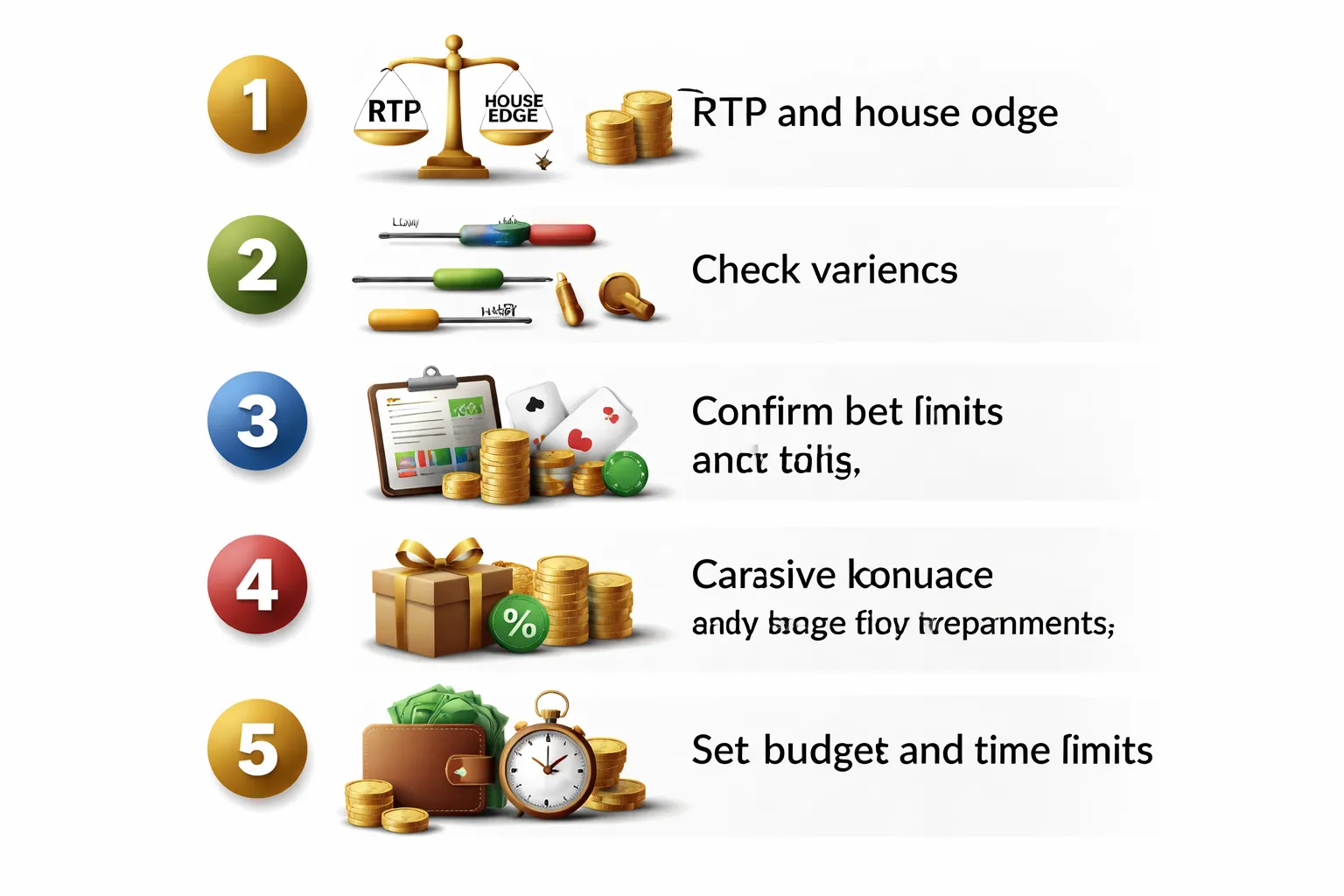
Practical Checklist: Use the Metrics Together
- Step 1, start with RTP or house edge. Pick the best math first. Higher RTP and lower house edge wins. Use the same source and rules set when you compare games.
- Step 2, confirm the rules that change the edge. In table games, small rule changes swing EV. In slots, the paytable and features drive RTP and volatility.
- Step 3, check variance next. Low variance fits steady bankrolls and longer sessions. High variance fits big-hit chasing and short sessions.
- Step 4, match bet limits to your bankroll. Find minimum and maximum bets. Make sure you can afford normal swings without raising stakes under pressure.
- Step 5, sanity-check speed and hands per hour. Faster games burn bankroll faster. A small house edge still costs more when you play more rounds.
- Step 6, factor in bonuses and wagering requirements. If you play with a bonus, treat the playthrough as a real cost. Some games count less toward wagering, which changes your real EV.
Order of Operations: Math, Then Swings, Then Table Fit
- Compare RTP and house edge first. This sets your expected loss rate. Use it to rank options. For deeper breakdowns, see best odds by house edge and how casino odds work.
- Use variance to pick your risk level. Two games can share similar RTP but feel nothing alike. High variance means longer losing runs and bigger spikes.
- Use bet limits to make the plan playable. Your target bet size must sit well above the table minimum. If it does not, you will overbet or leave.
Match the Game to Your Goal
- Goal, longer playtime. Favor higher RTP, lower house edge, and lower variance. Keep bets small relative to bankroll. Slow the pace when you can.
- Goal, big-win chasing. Accept higher variance. Keep the house edge as low as you can within that category. Set a hard stop-loss because swings cut both ways.
- Goal, skill and control. Choose games where decisions matter and the house edge stays low with correct play. Stay consistent with strategy and avoid side bets with high edge.
When RTP Is Not Published: Signals and Safer Defaults
- Use category defaults. Favor games with known, stable math, like baccarat banker bet and standard blackjack with good rules. Treat novelty games as higher edge until proven otherwise.
- Look for transparency. Trusted providers publish RTP per game version. Regulated casinos list rule sets and paytables. Missing details usually means worse value.
- Check the paytable. In video poker, the paytable is the game. Avoid short-pay versions. In blackjack, confirm key rules like dealer hits or stands on soft 17, blackjack payout, surrender, and double options.
- Avoid high-edge add-ons. Side bets and bonus features often carry large house edges. If RTP is unclear, skip them.
- If you cannot verify, lower stakes. Your safest move is to reduce bet size and session length.
Quick Reference Table: What Each Metric Controls
| Metric | What it tells you | How to use it |
|---|---|---|
| House edge | Your expected loss rate per unit wagered | Rank games. Lower is better for your bankroll. |
| RTP | Expected return over the long run | Rank games. Higher is better. Convert to house edge when needed. |
| Variance | How rough the ride feels | Pick low variance for longer play, high variance for big-hit attempts. |
| Bet limits | Whether your plan fits the table or slot | Ensure your normal bet sits safely above the minimum. |
| Wagering requirement | Bonus cost in required playthrough | Estimate total coin-in you must generate. Avoid low contribution games. |
Responsible Play Guardrails That Belong in Your “Strategy”
- Set a session budget. Use money you can lose. Separate it from bills and savings.
- Set a time limit. Faster games increase total wagers. Time controls total exposure.
- Set a stop-loss. Pick a number that ends the session. Do not chase losses with bigger bets.
- Lock in wins with a rule. If you hit a target, cash out a fixed share or end the session.
- Stay consistent. Rapid bet swings increase risk without improving EV.
- Keep etiquette tight. It reduces stress and mistakes at live tables. See casino etiquette basics.
- In het kort: House edge is your long-run cost per dollar wagered.
- In het kort: RTP is the flip side of house edge, it describes long-run payback.
- In het kort: Variance drives swing size, it does not change your expected value.
- In het kort: Volatility and hit frequency shape session feel and bankroll needs.
- In het kort: Rules, paytables, and game versions change edge more than most “strategies”.
- In het kort: Bankroll rules and time limits control exposure better than bet spikes.
House edge: Treat it as your average fee. If a game has a 2% house edge, you pay about $2 per $100 wagered over the long run.
RTP: Use it to compare games fast. Higher RTP means lower house edge, but it never guarantees short-term results. Use published RTP only when you can verify the exact version.
Variance: Plan for swings. Low variance needs less bankroll but pays smaller wins more often. High variance needs more bankroll and longer time to smooth results.
Volatility and hit frequency: Know what you are buying. High volatility often means fewer hits and bigger peaks. Low volatility often means more frequent small returns.
Rules and paytables: Read them before you play. A small rule change can move the edge by more than any betting pattern. Use the game info panel and paytable, then match it to the posted rules.
Practical use: Pick games with low edge, then size your bets for variance. Set a stop-loss and a win rule. Keep your bet size stable. For slots, use RTP as a filter first, then check volatility and bonus terms.
Next step: Learn to spot edge changes in seconds by checking rules and paytables at /how-to-read-casino-game-rules-and-paytables-so-you-know-what-you-re-playing.html, and go deeper on RTP at /rtp-explained-how-to-use-return-to-player-to-choose-slots.html.
FAQ
What is house edge?
House edge is the casino’s long-run advantage, shown as a percent of your total bets. A 2% edge means you lose about $2 per $100 wagered over time. It does not predict short sessions. See /how-casino-game-odds-work-house-edge-probability-and-payouts.html.
What is RTP?
RTP is the expected long-run return to players, also shown as a percent. RTP and house edge are linked. RTP 96% implies a 4% house edge. Use RTP to filter slots first, then check volatility. See /rtp-explained-how-to-use-return-to-player-to-choose-slots.html.
Are RTP and house edge the same thing?
They are two views of the same math. House edge equals 100% minus RTP for the same game and rules. Example, RTP 97% means house edge 3%. Always confirm you compare the same variant, limits, and paytable.
What is variance or volatility?
Variance measures how swingy results can get. Low variance pays smaller wins more often. High variance pays less often but can hit big. Variance does not change the house edge. It changes how fast your bankroll can rise or drop.
What does “long-run” mean in casino math?
Long-run means many bets, not minutes. The more bets you place, the closer results tend to move toward the expected value. Short runs can look wild in either direction. Treat any session result as noise, not proof of an edge.
How do I compare games fast?
Use house edge as your first filter, then speed of play, then rules. Table games vary by rule set. Slots vary by RTP and volatility. For a quick shortlist, see /casino-odds-comparison-poker-vs-blackjack-vs-baccarat.html.
Does a bonus change house edge?
Yes, it can. Convert the bonus to expected value after wagering, game contribution, caps, and expiry. Many offers look big but return little after terms. Check allowed games and max bet rules. Read the paytable and rules first.
What is EV?
EV means expected value. It is your average profit or loss per bet over the long run. Negative EV games cost money over time. Positive EV situations exist, but they depend on rules, promos, or player mistakes in peer games.
What is bankroll, and why does it matter?
Your bankroll is the money you set aside for gambling. It limits risk and controls bet sizing. Higher variance games need a larger bankroll for the same bet size. Set a stop-loss and win rule before you start.
What changes the edge in blackjack and baccarat?
Rules and paytables change the edge. In blackjack, rules like dealer hits soft 17 and payout for blackjack matter. In baccarat, side bets and 6:5 banker payouts increase the house edge. Use /how-to-read-casino-game-rules-and-paytables-so-you-know-what-you-re-playing.html.
Where can I learn the math behind casino profit?
Start with the link between house edge, RTP, and expected loss. Then learn how probability drives payout design. Use /how-casinos-make-money-house-edge-rtp-and-the-math-behind-it.html for the full breakdown.
Conclusion
You can play smarter when you know the terms. House edge tells you the cost of a game. RTP shows the long-run return. Variance and volatility tell you how rough the ride can get.
Use a simple process before you bet.
- Check the paytable and rules. Small rule changes can shift your expected loss fast.
- Compare house edge or RTP. Pick the better number when the game and limits match.
- Match variance to your bankroll. High variance needs more money and more time. Learn the basics at /slot-volatility-variance-explained-what-it-means-for-your-wins.html.
- Ignore streak logic. Past results do not change the odds. Use /the-gambler-s-fallacy-explained-with-simple-examples.html.
Final tip, pick one game, set a budget, and track your results. If you want the math behind the terms, use /how-casinos-make-money-house-edge-rtp-and-the-math-behind-it.html.
-
RTP Explained: How to Use Return to Player to Choose Slots
1 week ago -
What Is a Casino and How Does It Work? A Beginner’s Guide
1 week ago -
Casino RNG Explained: How Random Number Generators Work
1 week ago -
The Gambler’s Fallacy Explained (With Simple Examples)
1 week ago -
Casino Etiquette 101: Rules and Tips for First-Time Visitors
1 week ago
-
- Expected Value (EV)
- Hit Frequency (Hit Rate)
- Payout Percentage vs Payout Rate
- Paytable and Game Rules
- Random Number Generator (RNG) vs Live Dealer Outcomes
- Progressive Jackpot
- Contribution Rate
- Seed Value
- Bonus Rounds
- Free Spins
- Multipliers
- Wagering Requirements (Playthrough)
- Comps and Loyalty (Theo, Coin-In, Player Rating)
- Quick Glossary A to Z
-
- What is house edge?
- What is RTP?
- Are RTP and house edge the same thing?
- What is variance or volatility?
- What does “long-run” mean in casino math?
- How do I compare games fast?
- Does a bonus change house edge?
- What is EV?
- What is bankroll, and why does it matter?
- What changes the edge in blackjack and baccarat?
- Where can I learn the math behind casino profit?
-
-
- Expected Value (EV)
- Hit Frequency (Hit Rate)
- Payout Percentage vs Payout Rate
- Paytable and Game Rules
- Random Number Generator (RNG) vs Live Dealer Outcomes
- Progressive Jackpot
- Contribution Rate
- Seed Value
- Bonus Rounds
- Free Spins
- Multipliers
- Wagering Requirements (Playthrough)
- Comps and Loyalty (Theo, Coin-In, Player Rating)
- Quick Glossary A to Z
-
- What is house edge?
- What is RTP?
- Are RTP and house edge the same thing?
- What is variance or volatility?
- What does “long-run” mean in casino math?
- How do I compare games fast?
- Does a bonus change house edge?
- What is EV?
- What is bankroll, and why does it matter?
- What changes the edge in blackjack and baccarat?
- Where can I learn the math behind casino profit?
-
-
Fairness in Casino Games: RNGs, Odds, House Edge, and Return-to-Player (RTP) - Security, Fairness, and Regulation: How Casinos Keep Games Legit - What Is a Casino and How Does It Work? A Beginner’s Guide
1 week ago -
Regulation and Licensing: Who Oversees Casinos and What Rules They Must Follow - Security, Fairness, and Regulation: How Casinos Keep Games Legit - What Is a Casino and How Does It Work? A Beginner’s Guide
1 week ago -
Security, Fairness, and Regulation: How Casinos Keep Games Legit - What Is a Casino and How Does It Work? A Beginner’s Guide
1 week ago -
What Is a Casino and How Does It Work? A Beginner’s Guide
1 week ago -
How Casinos Make Money: House Edge, RTP, and the Math Behind It
1 week ago
-
Security, Fairness, and Regulation: How Casinos Keep Games Legit - What Is a Casino and How Does It Work? A Beginner’s Guide
1 week ago -
RTP Explained: How to Use Return to Player to Choose Slots
1 week ago -
What Is a Casino and How Does It Work? A Beginner’s Guide
1 week ago -
Casino RNG Explained: How Random Number Generators Work
1 week ago -
How to Set a Gambling Budget (and Stick to It)
1 week ago