How to Set a Gambling Budget (and Stick to It)

Most gambling losses come from poor limits, not bad luck. A budget gives you a hard stop. It protects your rent money, your savings, and your headspace.
This guide shows you how to set a gambling budget you can follow. You will learn how to pick an amount based on your real income and bills, split it into session limits, and set time limits that reduce impulse play. You will also learn how to use casino and app tools, like deposit caps, loss limits, and reality checks, plus a simple tracking method you can do in minutes.
If you need a wider set of guardrails, see our Responsible Gambling Tips: Limits, Tools, and Safer Play.
How to Set a Gambling Budget: What It Means (and What It’s Not)
Definition: a pre set money limit for a fixed time period
A gambling budget is a money cap you set before you play. It covers a fixed time period, like a week or a month.
You base it on your real cash flow, after bills, debt payments, and essentials. You treat it like any other discretionary spend.
Once you hit the cap, you stop. No top ups. No borrowing. No using savings.
Budget vs bankroll vs betting limits
People mix up these terms. They solve different problems.
- Gambling budget: Your total allowed spend for a set period. This is the master cap.
- Bankroll: The portion of your budget you bring to a session. It is the money in play today.
- Betting limits: Rules that control how fast you can spend your bankroll. These include deposit limits, loss limits, time limits, and max bet size.
| Item | What it controls | What it stops |
|---|---|---|
| Budget | Total spend over a set period | Chasing losses across days and sessions |
| Bankroll | Money available in one session | Draining your whole budget in one sitting |
| Deposit limit | How much you can add to your account | Reloading after losses |
| Loss limit | Maximum net loss in a period | Spirals after a bad run |
| Time limit | How long you can play | Long sessions that lead to impulse bets |
| Wager size limit | Maximum stake per bet or spin | Big swings that wipe out funds fast |
The goal: entertainment spend, not an income plan
Your budget exists to cap losses. It does not aim to create steady profit.
Casino games and most betting markets price in a house edge. Over time, the math works against you. A budget helps you control what that costs you.
If you want more guardrails, use the tools in our Responsible Gambling Tips: Limits, Tools, and Safer Play.
What it is not: common misconceptions
- A way to guarantee profit: A budget limits damage. It does not change odds.
- Money you must spend: It is a ceiling, not a target.
- A substitute for limits: A monthly cap can fail if you blow it in one night. Pair it with session bankroll and time limits.
- A fix for loss chasing: If you keep raising your cap after losing, you do not have a budget. You have permission to chase.
- Flexible “just this once” money: Exceptions become a pattern. Write the rule, then follow it.
If you struggle to stop when you hit limits, review Signs of Gambling Addiction: Warning Signs and Where to Get Help. If you need a hard stop, read Self-Exclusion Programs Explained.
Step 1 — Calculate What You Can Actually Afford to Lose
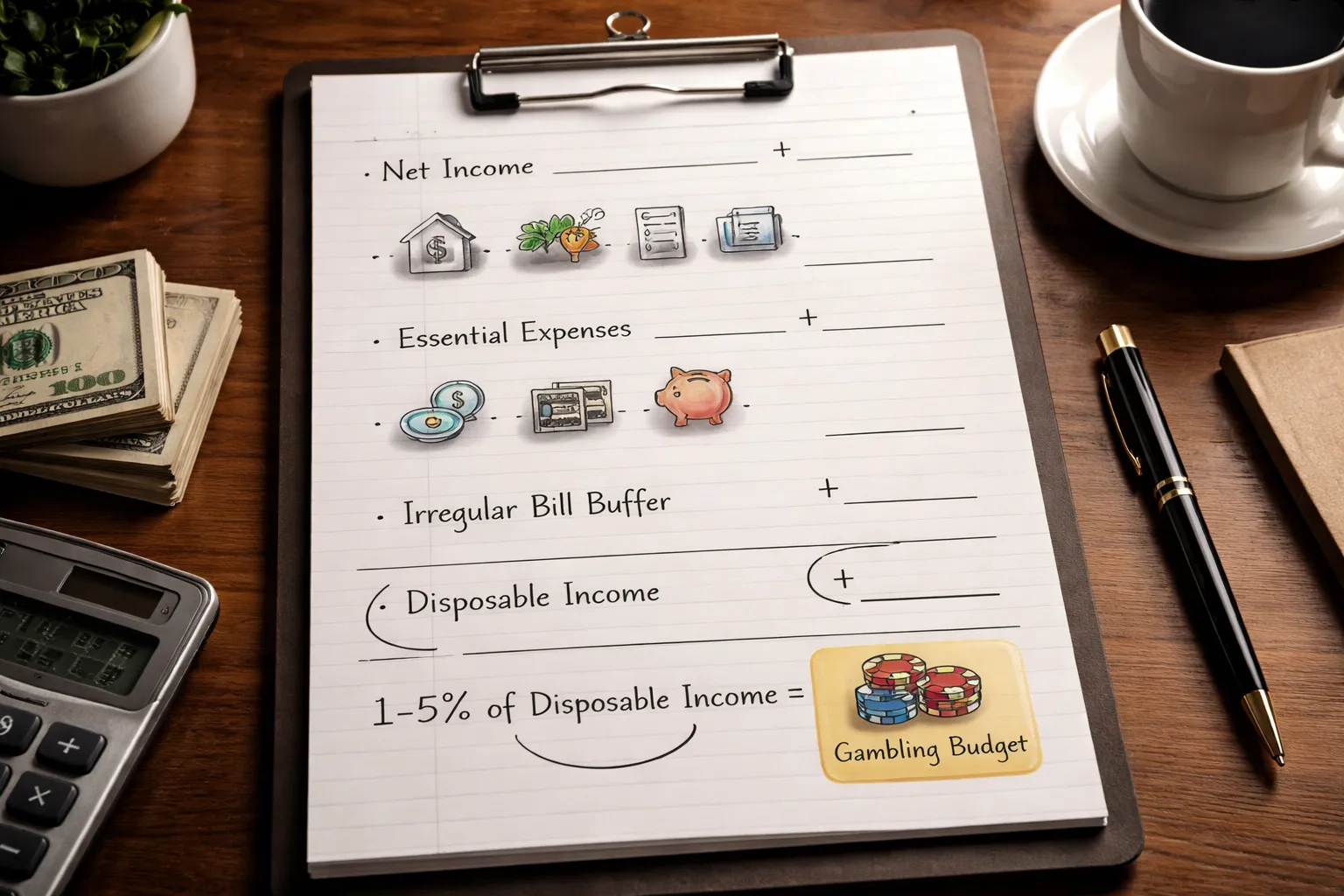
Start With Net Income and Essential Expenses
Use your net income. That is what hits your bank after tax and deductions.
List your essential expenses. Use your real numbers from the last 30 to 90 days.
- Rent or mortgage
- Utilities, phone, internet
- Groceries and basic household needs
- Transport, fuel, insurance
- Minimum debt payments
- Childcare, medical costs
- Required subscriptions and fees
Add a buffer for irregular bills. Annual renewals, car repairs, prescriptions. If you ignore these, you will “borrow” from your budget later.
Define Disposable Income, Then Choose a Conservative Cut
Disposable income is what remains after essentials and your buffer.
Start with a conservative portion for gambling. Treat it like entertainment. If you spend it, it is gone. No top-ups.
| Formula | Net income, minus essentials, minus irregular-bill buffer, equals disposable income |
| Gambling budget | Disposable income, multiplied by your chosen percentage |
Simple Rule of Thumb Ranges
Use a small range. Smaller is safer. Most people should stay at 1 to 5 percent of disposable income.
- 1%, if you have tight cash flow, variable income, or you feel tempted to chase losses.
- 2 to 3%, if bills stay current and you keep a steady emergency buffer.
- Up to 5%, only if your savings and debts stay on track every month.
If you want more protection, cap each session as well. Set deposit limits and time limits. See Responsible Gambling Tips: Limits, Tools, and Safer Play.
Red Flags That Mean Your Budget Should Be $0 for Now
Pause gambling if any of these apply. Set your budget to zero until you stabilize.
- Late rent, late utilities, late debt payments
- Using credit cards, overdrafts, or buy now pay later to fund play
- Borrowing from friends or family
- Skipping essentials to “free up” gambling money
- Debt pressure, collections, or payday loans
- Needing to win to cover bills
- Raising limits after losses
If stopping feels hard, read Signs of Gambling Addiction: Warning Signs and Where to Get Help. If you need a hard block, use Self-Exclusion Programs Explained.
Step 2 — Choose a Budget System That Fits Your Style (Weekly/Monthly + Session-Based)
Pick a time frame, weekly or monthly
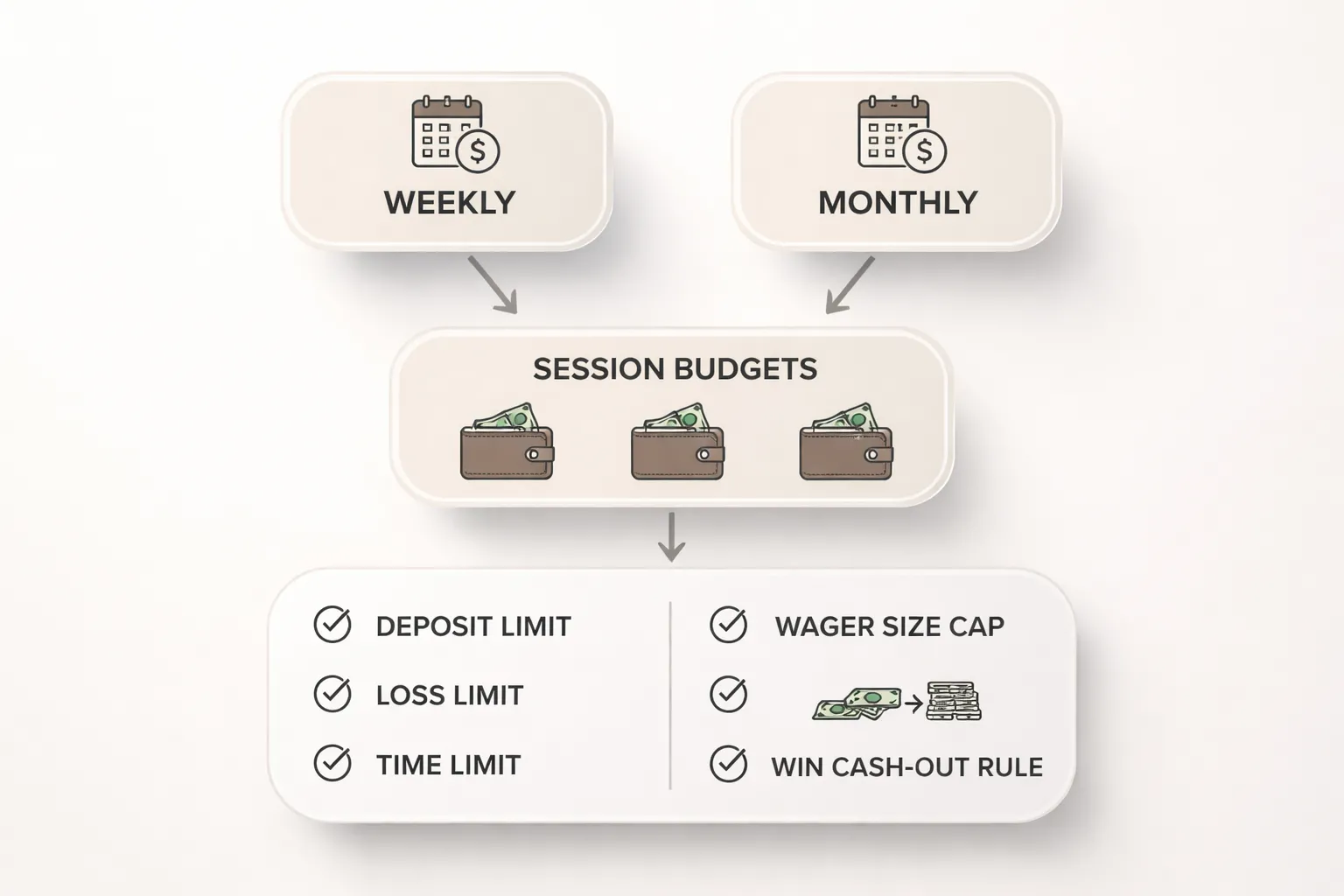
Your first choice is cadence. Weekly works best if you live paycheck to paycheck or you tilt after a bad night. Monthly works best if your income varies and you want fewer adjustments.
- Weekly budget. Faster feedback. Easier to stop a spiral. Harder if you travel or play less often.
- Monthly budget. Simple planning. Matches rent and bill cycles. Easier to overspend early and chase later.
If you tend to binge, pick weekly. If you play 1 to 2 times a month, pick monthly and lock session caps before you start.
Break your budget into sessions
A single pot of money invites blowouts. Session budgets force breaks. They also make your losses predictable. You stop treating one bad session as a reason to double down.
Define a session in plain terms. Example, one casino visit, one sports slate, or 90 minutes online. Set a cash amount for that session. When it is gone, you stop. No top ups.
- Decide how many sessions you want in the time frame.
- Divide your total budget by that session count.
- Round down. Leave the remainder unallocated.
- Use cash or a separate prepaid balance. Do not use a credit card.
If you want practical cost control on site, use your visit plan for parking, drinks, and ATM strategy. See Visiting a Casino on a Budget: Parking, Drinks, and Smart Money-Savers.
Set 3 to 5 hard limits
Hard limits protect you when emotions rise. Set them before you play. Use the casino or app tools where possible.
- Deposit limit. Max you can add in a day, week, or month. Set it at or below your budget.
- Loss limit. Max you can lose per session. When you hit it, you stop. No exceptions.
- Time limit. Start and end time. Use a phone alarm. When it rings, cash out and leave.
- Wager size cap. A fixed max bet per spin, hand, or play. This slows loss rate.
- Win and cash-out rule. Example, if you go up 50 percent of your session budget, you cash out profit and end the session.
If you gamble online, set limits inside your account and keep them locked. For a full list of tools, see Responsible Gambling Tips: Limits, Tools, and Safer Play.
Example budgets with session splits
| Disposable income level | Time frame | Total gambling budget | Sessions per time frame | Session budget | Suggested hard limits |
|---|---|---|---|---|---|
| Low | Weekly | $25 | 2 | $10 | Deposit $25 weekly, loss $10 per session, time 60 minutes, wager cap $0.50 to $1, cash out if up $10 |
| Medium | Monthly | $200 | 4 | $50 | Deposit $200 monthly, loss $50 per session, time 90 minutes, wager cap $2 to $5, cash out if up $50 |
| High | Monthly | $800 | 8 | $100 | Deposit $800 monthly, loss $100 per session, time 2 hours, wager cap set per game, cash out if up $100 |
These numbers are placeholders. Your real number depends on what you can lose without touching rent, food, bills, or debt payments. If you keep breaking limits, treat that as a signal. Read Signs of Gambling Addiction: Warning Signs and Where to Get Help. If you need a hard stop, use Self-Exclusion Programs Explained.
Step 3 — Set Per-Bet Rules (Sports Betting, Casino, and Slots)
Step 3, Set Per-Bet Rules (Sports Betting, Casino, and Slots)
Your session cap stops big losses. Per-bet rules stop slow leaks. Set them before you play. Keep them simple. Tie every wager to your session budget, your time limit, and your stop win rule.
For sports betting, pick a flat unit size and stick to it. Avoid chasing with bigger live bets. For casino table games, set a max bet and a hard limit on raises. For slots, lock your denomination and max spin. If you cannot follow your per-bet rules, lower the stakes or stop for the day.
Use the site or casino tools that enforce limits. Track each bet. If you keep breaking rules, use stronger controls in our Responsible Gambling Tips.
| Game type | Rule to set | What it prevents |
|---|---|---|
| Sports | Unit size, max live bet | Chasing after losses |
| Casino tables | Max bet, max raise | Escalation under pressure |
| Slots | Denomination, max spin | Rapid budget drain |
Read our detailed guide: Step 3 — Set Per-Bet Rules (Sports Betting, Casino, and Slots) - How to Set a Gambling Budget (and Stick to It)
How to Stick to Your Gambling Budget (Behavior + Practical Controls)

Separate Your Gambling Money
Keep your budget away from your everyday spending.
- Cash and envelopes: Bring one envelope. When it is empty, you stop.
- Separate account or e-wallet: Use a dedicated balance for gambling only. Do not link it to bills or savings.
This reduces impulse spending. It also makes your losses and wins clear.
Deposit Once Per Session, No Top-Ups
Deposit only what you planned for that session. Treat your deposit as a hard cap.
- Set a rule, one deposit per session.
- Remove saved cards from gambling sites and apps.
- Do not use credit. Do not use pay later products.
Top-ups turn a budget into a suggestion. You need a stop point you cannot argue with.
Automate Friction With Platform Controls
Use tools that block fast decisions. Set them before you play.
- Deposit limits: Set daily, weekly, and monthly caps. Match them to your budget.
- Loss limits: Set a maximum you can lose in a day or week.
- Time limits and session reminders: Set alerts that interrupt long sessions.
- Cooling-off periods: Lock yourself out for 24 hours to several weeks.
- Self-exclusion: Block access for months or years when control is slipping. See Self-Exclusion Programs Explained: How They Work and What to Expect.
These controls work because they remove choice in the moment. For more limit options, read Responsible Gambling Tips: Limits, Tools, and Safer Play.
Track Every Session, Then Review Weekly
If you do not track it, you will underestimate it. Most people do.
Log four numbers after every session.
- Stake: total amount wagered and total deposited.
- Time: start, end, and total minutes.
- Result: net win or net loss.
- Notes: where you played, what you played, and your mood.
Review once a week. Look for patterns, long sessions, bigger bets, and more frequent deposits. If your results show you are losing control, read Signs of Gambling Addiction: Warning Signs and Where to Get Help.
Control Your Emotional Triggers
Do not gamble when your brain wants relief.
- Avoid gambling when you feel stressed, angry, lonely, bored, or tired.
- Avoid gambling after alcohol or drugs.
- Do not gamble to fix your mood.
- Do not chase losses. Stop when you hit your limit, even if you feel close to a win.
Use a simple rule. If you feel urgent, you do not play.
Use Timers and Forced Breaks
Time makes budgets leak. Breaks reset your judgment.
- Set a phone timer for 30 to 60 minutes.
- When it goes off, stand up and leave the game for 5 to 10 minutes.
- Check your remaining budget before you continue.
- End the session at a fixed time, even if you are up.
If you gamble in a casino, plan exits and small cash access. See Visiting a Casino on a Budget.
Common Budgeting Mistakes (and What to Do Instead)
Chasing Losses and Tilting
Chasing losses breaks your budget fast. You stop following your plan and start trying to get back to even. Tilt adds speed. You make larger, faster bets and ignore stop points.
- Do instead: Set a hard loss limit per session. Stop when you hit it.
- Do instead: Use a timer and a forced break after any big swing, win or loss.
- Do instead: Leave the app or table if you feel rushed, angry, or numb. End the session.
Raising Stakes After Losses, Lowering Standards After Wins
After losses, many players raise stakes to “catch up.” This increases variance and shortens your bankroll. After wins, many players loosen rules. They bet on weaker games, riskier props, or longer shots. Both moves erase your edge and your plan.
- Do instead: Pick a stake size before you start. Keep it fixed for the session.
- Do instead: Use unit sizing. Example, 1 unit equals 1 to 2 percent of your session bankroll.
- Do instead: If you move up, do it only after a scheduled review, never mid-session.
Mixing Gambling Money With Bill Money
If your gambling funds share the same account as rent, food, or debt payments, you will borrow from yourself. This turns a “budget” into a suggestion. It also hides your real results. You stop tracking and start guessing.
- Do instead: Use a separate bankroll account or wallet.
- Do instead: Treat deposits as spending. Once money moves into your bankroll, do not replace it until your next planned funding date.
- Do instead: Set a zero rule. You never gamble with money meant for bills, even if it is “just one bet.”
Assuming Bonuses and Free Bets Are Not Real Money
Bonuses change how you bet. They make higher stakes feel safer. They also add rollover or playthrough rules that can force more betting than you planned. “House money” thinking increases risk and time spent.
- Do instead: Count bonus value in your limits. A free bet still drives real wagering.
- Do instead: Read the terms before you accept. Check wagering requirements, time limits, and game restrictions.
- Do instead: Decline offers that push you past your weekly cap or extend your sessions.
Not Accounting for Time Cost and Frequency Creep
Budgets fail when play time expands. Extra sessions stack up. Small deposits become routine. A monthly cap does not help if you gamble four times as often as you planned.
- Do instead: Set a weekly session limit. Example, two sessions per week, max 90 minutes each.
- Do instead: Set fixed gambling days. No “bonus” sessions.
- Do instead: Track sessions, not just money. Write down date, start time, end time, and net result.
Fixes That Work: Pre-Commitment, Accountability, Tighter Limits
You stick to a budget when you lock it in before you play. You also need friction. Easy access makes overspending easy.
- Pre-commitment rules: Set deposit caps, loss limits, and time limits in the app or at the casino cage. Use the strongest limits available. See Responsible Gambling Tips: Limits, Tools, and Safer Play.
- Accountability: Share your limits with someone you trust. Send them a screenshot of your set limits and your session log.
- Tighter access: Remove stored cards, disable one-click deposits, and keep only session cash on you. For casino planning, use Visiting a Casino on a Budget.
- Escalation plan: If you keep breaking limits, use stronger tools. Consider Self-Exclusion Programs. If gambling starts harming your finances or relationships, review Signs of Gambling Addiction.
Tools, Apps, and Templates to Manage Your Gambling Budget
You will not stick to a budget with willpower alone. Use tools that add friction and record what happens. Start with a simple session log. Track date, game, time, deposits, withdrawals, net result, and your stop points. Then lock your bankroll into separate accounts. Use bank features like spending categories, balance alerts, and low-balance warnings. Add casino and sportsbook limit tools. Set deposit limits, loss limits, wager limits, and time limits. Use cooling-off timers when you feel tilt. If you keep overriding controls, escalate. Use blocking software or self-exclusion. Pair these tools with your plan for Visiting a Casino on a Budget and the safer play checklist in Responsible Gambling Tips.
- Session log template: One row per session, totals per week and month.
- Budget apps: Category spend, alerts, and weekly caps.
- Bank controls: Separate account, transfer delays, card lock, cash-only withdrawals.
- Operator limits: Deposit, loss, wager, session time, and timeout tools.
- Blocking tools: Site and app blocks, device-level restrictions.
- Escalation: Use Self-Exclusion Programs if limits keep failing.
- Red flags: Review Signs of Gambling Addiction if money or relationships take hits.
| Tool | What you set | What it prevents |
|---|---|---|
| Session log | Start bankroll, stop-loss, stop-win, time cap | Memory gaps, chasing, “one more bet” drift |
| Bank alerts | Low balance, weekly spend, category caps | Silent overspending |
| Deposit and loss limits | Daily, weekly, monthly limits | Reload loops |
| Cooling-off and timeouts | Hours to weeks | Tilt sessions |
| Blocking and self-exclusion | Apps, sites, venues, time periods | Access when you break your own rules |
Read our detailed guide: Tools, Apps, and Templates to Manage Your Gambling Budget - How to Set a Gambling Budget (and Stick to It)
- In het kort: Treat gambling money as entertainment spend, not income.
- In het kort: Set one clear number for your total budget, then split it into session limits.
- In het kort: Use hard tools, deposit limits, loss limits, and timeouts, so your plan survives impulse.
- In het kort: Stop reload loops, one more deposit usually breaks the budget.
- In het kort: If you keep breaking your rules, switch to blocking or self-exclusion.
Your budget must be fixed. You set it before you play. You do not adjust it after a win or a loss.
Limits work best when you stack them. Use deposit limits and loss limits together. Add daily, weekly, and monthly caps. Put timeouts in place for tilt sessions.
Remove access when you break your own rules. Blocking tools and self-exclusion create a hard stop across apps, sites, or venues. Learn the basics in Self-Exclusion Programs Explained: How They Work and What to Expect.
Watch for pattern changes. Chasing losses, hiding spend, borrowing, or skipping bills are warning signs. Use Signs of Gambling Addiction: Warning Signs and Where to Get Help if this shows up.
Use a safer-play checklist. Set limits, track deposits, track time, and review results weekly. See Responsible Gambling Tips: Limits, Tools, and Safer Play.
FAQ
What is a gambling budget?
Your gambling budget is the maximum money you can lose in a set period without affecting bills, debt payments, savings, or essentials. Treat it as entertainment spend. Once you hit the limit, you stop. No top-ups, no borrowing.
How much should I budget for gambling?
Start with what you can afford to lose after essentials and planned savings. Keep it small until you track results for a month. If you carry high-interest debt or miss bills, set the budget to zero and pause play.
Should my budget be weekly or monthly?
Use weekly for control and faster feedback. Use monthly only if you already track spending. Many people overspend with monthly limits because losses cluster on a few days. Split monthly money into weekly caps.
What is the difference between a deposit limit, loss limit, and time limit?
- Deposit limit: Caps how much you add to your account.
- Loss limit: Caps net losses over a period.
- Time limit: Caps session or daily play time.
How do I stop chasing losses?
Set a hard stop-loss and a time limit before you play. Leave payment cards at home. Use operator limits and cooling-off tools. If you break rules more than once, stop gambling and use support options in Signs of Gambling Addiction: Warning Signs and Where to Get Help.
What rules keep me from breaking my budget?
- One funding source: One prepaid card or one e-wallet.
- No credit: No loans, no payday apps, no cash advances.
- One session plan: Stake size, stop-loss, stop-win, time cap.
- Weekly review: Deposits, time, and net result.
Should I set a stop-win limit?
Yes. Profit can trigger bigger stakes and longer sessions. Set a cash-out point and stop when you reach it. Move winnings out of your gambling balance. Treat profit as saved money, not fuel for more bets.
What is a bankroll and how is it different from a budget?
Your budget is what you can afford to lose. Your bankroll is the money you bring into play for a session or week. Your bankroll must fit inside your budget. If bankroll hits zero, you stop.
What tools can help me stick to limits?
Use deposit limits, loss limits, time limits, reality checks, and cooling-off features. Turn on notifications for deposits and time. Use a spreadsheet or banking app tagging. See Responsible Gambling Tips: Limits, Tools, and Safer Play for setup steps.
When should I use self-exclusion?
Use self-exclusion if you keep breaking limits, hide spending, borrow, or skip bills. It creates a hard barrier when willpower fails. Start with a cooling-off period if needed, then escalate. Learn the process at Self-Exclusion Programs Explained.
How do I budget for a casino trip?
Separate gambling money from trip costs. Budget parking, transport, food, tips, and drinks. Bring cash for your gambling cap and leave cards locked away. Plan your exit time. Use Visiting a Casino on a Budget for cost control.
What are warning signs my budget is not working?
You chase losses, raise stakes fast, add deposits mid-session, hide spend, borrow money, or miss bills. You feel panic when you stop. Treat these as stop signals, not challenges. Use Warning Signs and Where to Get Help.
Conclusion
A gambling budget works when you treat it like a hard limit, not a target. Set the number before you play. Use deposit limits, loss limits, and time limits. Track every session. Stop when you hit your cap, even if you feel “close.”
- Write your rules. Weekly cap, per-session cap, max time, and a firm stop-loss.
- Use tools. Turn on limits and reminders in your account. See Responsible Gambling Tips: Limits, Tools, and Safer Play.
- Control access. Take only the cash you planned. Leave cards and banking apps out of reach.
- Review fast. After each session, log spend and time. If you broke a rule, lower stakes or stop for a set break.
- Escalate when needed. If you keep chasing losses or adding money mid-session, use stronger barriers. See Self-Exclusion Programs Explained and Warning Signs and Where to Get Help.
Final tip. Make your budget automatic. Set limits in your account, set a calendar reminder to review your totals, and pre-plan your exit time. If you need extra cost control on-site, use Visiting a Casino on a Budget.
-
-
- What is a gambling budget?
- How much should I budget for gambling?
- Should my budget be weekly or monthly?
- What is the difference between a deposit limit, loss limit, and time limit?
- How do I stop chasing losses?
- What rules keep me from breaking my budget?
- Should I set a stop-win limit?
- What is a bankroll and how is it different from a budget?
- What tools can help me stick to limits?
- When should I use self-exclusion?
- How do I budget for a casino trip?
- What are warning signs my budget is not working?
-
-
-
- What is a gambling budget?
- How much should I budget for gambling?
- Should my budget be weekly or monthly?
- What is the difference between a deposit limit, loss limit, and time limit?
- How do I stop chasing losses?
- What rules keep me from breaking my budget?
- Should I set a stop-win limit?
- What is a bankroll and how is it different from a budget?
- What tools can help me stick to limits?
- When should I use self-exclusion?
- How do I budget for a casino trip?
- What are warning signs my budget is not working?
-
-
Fairness in Casino Games: RNGs, Odds, House Edge, and Return-to-Player (RTP) - Security, Fairness, and Regulation: How Casinos Keep Games Legit - What Is a Casino and How Does It Work? A Beginner’s Guide
1 week ago -
Regulation and Licensing: Who Oversees Casinos and What Rules They Must Follow - Security, Fairness, and Regulation: How Casinos Keep Games Legit - What Is a Casino and How Does It Work? A Beginner’s Guide
1 week ago -
Security, Fairness, and Regulation: How Casinos Keep Games Legit - What Is a Casino and How Does It Work? A Beginner’s Guide
1 week ago -
What Is a Casino and How Does It Work? A Beginner’s Guide
1 week ago -
How Casinos Make Money: House Edge, RTP, and the Math Behind It
1 week ago
-
Security, Fairness, and Regulation: How Casinos Keep Games Legit - What Is a Casino and How Does It Work? A Beginner’s Guide
1 week ago -
RTP Explained: How to Use Return to Player to Choose Slots
1 week ago -
What Is a Casino and How Does It Work? A Beginner’s Guide
1 week ago -
Casino RNG Explained: How Random Number Generators Work
1 week ago -
Responsible Gambling Tips: Limits, Tools, and Safer Play
1 week ago