Casino Myths vs Facts: Hot Streaks, “Due” Numbers, and Luck Explained

Casino myths cost you money. They push you to chase losses, raise your stakes, and trust patterns that do not exist. Hot streaks, “due” numbers, and lucky rituals feel real because your brain remembers wins and ignores the boring spins.
This guide separates myth from fact using simple probability and casino math. You will learn why each spin stands alone, how randomness works in slots and roulette, and what results you can and cannot control. You will also learn the few numbers that matter, house edge, RTP, and volatility, so you can pick games with intent and manage your bankroll.
- Myths, what players claim and why they believe it
- Facts, what the math says about streaks and “due” outcomes
- Action, what to change in your bets, game choice, and limits
Casino Myths vs Facts (Hot Streaks, Due Numbers, Luck): The Core Ideas
Definition: Myths vs Facts in Casino Play
Casino myths try to explain wins and losses with patterns. Facts come from probability. Your results come from three drivers. Randomness, payout rules, and the house edge.
Common claims sound practical. A machine is hot. A number is due. Luck is with you tonight. These claims feel true because short runs swing hard.
Randomness, Probability, and Independence
Most casino outcomes are independent. Independence means your last result does not change the next one.
- Roulette: Each spin has the same odds. Red does not become more likely after a run of black.
- Slots: Each spin uses a random number generator. The last spin does not affect the next spin.
- Blackjack: Past cards can matter in the same shoe. Your edge still depends on rules and how you play.
Probability does not “balance out” on your schedule. In the long run, results trend toward the expected value. In the short run, anything can happen, including long streaks.
Hot Streaks: What They Are and What They Are Not
A hot streak is a cluster of wins. It does not prove the game changed. It proves variance exists.
- Streaks happen in random sequences. You notice them because they feel meaningful.
- A streak does not improve your next chance on independent games.
- Chasing a streak often raises your bet size at the worst time.
“Due” Numbers and the Gambler’s Fallacy
A “due” number is a myth. It comes from the gambler’s fallacy. You assume past outcomes force a correction.
- Roulette example: If black hits 8 times, red is not “due.” Red still has the same probability on the next spin.
- Slots example: A machine that “has not paid” is not building pressure to pay soon.
Casinos benefit when you think outcomes must even out soon. You stay longer. You bet bigger. Your expected loss grows with time and total wagered.
House Edge vs Short-Term Variance
House edge tells you the average loss rate over many bets. Variance tells you how wild the ride feels along the way.
- House edge: The built-in advantage in the rules and payouts.
- RTP: Return to player, the flip side of house edge. Higher RTP usually means lower long-run loss rate.
- Volatility: How often and how big wins tend to be. High volatility means longer dry spells and larger spikes.
| Concept | What it affects | What it does not do |
|---|---|---|
| House edge | Your long-run expected loss per dollar wagered | Guarantee you lose every session |
| Variance | Session swings, streak length, bankroll stress | Change the game’s underlying odds |
| Independence | Next outcome odds stay the same on each trial | Make streaks impossible |
Common Thinking Traps: Pattern-Seeking and Selective Memory
- Pattern-seeking: You see meaning in noise. You label normal streaks as signals.
- Selective memory: You remember the wins that match your story. You forget the losses that contradict it.
- Outcome bias: You judge a decision by the result. A bad bet can win. A good bet can lose.
- Recency bias: You weigh the last few results too much. You change strategy without a math reason.
What to Change in Your Bets, Game Choice, and Limits
- Pick games by house edge and rules, not vibes. Use the odds list in Which Casino Games Have the Best Odds? Ranked by House Edge.
- Set bet sizes before you play. Keep them stable. Do not “press” because you feel hot.
- Use stop-loss and stop-win limits. Follow them. Your discipline matters more than your prediction.
- Choose volatility that fits your bankroll. Low volatility supports longer play. High volatility demands larger buffers.
- Track time and total wagered. The house edge applies to volume. More volume means more expected loss.
- Learn simple games with clear rules if you are new. Start with Best Casino Game for Beginners: The Easiest Games to Learn First.
Myth #1: Hot Streaks (and Cold Streaks) Prove a Game or Machine Has “Momentum”
Facts: “Momentum” Does Not Carry in RNG Games
Most casino results do not remember your last result. Each spin, deal, or roll runs as a new trial.
Roulette. The wheel has no memory. Red does not become more likely after a run of black. Each spin resets the same base odds, minus the house edge.
Slots. Modern slots use RNG output to pick outcomes. A win does not make the next win easier. A loss does not make the next loss harder. Payout rate works over huge sample sizes, not your session. Read Casino RNG Explained: How Random Number Generators Work.
Many table outcomes. Baccarat and roulette outcomes do not change because of a streak. Blackjack changes with card removal, but a “heater” still does not force future wins. Your decisions and the remaining deck matter, not a feeling of momentum. See Casino Odds Comparison: Poker vs Blackjack vs Baccarat.
Variance: Streaks Are Normal in Random Sequences
Random does not mean “evenly mixed.” Random includes clumps.
If an event has a 50 percent chance, long runs still show up. With enough trials, you will see long strings of the same outcome.
- In 100 even coin flips, a longest run around 6 to 8 is common.
- In 1,000 flips, a longest run around 9 to 11 is common.
- More play creates more chances for extreme streaks, both good and bad.
Slots add another layer. Many slots pay rarely and in spikes. That design produces longer dead periods and sudden clusters of wins. Learn the terms in Slot Volatility & Variance Explained: What It Means for Your Wins.
Streaks feel meaningful because your brain searches for patterns. The math does not change.
Where “Streaks” Can Be Real
Streaks can reflect a real edge when skill or information changes outcomes.
- Poker. Your win rate can improve with better table selection, better reads, and better tilt control. Short-term results still swing because of variance.
- Sports betting. Your edge can improve with better models, faster news, and better prices. A run can still come from luck.
- Blackjack. Deck composition can shift expected value. Card counting tracks this. It does not guarantee a winning streak, it shifts the long-run expectation.
Even in skill games, you must separate process from results. You can play well and lose. You can play poorly and win.
Practical Takeaway: What to Do When You’re Winning or Losing
When you’re winning, treat it as variance, not proof. Lock value while you have it.
- Set a cash-out number before you start. Stick to it.
- Do not raise stakes because you feel “hot.” Raise only if your bankroll plan allows it.
- Track total wagered. The house edge applies to volume. Learn the mechanics in How Casino Game Odds Work: House Edge, Probability, and Payouts.
When you’re losing, do not chase. Chasing turns variance into damage.
- Stop at your loss limit. Leave.
- Do not switch machines to “break the curse.” Odds stay the same.
- Lower bet size or end the session. More spins do not “reset” luck, they increase exposure.
Myth #2: “Due” Numbers and the Gambler’s Fallacy (Roulette, Lotto Thinking, and Beyond)
Facts: What “Due” Means, and Why It Usually Fails
“Due” means you think an outcome must happen soon because it has not happened lately.
That logic breaks in most casino games because each trial resets. The wheel has no memory. The RNG has no memory. Your last 50 results do not create a debt the game must pay.
Independence is the key fact. If each spin, draw, or hand is independent, the chance stays the same every time.
If you want a clean breakdown, read The Gambler’s Fallacy Explained (With Simple Examples).
Gambler’s Fallacy vs Hot-Hand Fallacy
These mistakes look similar. They point in opposite directions.
- Gambler’s fallacy: you think a result is due after a streak. Example, red has hit a lot, so black must come next.
- Hot-hand fallacy: you think a streak will continue because it is “hot.” Example, red has hit a lot, so red will keep hitting.
Both ignore the same fact. Past outcomes do not change the next probability in an independent game.
Roulette Example: Past Spins Do Not Change the Next Spin
On a fair European roulette wheel, each spin stays the same.
- Red: 18 numbers out of 37, probability 18/37, about 48.65%.
- Black: 18/37, about 48.65%.
- Green (0): 1/37, about 2.70%.
If red hits 10 times in a row, the next-spin probability for black still stays 18/37. The wheel does not “balance” on schedule.
| Claim | What the math says (European roulette) |
|---|---|
| “Black is due after many reds.” | Black stays 18/37 on the next spin. |
| “A long streak proves a pattern.” | Streaks happen under random sequences. |
| “If I wait long enough, I can time the hit.” | Waiting does not change the next-spin odds. |
This applies to many games. Slots use RNG outcomes per spin. Many online games do the same. Learn the mechanics in Casino RNG Explained: How Random Number Generators Work.
Lotto Thinking: Rare Events Stay Rare
People bring lottery thinking into casinos. They track misses and expect a correction.
In lottery draws, numbers can repeat. Long gaps can happen. The draw does not owe you a specific ball.
In casinos, the same mistake pushes you into bigger bets and longer sessions. That increases loss rate because the house edge applies to volume.
When the Past Can Matter: Non-Random or Biased Processes
Past results can matter when the process is not independent.
- Biased roulette wheel: a mechanical defect or dealer signature creates a real skew.
- Physical wear: frets, pockets, or ball behavior produce repeatable bias over large samples.
- Non-random dealing: rare in regulated games, but possible in unregulated settings.
Look for responsibility and realism.
- Do not trust a short streak. You need a large sample and consistent conditions.
- Track outcomes with time stamps and table identifiers. Remove emotional notes.
- Expect the casino to change wheels, swap balls, or close a table if bias appears.
For most players, “bias hunting” turns into another form of chasing. Assume fair randomness unless you have strong evidence.
Practical Takeaway: Stop “Due” Thinking Before You Escalate
“Due” thinking leads to one move. You increase exposure.
- Do not raise bets to “catch up.” Keep your base bet fixed.
- Do not add spins to “get the correction.” Set a time cap and a spin cap.
- Use a hard stop loss. When you hit it, end the session.
- Do not switch games because of a streak. Read rules and paytables first, so you know what changes and what does not, see How to Read Casino Game Rules and Paytables.
Streaks happen. They do not predict the next result. Your best defense is limits, not theories.
Myth #3: Luck Is a “Force” You Can Control (Rituals, Charms, and “Casino Vibes”)
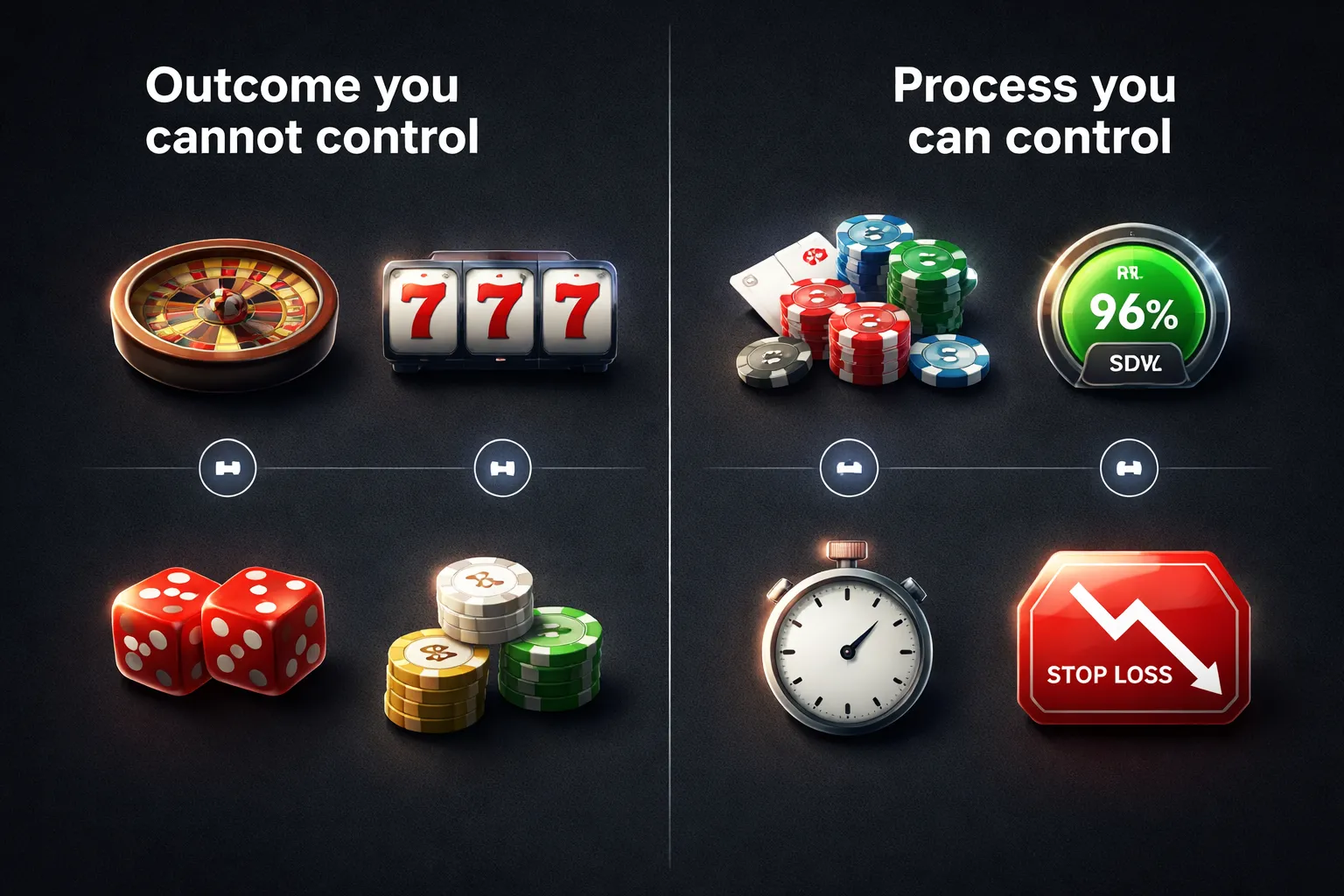
Facts: Luck Is a Label for Variance, Not a Controllable Input
Casino games run on probability. Results vary around an average. People call that swing “luck.”
Luck does not change the math. It does not change the house edge. It does not change the RNG in slots or the shuffle in cards.
Your short-term results can look extreme. That can happen in any direction. It still stays within variance.
If you want the real inputs, track these: RTP, house edge, rules, and your bet size. Start with /rtp-explained-how-to-use-return-to-player-to-choose-slots.html and /which-casino-games-have-the-best-odds-ranked-by-house-edge.html.
Illusion of Control: Why Rituals Feel Effective
Rituals create a sense of pattern. Your brain links the ritual to a win and ignores the times it did nothing.
Charms and routines also reduce stress. Less stress can help you stick to your plan. That is not outcome control. That is mood control.
Casinos support the story. Lighting, sound, and fast feedback make wins feel “earned” and losses feel “one step away.” That pushes you to keep playing.
Outcome Control vs Process Control: What You Can Actually Influence
You cannot control the next card, spin, or roll. You can control decisions that set your expected loss rate and your risk.
- Game choice: Pick lower house edge games when possible. Use /casino-odds-comparison-poker-vs-blackjack-vs-baccarat.html for quick comparisons.
- Rules and paytables: Small rule changes move the edge. Check before you sit down.
- Bet sizing: Bigger bets increase variance and speed up losses. Keep bets flat if your goal is longer play time.
- Time limits and spin limits: More trials increase the chance you drift toward the negative expectation.
- Stop loss and stop win: They do not change odds. They stop damage and stop tilt.
“Due” thinking often sneaks in here. When you feel the need to “fix” a session with a ritual or a chase, revisit /the-gambler-s-fallacy-explained-with-simple-examples.html.
Practical Takeaway: Build a Luck-Proof Decision Routine
- Before you play: choose the game, confirm RTP or rules, set a budget you can lose, set a time cap, set a bet size.
- During play: do not change bets because you feel hot or cold. Do not switch games to “find better energy.” Take breaks on a timer.
- Exit rules: stop at your stop loss. Stop at your time cap. Cash out when you hit either, no exceptions.
- After: log game, time, stakes, and result. Ignore stories. Track numbers.
If a charm helps you stay calm, keep it. Do not treat it as a lever. Your only real levers are selection, sizing, and limits.
What Actually Determines Results: RNGs, House Edge, Volatility, and Game Design
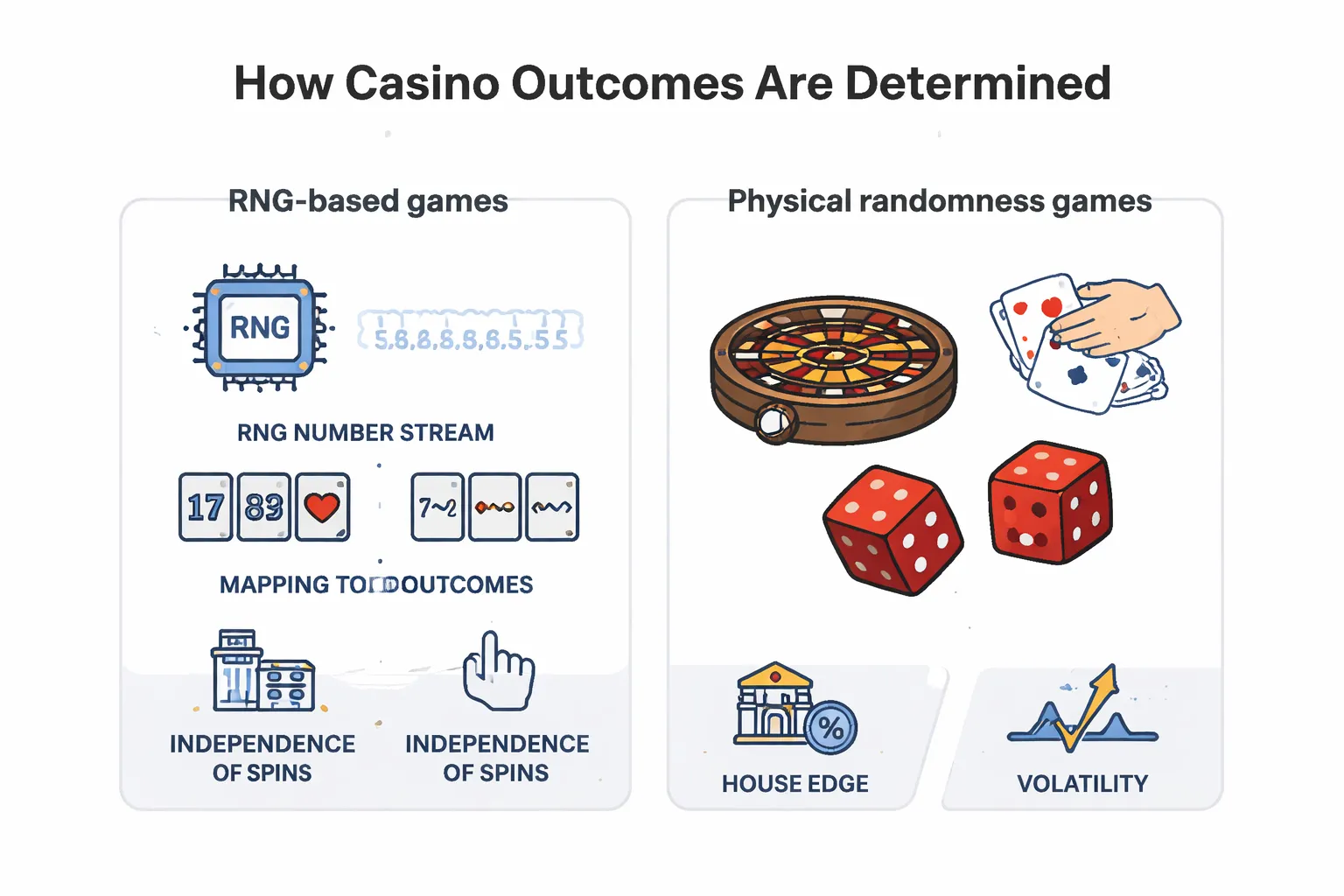
How Casino Games Generate Outcomes
Every casino game uses one of two sources of randomness. Software randomness or physical randomness.
Online slots, video poker, and most digital table games use an RNG. The RNG produces a stream of numbers. The game maps those numbers to outcomes. Each spin or hand stands alone.
Live roulette, baccarat, and dice use physical randomness. The wheel, ball, cards, and dice create the result. The house still sets the rules and payouts.
If you want the mechanics, read Casino RNG Explained: How Random Number Generators Work.
House Edge, What It Is and How It Shows Up
House edge is the average cost of a bet. It is math built into the rules and payout table.
If a game has a 2% house edge, your long-run expected loss is about $2 per $100 wagered. That does not mean you lose $2 every $100. It means the average trends that way as your total action grows.
House edge hits you through volume. The more you bet, the more the edge has time to work.
RTP is the same idea stated from the player side. RTP of 96% implies a house edge near 4%.
For a clean breakdown, see How Casinos Make Money: House Edge, RTP, and the Math Behind It.
Volatility and Variance, Why Similar Edges Feel Different
Volatility controls the shape of your ride. It changes how often you win and how big wins can be.
- Low volatility, more small wins, fewer long dry spells.
- High volatility, fewer wins, bigger swings, longer losing runs.
Two games can share the same house edge and still feel nothing alike. A high volatility slot can run cold for a long time, then hit a large payout. A low volatility game can give frequent small hits, while still costing you over time.
Do not confuse variance with “luck changing.” It is just distribution.
Game Design, What You Can Control
Rules and pay tables set your expected cost. Volatility sets your risk of swings. Your bet size sets how fast both hit your bankroll.
- Pick games with a lower edge when possible.
- Pick volatility that fits your bankroll and time limit.
- Keep sizing consistent. Do not chase losses.
If you need a simple starting point, use Best Casino Game for Beginners: The Easiest Games to Learn First.
Misconception Checks
“Casinos control payouts on demand.” Licensed games run on certified software and audited configurations. Casinos can choose which games to offer and what stakes to allow. They do not press a button to force your next spin.
“Machines tighten after wins.” A win does not change the next roll of the RNG. Outcomes do not remember. Your timing does not matter.
“You’re due a bonus.” Bonus triggers have a probability, not a schedule. Past misses do not increase future odds. This is the same error as the gambler’s fallacy. Read The Gambler’s Fallacy Explained (With Simple Examples).
Myth #4: Systems, Progressions, and “Beating the System” (Quick Reality Check)
Progression systems feel safe because they give you rules to follow. They do not change the math. Every bet still faces the same house edge. Martingale and similar ladders fail for two reasons. Table limits stop the doubling. Your bankroll runs out first. Even if you avoid both, variance can trap you in long losing runs. The final loss wipes out many small wins. “Guaranteed” systems usually hide costs, like low payouts, high volatility, or rule changes that cut expected value. If you want real leverage, focus on game selection and rules. Start with house edge, then learn how to read paytables and rules.
| Claim | Reality |
|---|---|
| “A system beats the casino.” | Bet sizing does not remove the house edge. |
| “Doubling guarantees recovery.” | Limits and bankroll caps break the progression. |
| “Small steady wins prove it works.” | One long run can erase many sessions. |
Read our detailed guide: Myth #4: Systems, Progressions, and “Beating the System” (Quick Reality Check) - Casino Myths vs Facts: Hot Streaks, “Due” Numbers, and Luck Explained
In het kort:
- Hot streaks happen, but they do not change the math of the game.
- “Due” numbers do not exist in independent games like roulette and slots.
- Past results do not affect the next spin, roll, or deal.
- Random does not look “even” in the short run. Clumps and repeats are normal.
- House edge stays in place. No pattern removes it.
- Systems can change bet size, not expected value.
- Progressions fail because of table limits, bankroll limits, and long losing runs.
- Short-term wins prove nothing. Variance can hide the edge for a while.
- Your best lever is game selection and rules, not “luck control.”
- You can manage risk with bankroll rules, stop points, and time limits.
Myths vs facts, fast
Practical rules you can use
- Pick games with clear odds and low house edge. Learn the rules and paytables before you bet.
- Use flat betting if you want control. Treat progressions as higher risk, not higher skill.
- Set a bankroll for the session. Set a loss cap. Stop when you hit it.
- Set a win target if you want discipline. Cash out when you reach it.
- Track time. Long sessions increase the chance the house edge shows up.
- Know key terms like RTP, house edge, and variance. Use them to compare games.
Next steps: Learn how casinos make money and why the edge persists, read What Is a Casino and How Does It Work? A Beginner’s Guide at /what-is-a-casino-and-how-does-it-work-a-beginner-s-guide.html. For game specifics, use How to Read Casino Game Rules and Paytables at /how-to-read-casino-game-rules-and-paytables-so-you-know-what-you-re-playing.html and the Casino Terminology Glossary at /casino-terminology-glossary-house-edge-rtp-variance-and-more.html.
FAQ: Hot Streaks, Due Numbers, and Luck
Are casino hot streaks real?
Streaks happen in random sequences. Your last results do not change your next odds. Track decisions, not patterns. Use session limits and quit points. If you play online slots, learn how randomness works at /casino-rng-explained-how-random-number-generators-work.html.
What does “due” mean in gambling?
“Due” means you think a result must happen because it has not happened lately. That belief is the gambler’s fallacy. Independent games reset every round. A roulette wheel does not “remember” past spins.
Can you predict the next spin, hand, or slot result?
No. In regulated games, outcomes come from physical randomness or an RNG. You can predict payouts over time, not the next result. Focus on house edge, RTP, and variance. See /casino-terminology-glossary-house-edge-rtp-variance-and-more.html.
Does changing machines or tables improve your luck?
Usually no. A new seat does not change the math. For slots, each spin stays independent. For table games, the rules and payouts drive your long-term results. Pick games you can play well. Start here, /best-casino-game-for-beginners-the-easiest-games-to-learn-first.html.
Are slots “tight” after a big win?
Past wins do not force future losses. Most slots use an RNG. The return targets a long run, not your session. The casino can set RTP by game version, but it does not switch because you hit a bonus.
Do casinos control outcomes in real time?
Licensed casinos use certified game software and tested RNGs. Casinos control game selection, limits, and rules. They do not pick your next card or spin. If you want more context on who builds games, read /casino-game-providers-explained-who-makes-the-games-and-why-it-matters.html.
Does a “lucky” strategy beat the house?
Luck is short-term variance. Strategy only helps in games where decisions change expected value, like blackjack. In pure-chance games, you cannot outplay the edge. You can only manage risk with bankroll rules and lower-house-edge games.
What is the fastest way to stop chasing streaks?
Set hard limits before you start, time, loss, and win. Use fixed bet sizes. Avoid raising stakes to “get even.” Take breaks after big swings. If you feel tilt, end the session.
Conclusion: Play Smarter by Replacing Myths with Math (and Better Habits)
Conclusion: Play Smarter by Replacing Myths with Math (and Better Habits)
Hot streaks do not change the odds. “Due” numbers do not exist. Each spin, roll, and hand resets. The house edge stays in place.
Play with facts. Know the edge, know the variance, and know your limits. If you want a quick refresher, read The Gambler’s Fallacy Explained (With Simple Examples) and How Casinos Make Money: House Edge, RTP, and the Math Behind It.
- Pick games by math. Lower house edge, clearer rules, fewer side bets.
- Use fixed stakes. Set a base bet. Do not scale up after losses.
- Set three limits. Time, loss, and win. Stop when you hit any one.
- Track results. Log session length, buy-in, cash-out, and biggest swing. Patterns beat feelings.
- Quit on tilt. If you feel urgency or anger, end the session.
Final tip. Decide your limits before you place the first bet. Your best “system” is bankroll rules you follow every time.
-
RTP Explained: How to Use Return to Player to Choose Slots
1 week ago -
What Is a Casino and How Does It Work? A Beginner’s Guide
1 week ago -
Casino RNG Explained: How Random Number Generators Work
1 week ago -
The Gambler’s Fallacy Explained (With Simple Examples)
1 week ago -
Casino Etiquette 101: Rules and Tips for First-Time Visitors
1 week ago
-
- Definition: Myths vs Facts in Casino Play
- Randomness, Probability, and Independence
- Hot Streaks: What They Are and What They Are Not
- “Due” Numbers and the Gambler’s Fallacy
- House Edge vs Short-Term Variance
- Common Thinking Traps: Pattern-Seeking and Selective Memory
- What to Change in Your Bets, Game Choice, and Limits
-
- Are casino hot streaks real?
- What does “due” mean in gambling?
- Can you predict the next spin, hand, or slot result?
- Does changing machines or tables improve your luck?
- Are slots “tight” after a big win?
- Do casinos control outcomes in real time?
- Does a “lucky” strategy beat the house?
- What is the fastest way to stop chasing streaks?
-
- Definition: Myths vs Facts in Casino Play
- Randomness, Probability, and Independence
- Hot Streaks: What They Are and What They Are Not
- “Due” Numbers and the Gambler’s Fallacy
- House Edge vs Short-Term Variance
- Common Thinking Traps: Pattern-Seeking and Selective Memory
- What to Change in Your Bets, Game Choice, and Limits
-
- Are casino hot streaks real?
- What does “due” mean in gambling?
- Can you predict the next spin, hand, or slot result?
- Does changing machines or tables improve your luck?
- Are slots “tight” after a big win?
- Do casinos control outcomes in real time?
- Does a “lucky” strategy beat the house?
- What is the fastest way to stop chasing streaks?
-
Fairness in Casino Games: RNGs, Odds, House Edge, and Return-to-Player (RTP) - Security, Fairness, and Regulation: How Casinos Keep Games Legit - What Is a Casino and How Does It Work? A Beginner’s Guide
1 week ago -
Regulation and Licensing: Who Oversees Casinos and What Rules They Must Follow - Security, Fairness, and Regulation: How Casinos Keep Games Legit - What Is a Casino and How Does It Work? A Beginner’s Guide
1 week ago -
Security, Fairness, and Regulation: How Casinos Keep Games Legit - What Is a Casino and How Does It Work? A Beginner’s Guide
1 week ago -
What Is a Casino and How Does It Work? A Beginner’s Guide
1 week ago -
How Casinos Make Money: House Edge, RTP, and the Math Behind It
1 week ago
-
Security, Fairness, and Regulation: How Casinos Keep Games Legit - What Is a Casino and How Does It Work? A Beginner’s Guide
1 week ago -
RTP Explained: How to Use Return to Player to Choose Slots
1 week ago -
What Is a Casino and How Does It Work? A Beginner’s Guide
1 week ago -
Casino RNG Explained: How Random Number Generators Work
1 week ago -
How to Set a Gambling Budget (and Stick to It)
1 week ago