The Gambler’s Fallacy Explained (With Simple Examples)

The gambler’s fallacy is the belief that past random results change what comes next. You see a run of one outcome, then you think the opposite outcome is “due.” In games like roulette, slots, and coin flips, each spin or flip has its own fixed odds. The streak does not create a correction.
You will learn how the fallacy works, why your brain falls for it, and how it shows up in real casino play. You will also get simple examples you can apply to your own betting and bankroll decisions, so you stop chasing “due” outcomes. For a deeper odds baseline, read how casino game odds work and casino myths vs facts.
Gambler’s Fallacy Explained (With Simple Examples): Definition and the Core Idea
Plain-English definition
Gambler’s fallacy is the belief that a past streak changes what must happen next in a random game.
You see several losses or several wins, then you think the opposite outcome is “due.”
In most casino games, each new spin, roll, or shuffle starts with the same odds as before.
The core idea: you expect short-run “balance”
The fallacy starts with one bad assumption, random results must “even out” soon.
Over a very long run, results can look closer to the true odds. That does not create a timer that forces the next result to fix a streak.
A streak can continue because randomness allows clusters. The game does not track your recent history.
Independent vs. dependent events
Independent events do not change the odds from one try to the next.
- Independent: roulette spins, coin flips, most slot spins, many dice rolls.
- What does not change odds: a streak, your last bet size, table “heat,” time of day.
Dependent events can change the odds because the situation changes.
- Dependent: drawing cards without reshuffling, pulling balls from a bag without replacement.
- What can change odds: removed cards, removed balls, known deck composition, rule changes.
In a casino, this matters because many games reset each round. Some do not. You need to know which you are playing. Use the rules and paytable as your source of truth, see /how-to-read-casino-game-rules-and-paytables-so-you-know-what-you-re-playing.html.
“Due” outcomes vs. actual probability
“Due” is a feeling. Probability is a number tied to the game’s rules.
| Situation | What “due” thinking says | What the odds say |
|---|---|---|
| Roulette: red hit 7 times in a row | Black must be next | Next spin stays the same probability as always for that wheel |
| Coin flip: heads hit 5 times in a row | Tails is more likely now | Next flip stays 50% tails if the coin is fair |
| Cards without reshuffle: many low cards already dealt | High cards are due | High-card chance can rise because the deck composition changed |
If you want the math that sets those numbers, read /how-casinos-make-money-house-edge-rtp-and-the-math-behind-it.html.
Simple Examples: Coin Flips, Dice Rolls, Roulette, and Lottery Thinking
Coin flips: 5 heads in a row does not change the next flip
A fair coin has two outcomes. Each flip stays independent.
- Chance of tails on the next flip stays 50%.
- Five heads in a row feels rare, but it does not make tails “due”.
- Your mistake is mixing up long-run balance with short-run prediction.
Dice: after multiple sixes, a six is not less likely
A fair die has six outcomes. Each roll stays independent.
- Chance of a six on the next roll stays 1 in 6.
- Three or four sixes in a short span can happen. It does not “use up” sixes.
- Past rolls do not change the die. The odds stay the same.
Roulette (red and black): streaks happen, the wheel does not correct itself
On an unbiased wheel, each spin stays independent. The last 10 spins do not push the next one.
- If red hits 8 times in a row, the next spin does not become “more likely” to land on black.
- The “due” trap shows up as bigger bets after a streak. That is how you get crushed faster.
- The house edge stays in place on every spin. Streaks do not remove it.
If you need a refresher on terms like house edge and variance, use the casino terminology glossary.
Lottery and scratch-offs: “it has not hit yet” does not improve your odds
Many players track drawings or tickets and hunt for “overdue” numbers or prizes. That logic fails in most real setups.
- For standard lotteries, each draw stays independent. Last week’s results do not change this week’s odds.
- For scratch-offs, the true odds depend on how many winning tickets remain and how many total tickets remain. You rarely have clean, current data at the store.
- A sign that says “big prize still unclaimed” does not tell you your odds on the next ticket. It only tells you the game can still pay out.
Do not confuse “still possible” with “more likely now”. If you want a better handle on randomness and swingy outcomes, read slot volatility and variance.
A quick check yourself mini-quiz
Spot the fallacy: “Black has hit seven times, so red is more likely on the next spin.”
- Answer: This is the gambler’s fallacy. Past spins do not change the next spin’s probability.
Why It Feels True: Psychology Behind the Gambler’s Fallacy
Your brain hates randomness. It searches for patterns because patterns help you act fast. In gambling, that instinct backfires.
- Pattern seeking: You treat short streaks as signals. You ignore that independent events reset every time.
- Law of small numbers: You expect a small sample to look “balanced” like a long run. It will not.
- Selective memory: You remember the times a switch felt “right.” You forget the times it failed.
- Loss pressure: After losses, you want a clean story. “It must turn” feels safer than “anything can happen.”
Casinos benefit when you chase correction. If you want cleaner decisions, pair this with house edge and RTP, and compare odds across games.
Read our detailed guide: Why It Feels True: Psychology Behind the Gambler’s Fallacy - The Gambler’s Fallacy Explained (With Simple Examples)
How to Avoid the Gambler’s Fallacy (Practical Checks)
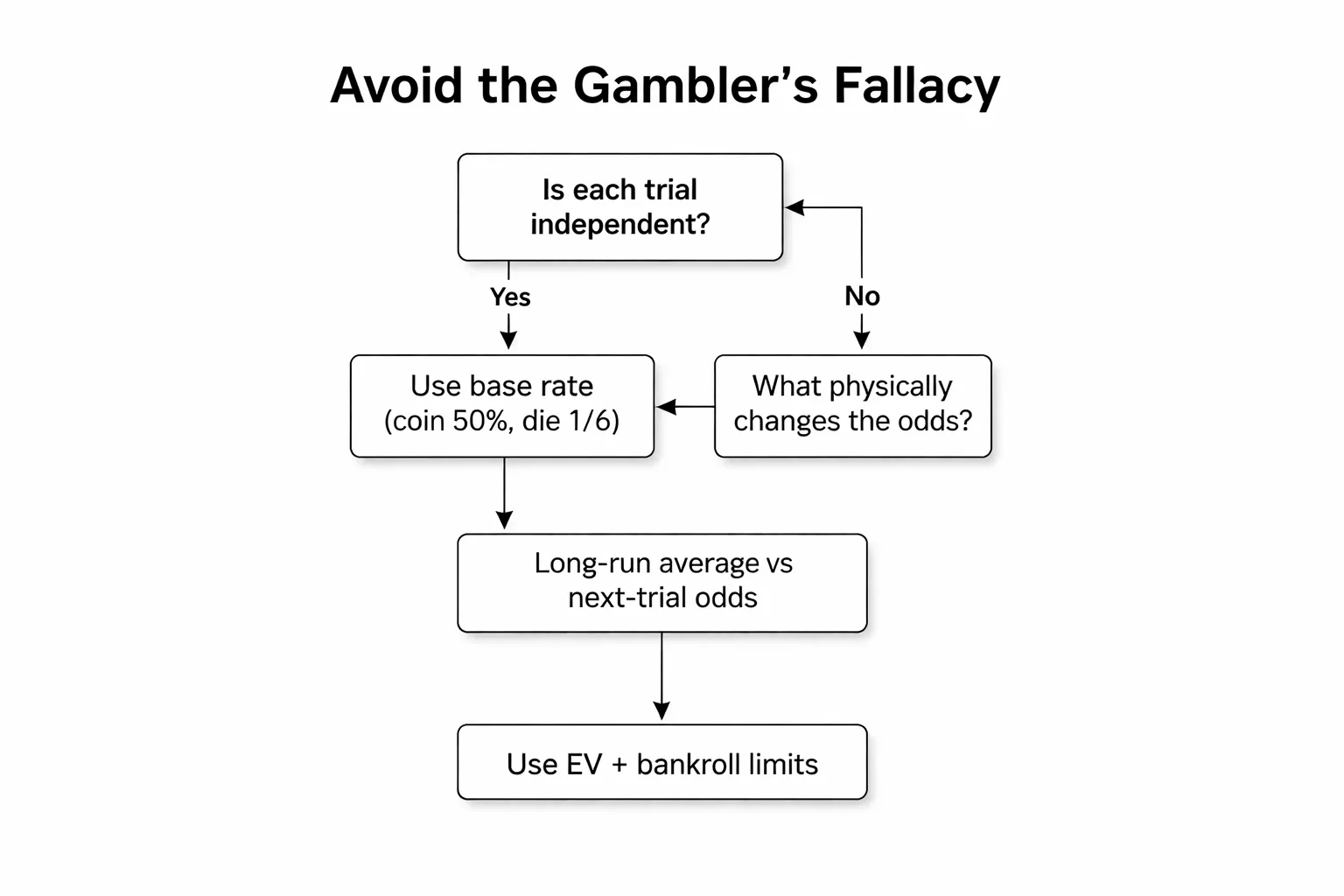
Ask: are the events independent?
Start with the mechanism. Independence decides everything.
- Independent: Each trial resets. Past results do not change the next odds. Examples include coin flips, fair dice, most RNG-based spins.
- Dependent: The system has memory. Past results can change what remains. Examples include cards dealt from the same shoe, bag draws without replacement, progressive jackpots that grow.
If you cannot point to a real carryover, treat the next trial as unchanged.
What would physically change the odds?
Force yourself to name the change. If you cannot, you are guessing.
- Cards removed from a deck or shoe.
- Tiles, balls, or tokens removed from a container.
- A rule that tracks history, like a must-hit-by jackpot, or a bonus meter that fills.
- A payout table change, a bet type change, or a different game entirely.
A streak does not count as a mechanism. It is just a record.
Use reference probabilities, even during streaks
Anchor to known base rates. Do this before you bet or act.
- Fair coin. Heads stays 50% on every flip.
- Fair die. A 6 stays 1/6 on every roll.
- Single-number roulette bet. In European roulette it stays 1/37 each spin. In American roulette it stays 1/38.
If your game uses RNG and the rules do not carry state forward, your base rate stays the base rate.
Separate long-run average from next-trial odds
Two ideas look similar. They are not the same.
- Long-run: Over many trials, results often move toward the expected average.
- Next trial: The chance stays the same in an independent process.
Example. After 10 heads in a row, the long-run average might drift back toward 50% over time. The next flip still stays at 50%.
Decision checklist for money decisions
- Define the event: What exact outcome must happen for you to win or save?
- Check independence: Does each attempt reset, or does the system keep state?
- Name the mechanism: What changed in the physical setup, the rules, or the payouts?
- Write the base rate: Use the known probability, not your feeling from the streak.
- Ignore “due” language: Replace “it must hit” with “it is still X%.”
- Compare alternatives: If you are choosing casino games, compare house edge, not recent results. See Which Casino Games Have the Best Odds? Ranked by House Edge.
- Stop escalation: Do not increase stakes just to “recover” from a run. Size bets from a plan.
Safer framing: expected value and bankroll limits
Use math that does not care about streaks.
- Expected value (EV): Focus on what you expect per bet or decision, based on true odds and payouts. A negative EV does not turn positive because you are “due.”
- House edge: In casino games, the rules bake in an average loss rate. Learn how casinos make money in What Is a Casino and How Does It Work? A Beginner’s Guide.
- Bankroll limits: Set a hard budget, a stop-loss, and a stop-win. Follow them. Streaks push you to break them.
- Pre-commit your stakes: Decide bet size before you start. Do not adjust based on “runs.”
- In het kort: Past results do not change the odds of the next independent event.
- In het kort: “Due” is a story, not a statistic. Each coin flip, spin, or roulette result resets.
- In het kort: Chasing losses increases variance in your results, it does not improve your expected return.
- In het kort: House edge stays constant. The longer you play, the more your results drift toward the average loss.
- In het kort: Use rules that block impulse. Set a bankroll limit, stop-loss, and stop-win, then follow them.
- In het kort: Pre-commit your stake size. Do not raise bets because of a streak.
- In het kort: Learn the math before you choose a game. See How Casino Game Odds Work: House Edge, Probability, and Payouts.
- In het kort: If you want lower-complexity games, start here. Best Casino Game for Beginners: The Easiest Games to Learn First.
Rule you can use: If the outcome does not “remember” the past, your odds do not improve after a streak.
Focus on what you control. Your budget, your stake size, and your time at the table.
FAQ
What is the gambler’s fallacy?
You assume a past streak changes the next outcome. Example, after five reds in roulette, you expect black is “due.” On fair, independent events, each spin stays the same. The wheel does not track history.
Does a streak change your odds?
No. If the outcome does not remember the past, your odds do not improve after a streak. A fair coin stays 50 50 each flip. European roulette stays 18 37 for red each spin. Your chance resets every time.
What games trigger it most?
Games with fast, clear outcomes. Roulette, slots, baccarat, and coin-flip style side bets. You see streaks often because you play many rounds. That volume creates patterns that look meaningful. They are not.
How can you spot the fallacy in your own play?
You change bets because you feel an outcome is “due.” You chase losses after a run. You raise stakes to “catch” the reversal. When your reason is a streak, you are using the fallacy.
Is the “hot hand” the same thing?
No. Hot hand means a player has a higher chance due to skill or momentum. Gambler’s fallacy means random events will “balance out” soon. In casino games like roulette or slots, you face randomness, not skill.
What is the difference between independence and “balancing out”?
Independence means each trial has the same odds as the last. “Balancing out” happens only over large samples, and it does not force the next result. Short runs can stay uneven for a long time.
Can you use streaks to win at roulette or slots?
No. Betting systems do not change the house edge. You can change variance and bankroll risk, but the expected loss stays tied to the game odds. See How Casino Game Odds Work: House Edge, Probability, and Payouts.
What is a simple example with numbers?
European roulette has 37 pockets. Red has 18. After ten reds in a row, the chance of red next spin stays 18/37, about 48.65%. Black stays 18/37. Green stays 1/37, about 2.70%.
Does the casino “need” a black after many reds?
No. The casino does not need any result. The wheel has no target distribution per hour or per day. The house edge comes from the zero pocket and payouts, not from outcomes “correcting” themselves.
What should you control instead?
Control your budget, your stake size, and your time at the table. Set a session limit. Avoid raising bets to recover losses. Pick lower-complexity games you understand. Start with What Is a Casino and How Does It Work?.
What is a quick rule to remember?
If the outcome does not remember the past, your odds do not improve after a streak. Treat each round as new. Plan your bankroll like the next result will be random, because it will.
Conclusion
The gambler’s fallacy makes you trust patterns that do not exist. It pushes you to chase losses, overbet, and stay longer than planned. The math does not change. The house edge stays the same each round.
Use one rule. Treat every spin, deal, and roll as independent unless the game rules say otherwise. Base your choices on numbers you can verify, not on streaks.
- Set a stop loss and stop win, then leave when you hit either one.
- Size bets as fixed units, not as reactions to recent results.
- Pick games with known odds, then compare house edge and payouts.
- Choose slots by RTP, not by “hot” machines or recent wins.
- Assume the RNG stays random, because it does.
If you want to go deeper, read Casino RNG Explained: How Random Number Generators Work, How Casino Game Odds Work: House Edge, Probability, and Payouts, RTP Explained: How to Use Return to Player to Choose Slots, and Casino Myths vs Facts: Hot Streaks, “Due” Numbers, and Luck Explained.
-
RTP Explained: How to Use Return to Player to Choose Slots
1 week ago -
What Is a Casino and How Does It Work? A Beginner’s Guide
1 week ago -
Casino RNG Explained: How Random Number Generators Work
1 week ago -
Casino Etiquette 101: Rules and Tips for First-Time Visitors
1 week ago -
Casino Myths vs Facts: Hot Streaks, “Due” Numbers, and Luck Explained
1 week ago
-
-
-
- What is the gambler’s fallacy?
- Does a streak change your odds?
- What games trigger it most?
- How can you spot the fallacy in your own play?
- Is the “hot hand” the same thing?
- What is the difference between independence and “balancing out”?
- Can you use streaks to win at roulette or slots?
- What is a simple example with numbers?
- Does the casino “need” a black after many reds?
- What should you control instead?
- What is a quick rule to remember?
-
-
-
-
- What is the gambler’s fallacy?
- Does a streak change your odds?
- What games trigger it most?
- How can you spot the fallacy in your own play?
- Is the “hot hand” the same thing?
- What is the difference between independence and “balancing out”?
- Can you use streaks to win at roulette or slots?
- What is a simple example with numbers?
- Does the casino “need” a black after many reds?
- What should you control instead?
- What is a quick rule to remember?
-
-
Fairness in Casino Games: RNGs, Odds, House Edge, and Return-to-Player (RTP) - Security, Fairness, and Regulation: How Casinos Keep Games Legit - What Is a Casino and How Does It Work? A Beginner’s Guide
1 week ago -
Regulation and Licensing: Who Oversees Casinos and What Rules They Must Follow - Security, Fairness, and Regulation: How Casinos Keep Games Legit - What Is a Casino and How Does It Work? A Beginner’s Guide
1 week ago -
Security, Fairness, and Regulation: How Casinos Keep Games Legit - What Is a Casino and How Does It Work? A Beginner’s Guide
1 week ago -
What Is a Casino and How Does It Work? A Beginner’s Guide
1 week ago -
How Casinos Make Money: House Edge, RTP, and the Math Behind It
1 week ago
-
Security, Fairness, and Regulation: How Casinos Keep Games Legit - What Is a Casino and How Does It Work? A Beginner’s Guide
1 week ago -
RTP Explained: How to Use Return to Player to Choose Slots
1 week ago -
What Is a Casino and How Does It Work? A Beginner’s Guide
1 week ago -
Casino RNG Explained: How Random Number Generators Work
1 week ago -
How to Set a Gambling Budget (and Stick to It)
1 week ago