How Casino Game Odds Work: House Edge, Probability, and Payouts
Casino games run on math. You can use it.
This guide breaks down how casino game odds work, from probability to payouts. You will learn what house edge means, how it links to your long-term loss rate, and why short sessions can still swing either way. You will also learn how RTP and paytables shape slot and table game returns, and how rules and side bets change your expected value. You will leave with a simple way to compare games, spot bad bets, and set realistic bankroll and session goals. If you want to go deeper on slot returns, read RTP Explained: How to Use Return to Player to Choose Slots. For common thinking traps, see The Gambler’s Fallacy Explained.
What Is "how casino game odds work"?
Definition
Casino game odds describe how often each outcome happens, and how much that outcome pays when it hits.
Odds start as probability. The casino maps that probability to payouts using rules and a paytable. If payouts match true probability, the game breaks even. In real games, payouts sit below true probability. That gap creates the house edge.
Key terms you must know
- Probability. The chance an outcome occurs on one bet. Example, 1 in 38 on American roulette for a single number.
- Payout. What the game pays when you win. This can include profit only or profit plus your stake, depending on the game. Read the rules so you know which one applies. See How to Read Casino Game Rules and Paytables.
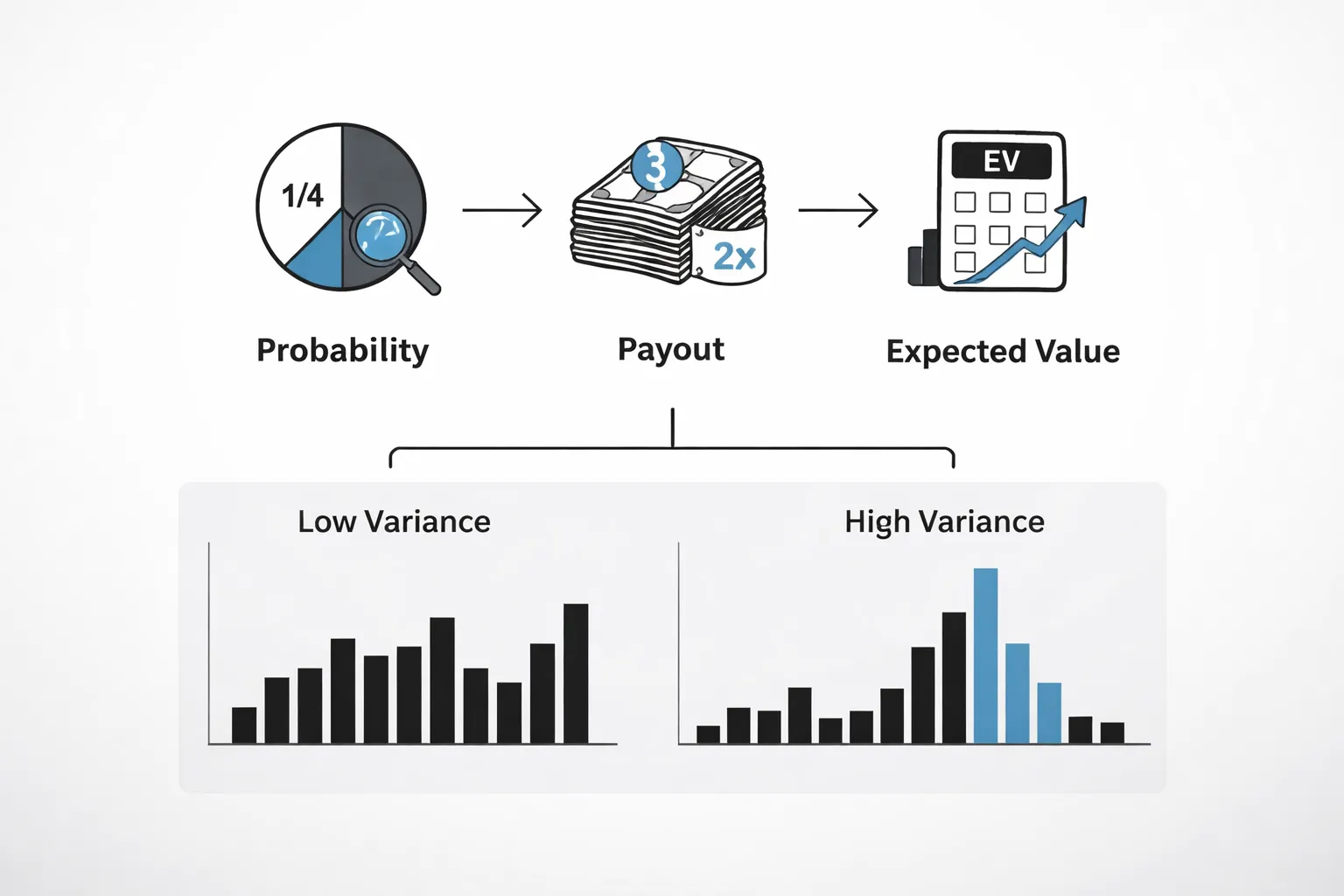
- Expected value (EV). Your average result per bet over the long run. EV includes wins and losses weighted by probability.
- Variance, volatility. How swingy results feel in the short run. High variance games pay less often and in bigger chunks. Low variance games pay more often in smaller chunks.
How probability turns into EV
EV comes from two inputs, probability and payout. You multiply each outcome’s net result by its probability, then add them up.
When the sum is negative, the game favors the house. The more negative it is, the faster your bankroll tends to drop.
| Term | What it tells you | What to do with it |
|---|---|---|
| Probability | How often you should expect a win or event | Estimate hit rate and losing streak length |
| Payout | How much you gain when a win happens | Compare paytables and side bets |
| EV, house edge | Your long-run cost per dollar bet | Choose games and rules with lower edge |
| Variance | How rough the ride feels | Set bet size and session length |
Why you can win now and still lose later
Short sessions run on variance. You can hit a hot streak, land a big payout, or dodge long losing runs.
Long sessions move toward EV. The law of large numbers pulls results toward the game’s average. If the house edge is 2 percent, the longer you play, the more your results tend to reflect that cost.
RTP is the same idea shown from the casino side, average return back to players. Use it to compare games, especially slots. See RTP Explained: How to Use Return to Player to Choose Slots.
The Math Behind Casino Odds: Probability, Expected Value, and House Edge
Probability basics, single events and multiple outcomes
Probability is the chance of a result. You can write it as a fraction, a percent, or odds.
A single event has one result you care about. Example, a coin flip landing heads. The probability is 1/2 or 50 percent.
Most casino bets have multiple outcomes. You might win, lose, or push. Each outcome has its own probability, and the payout can differ for each one.
When you track long play, focus on the average result, not short streaks. If you need a quick reset on streak thinking, read The Gambler’s Fallacy Explained (With Simple Examples).
Expected value (EV), the number that matters
Expected value is your average profit or loss per bet over many bets. EV combines probability and payout.
Use this formula.
- EV = (Win probability x win amount) minus (Loss probability x loss amount)
Simple example. You bet $1 on a game with a 48 percent chance to win $1 profit, and a 52 percent chance to lose $1.
- EV = (0.48 x $1) minus (0.52 x $1) = minus $0.04
Your average loss is 4 cents per $1 bet. That is the cost of the game, before comps and promos.
House edge, what it means and how casinos calculate it
House edge is the casino’s average profit as a percent of your wager.
If a $1 bet has EV of minus $0.04, the house edge is 4 percent.
- House edge = (Expected loss per bet) divided by (Bet size)
House edge does not predict your next result. It describes the long-run average. Long sessions tend to move toward it.
For quick definitions across games, use the Casino Terminology Glossary: House Edge, RTP, Variance, and More.
RTP vs house edge, why both get used
RTP is the return to player. It shows the average percent paid back to players over time.
- RTP = 100 percent minus house edge
- House edge 4 percent equals RTP 96 percent
Table game players often talk in house edge. Slot players often see RTP on the paytable or game info screen. Both describe the same math from different sides.
Why rules and payouts change the edge
Odds change when the payout changes, or when the probabilities change. Small rule tweaks can shift EV fast.
- Blackjack: paying 6:5 instead of 3:2 lowers the win amount on blackjacks. EV drops, house edge rises.
- Roulette: adding a double-zero adds losing outcomes without raising payouts. EV drops, house edge rises.
- Video poker: changing one line in the paytable changes the average return. Two machines can look similar and have different RTP.
When you compare games, compare the exact rules and the exact payouts. That is where the edge lives.
| Concept | What you track | What changes it |
|---|---|---|
| Probability | Chance of each outcome | Rules, number of outcomes |
| EV | Average win or loss per bet | Probabilities and payouts |
| House edge | EV as a percent of your wager | Any rule or payout change |
| RTP | Average percent returned to players | Same drivers as house edge |
How Payouts (Paytables) Convert Probability Into “Odds”
True odds vs casino odds
Probability tells you how often something should happen. The paytable tells you what the casino pays when it happens.
True odds use a fair payout. Casino odds use a slightly worse payout. That gap creates house edge.
Example, a 1-in-38 event has a true payout of 37 to 1 on a 1-unit bet. American roulette pays 35 to 1. You lose 2 units of value each time that win shows up, compared to fair odds.
| Event | True probability | Fair payout (to 1) | Typical casino payout (to 1) | Value gap |
|---|---|---|---|---|
| American roulette, single number | 1/38 = 2.63% | 37 | 35 | -2 |
| European roulette, single number | 1/37 = 2.70% | 36 | 35 | -1 |
Most casino games work the same way. The probabilities come from the rules. The paytable sets the price you get for those probabilities.
Implied probability from payout odds
You can convert any payout into an implied probability. Use this quick rule for “to 1” payouts.
- Implied probability = 1 / (payout + 1)
Example, a 35 to 1 payout implies 1/36 = 2.78%. On American roulette the true chance is 1/38 = 2.63%. The payout suggests a better chance than you actually have. That difference is house edge.
Common misunderstandings:
- Players treat payout odds as the true odds. They are not. They are the casino’s price.
- Players ignore the “+1” for getting your stake back. A 1 to 1 payoff implies a 50% break-even chance, not 100%.
- Players assume past results change the next result. They do not. Learn the basics at The Gambler’s Fallacy Explained (With Simple Examples).
Pushes, commissions, and side bets
Small rule details change EV fast because they change the effective payout.
- Pushes. A push returns your bet. It lowers risk, but it can also lower EV if the game uses pushes to reduce paid wins. Blackjack “push on 22” variants do this. Some baccarat side bets pay pushes as losses. Read the felt.
- Commissions. Baccarat banker often charges 5% commission on wins. That reduces your net payout. It can still be the best main bet because the win rate is high, but the commission is part of the math.
- Side bets. They often pay huge odds on rare events. The paytable usually lags the true odds by a lot. Treat side bets as entertainment unless you have the full table and can compute EV.
When you compare games, compare the full paytable, including fees and special rules. RTP summaries help, but the paytable tells you where the edge comes from. See RTP Explained: How to Use Return to Player to Choose Slots.
Variance and volatility, same edge, different ride
Two games can share the same house edge and feel nothing alike. Paytables shape variance.
- Frequent small wins. More hits, smaller payouts. You last longer on average, but you rarely spike a big profit.
- Rare big wins. Fewer hits, larger payouts. Your bankroll swings harder. You can bust faster, even at the same RTP.
Slots show this clearly. Two slots can both list 96% RTP, but one pays steady small wins while the other stores value in rare bonuses. If you play slots, use volatility as a selection tool. See Slot Volatility & Variance Explained: What It Means for Your Wins.
Odds by Game Type: Why Some Casino Games Are Better (or Worse) for Players
Blackjack: Rules, Strategy, and How Your Decisions Change EV
Blackjack gives you real control. Your choices change expected value.
With strong rules and perfect basic strategy, the house edge often sits around 0.3% to 0.8%. With weak rules or bad play, it can jump to 2% to 5%+.
- Play with a basic strategy chart. It removes most avoidable mistakes.
- Look for player-friendly rules. Dealer stands on soft 17, blackjack pays 3:2, double after split allowed, resplit options.
- Avoid side bets. Many run 5% to 15%+ house edge even when the main game is strong.
Roulette: European vs American vs Triple-Zero
Roulette is fixed-odds. You cannot outplay the wheel. The zeros set the edge.
| Wheel | Zeros | House edge |
|---|---|---|
| European | 1 (0) | 2.70% |
| American | 2 (0, 00) | 5.26% |
| Triple-zero | 3 (0, 00, 000) | 7.69% |
- Choose European when you can. It cuts the edge about in half vs American.
- Avoid triple-zero. It is a large hidden cost for the same gameplay.
- Outside bets do not reduce the edge. Red, black, even, odd still carry the same house edge as most other bets on that wheel.
Craps: Pass Line vs Proposition Bets
Craps mixes low-edge core bets with high-edge propositions. The table layout makes it easy to overpay the house.
- Pass Line sits around 1.41% house edge.
- Don’t Pass sits around 1.36% house edge, but pushes on 12 in many casinos.
- Come and Don’t Come are close to the same edges as Pass and Don’t Pass.
- Odds bets have 0% house edge. They do not change the casino’s advantage on the base bet, but they reduce your total blended edge by adding fair money behind it.
- Proposition bets can be brutal. Many sit around 5% to 17%+ house edge, depending on the bet and pay table.
If you want better odds, keep your action on line bets and take odds. Limit the props.
Baccarat: Banker vs Player vs Tie
Baccarat has simple choices. The edges differ a lot.
- Banker is usually best, around 1.06% house edge with a typical 5% commission on Banker wins.
- Player sits around 1.24% house edge.
- Tie is the trap. It often runs around 14%+ house edge, depending on the payout.
If you want to keep the edge low, bet Banker or Player. Skip Tie and most side bets.
Slots: RTP Ranges, Hit Frequency, Volatility, and Bonus Features
Slots lock your odds into the math model. You cannot improve EV with skill.
RTP varies by game and jurisdiction. Many modern slots land around 88% to 97% RTP, with some higher in specific markets and some lower in regulated minimum-RTP areas.
- RTP tells you the long-run return. It does not tell you how smooth the ride feels.
- Hit frequency tells you how often you win something. It can still mean many small wins that return less than your bet.
- Volatility tells you how much value sits in rare events like bonuses, free spins, and multipliers.
- Bonus features change payout shape. Buy-bonus options and feature spins often increase swing and can carry different effective costs than base spins.
If you want a steadier session, pick lower volatility and higher hit frequency. If you chase big wins, expect deeper drawdowns and more losing streaks even at the same RTP. For RNG basics, see Casino RNG Explained: How Random Number Generators Work.
Video Poker: Paytables and Why Full Pay Matters
Video poker can offer some of the best odds in the casino, but only with the right paytable and correct play.
Small paytable changes create big EV changes. A “tight” table can add multiple percentage points of house edge.
- Full-pay games can push house edge near 0% with perfect strategy on certain variants.
- Short-pay games often sit around 1% to 4%+ house edge, even if you play well.
- Learn the correct holds. Strategy errors cost real money because the game is decision-driven.
Before you sit down, check the paytable. If you want definitions for RTP, house edge, and variance, use the Casino Terminology Glossary.
| Game | Best common player option | Typical house edge | Main risk |
|---|---|---|---|
| Blackjack | Basic strategy, good rules | 0.3% to 0.8% | Player mistakes, side bets |
| Roulette | European wheel | 2.70% | Extra zeros |
| Craps | Pass, Come, take Odds | 1.4% base, 0% on Odds | Proposition bets |
| Baccarat | Banker | ~1.06% | Tie bet, side bets |
| Slots | Higher RTP, fit volatility | Varies, often 88% to 97% RTP | Volatility, lower RTP titles |
| Video poker | Full-pay table plus correct play | Near 0% to 2%+ | Short-pay tables, misplays |
Online vs Land-Based Odds: RNGs, Game Rules, and What Actually Changes
Online and land-based casinos use the same math. Your results change when the rules change, not because the game sits on a screen.
- RNG vs physical gear: Online games use RNGs. Roulette wheels and card shoes use hardware. Both should produce random outcomes over time.
- Rule sets drive edge: Blackjack tables vary by dealer hits soft 17, double rules, and surrender. Roulette varies by single-zero vs double-zero. Baccarat stays tight on Banker, side bets do not.
- RTP and paytables: Online slots and video poker show RTP or reveal it through paytables. Land-based versions often post less detail. The paytable still controls your long-run return.
- Speed changes variance: Online play runs more hands and spins per hour. Your bankroll swings faster, even if the edge stays the same.
Read our detailed guide: Online vs Land-Based Odds: RNGs, Game Rules, and What Actually Changes - How Casino Game Odds Work: House Edge, Probability, and Payouts
Practical Ways to Use Odds Knowledge (Without Chasing Systems)
Pick Lower-Edge Games, Then Avoid the High-Edge Bets
Your main lever is game selection. House edge sets your long-run cost per dollar wagered. Start with lower-edge games. Then remove the worst bet options inside them.
| Game or bet type | What to do | Why it matters |
|---|---|---|
| Blackjack | Play basic strategy. Skip side bets. | Main game can stay low edge with correct play. Side bets often carry much higher edge. |
| Baccarat | Bet Banker or Player. Avoid Tie. | Tie usually has one of the highest edges on the table. |
| Roulette | Choose European over American. Avoid most specialty bets. | 00 adds edge. Many novelty bets raise variance without improving return. |
| Craps | Use Pass, Don’t Pass, Come, Don’t Come. Add Odds. Skip propositions. | Odds bets pay true odds. Proposition bets usually carry a large edge. |
| Slots | Use the posted RTP when available. Avoid extra-cost features if they lower RTP. | RTP is your best proxy for long-run return. Features can change your effective RTP. |
Ignore hot and cold streak talk. It pushes you toward worse bets and bigger swings. If you want a clean explanation of why streaks do not “owe” outcomes, read The Gambler’s Fallacy Explained (With Simple Examples).
Plan Bankroll and Session Size Using Variance
Odds tell you average cost. Variance tells you how rough the ride gets. High variance does not change house edge. It changes how quickly your bankroll can spike or crash.
- Set a session bankroll. Treat it as spent money. Do not reload to “get even.”
- Pick a base unit. Keep most bets at 1 unit. Large jumps increase swing speed.
- Set time and loss caps. Use a hard stop. Do not negotiate with yourself mid-session.
- Match game speed to your goal. Faster play reaches the long-run average faster. It also reaches the long-run losses faster.
- Respect bet volatility. Side bets, bonus buys, and longshot props raise variance fast.
If you play online, you face more outcomes per hour. That can make “short sessions” expensive. Game randomness still behaves the same. The machine just deals more hands. For the mechanics behind digital results, see Casino RNG Explained: How Random Number Generators Work.
Know When Strategy Changes the Edge
Some games let you reduce the edge with correct decisions. Others do not. Do not waste effort on systems in pure chance games.
- Strategy matters: Blackjack, video poker, some poker formats. Correct choices change your expected return.
- Strategy does not matter: Roulette, baccarat, slots, keno. Your decisions do not change the math unless you change the bet type.
Use this rule. If the game has decision points with different expected values, learn the correct chart or play guide. If the game only asks for a bet size and a bet type, focus on picking the lowest-edge option and controlling volume.
Treat Bonuses and Wagering Terms as Hidden Odds
A bonus can raise or crush your expected value. The real edge comes from the terms. Read them like a paytable.
- Wagering requirement. Higher playthrough increases your expected losses before you can withdraw.
- Game contribution. Slots may count 100%. Table games may count 10% or 0%. This changes the real cost of clearing.
- Max bet rules. A low cap can force slow clearing. A high cap can trigger forfeiture.
- Max cashout limits. A cap can cut off upside. It lowers your real EV even if you win big.
- Excluded games and providers. Your planned game may not qualify. Your effective choices shrink to higher-edge options.
- Time limits. Short windows push you into higher volume, which increases variance and likely losses.
Simple checkpoint. Estimate how much you must wager. Multiply required wagering by the house edge of the eligible game. That product approximates the expected cost to clear the offer.
In het kort:
- Your long-run result comes from math, not streaks. House edge sets your expected loss rate.
- Probability drives variance. Short sessions can swing hard, even in low-edge games.
- RTP and house edge describe the same idea in different units. House edge = 100% minus RTP.
- Payout size does not mean good odds. A big jackpot usually comes with a low hit rate.
- Game rules change the edge. Small rule changes can shift your costs over time.
- Use expected value for planning. Expected cost ≈ total amount wagered times house edge.
- Bonuses can raise your expected cost. Wagering requirements often force higher-edge games and more variance.
- Do not trust pattern thinking. Past spins do not change future odds; see The Gambler’s Fallacy Explained.
- Compare games before you play. Start with Casino Odds Comparison and RTP Explained.
FAQ
What is house edge?
House edge is the casino’s average advantage on each bet. If a game has a 2% house edge, you expect to lose about $2 per $100 wagered over the long run. Short sessions can swing high or low.
How do I estimate my expected loss?
Use expected value. Expected cost equals total amount wagered times house edge. If you wager $2,000 on a 1.5% edge game, expected cost is about $30. Count total wagers, not your starting bankroll.
What is RTP, and how does it relate to house edge?
RTP is the long-run payback percentage. House edge equals 100% minus RTP. A 96% RTP slot has a 4% house edge. Use RTP to compare similar games. See /rtp-explained-how-to-use-return-to-player-to-choose-slots.html.
Does a game “owe” a win after a losing streak?
No. Each spin, roll, or hand is independent in fair games. Past results do not change future probabilities. Streaks happen in random sequences. Plan your budget around odds and variance, not patterns.
Why do slots feel worse than table games?
Many slots have higher house edges and higher volatility. You can lose faster even with the same bet size. Table games like blackjack and baccarat often offer lower edges with correct play and better rules.
Do bonuses change the odds?
Bonuses do not change game probability. They change your expected cost through wagering requirements and game restrictions. If terms push you into higher-edge games or more spins, you often pay more in expected loss.
What is variance, and why should you care?
Variance measures how much results swing around the expected value. High variance means bigger streaks and larger bankroll swings. Two games can share the same house edge but feel very different. Match variance to your budget.
Can skill reduce the house edge?
Sometimes. Blackjack strategy, video poker pay tables, and some poker decisions can lower your expected loss. You cannot beat a bad ruleset with skill alone. Learn rules first, then use correct strategy.
Do game providers affect your odds?
Providers set math models, RTP options, and volatility profiles. Casinos choose settings in some cases. Check RTP and rules, not the brand name. Learn how providers shape games at /casino-game-providers-explained-who-makes-the-games-and-why-it-matters.html.
What is the safest way to compare casino games?
Compare house edge, rules, and total cost per hour. Track average bet times bets per hour times house edge. Then check variance and bankroll needs. Choose the lowest edge game you can play correctly.
Conclusion
Casino odds come from math you can measure. House edge tells you your long run cost. Probability and payouts tell you how swingy the ride will feel.
Your best move is simple. Pick a low edge game you can play correctly, then control your cost per hour.
- Start with edge. Use house edge or RTP, then confirm the exact rules table.
- Price the session. Average bet times hands or spins per hour times house edge equals expected loss per hour.
- Match variance to bankroll. Higher variance needs more money and more time. Learn volatility basics at /slot-volatility-variance-explained-what-it-means-for-your-wins.html.
- Use rankings and definitions. Compare games at /which-casino-games-have-the-best-odds-ranked-by-house-edge.html. Check terms at /casino-terminology-glossary-house-edge-rtp-variance-and-more.html.
Final tip. Set a time limit and a loss limit before you play. When you hit either one, stop. The house edge does not negotiate.
-
RTP Explained: How to Use Return to Player to Choose Slots
1 week ago -
What Is a Casino and How Does It Work? A Beginner’s Guide
1 week ago -
Casino RNG Explained: How Random Number Generators Work
1 week ago -
The Gambler’s Fallacy Explained (With Simple Examples)
1 week ago -
Casino Etiquette 101: Rules and Tips for First-Time Visitors
1 week ago
-
-
- What is house edge?
- How do I estimate my expected loss?
- What is RTP, and how does it relate to house edge?
- Does a game “owe” a win after a losing streak?
- Why do slots feel worse than table games?
- Do bonuses change the odds?
- What is variance, and why should you care?
- Can skill reduce the house edge?
- Do game providers affect your odds?
- What is the safest way to compare casino games?
-
-
-
- What is house edge?
- How do I estimate my expected loss?
- What is RTP, and how does it relate to house edge?
- Does a game “owe” a win after a losing streak?
- Why do slots feel worse than table games?
- Do bonuses change the odds?
- What is variance, and why should you care?
- Can skill reduce the house edge?
- Do game providers affect your odds?
- What is the safest way to compare casino games?
-
-
Fairness in Casino Games: RNGs, Odds, House Edge, and Return-to-Player (RTP) - Security, Fairness, and Regulation: How Casinos Keep Games Legit - What Is a Casino and How Does It Work? A Beginner’s Guide
1 week ago -
Regulation and Licensing: Who Oversees Casinos and What Rules They Must Follow - Security, Fairness, and Regulation: How Casinos Keep Games Legit - What Is a Casino and How Does It Work? A Beginner’s Guide
1 week ago -
Security, Fairness, and Regulation: How Casinos Keep Games Legit - What Is a Casino and How Does It Work? A Beginner’s Guide
1 week ago -
What Is a Casino and How Does It Work? A Beginner’s Guide
1 week ago -
How Casinos Make Money: House Edge, RTP, and the Math Behind It
1 week ago
-
Security, Fairness, and Regulation: How Casinos Keep Games Legit - What Is a Casino and How Does It Work? A Beginner’s Guide
1 week ago -
RTP Explained: How to Use Return to Player to Choose Slots
1 week ago -
What Is a Casino and How Does It Work? A Beginner’s Guide
1 week ago -
Casino RNG Explained: How Random Number Generators Work
1 week ago -
Responsible Gambling Tips: Limits, Tools, and Safer Play
1 week ago